This post and/or page contains affiliate links, at no additional cost
to you I am compensated only if you purchase after clicking on the links.
to you I am compensated only if you purchase after clicking on the links.

|
Disclaimer Notice: To each cherished visitor, ClassicShoppes.us and The Unique Galleria3, has made every reasonable effort to re-record the individual "Profile" information found on this page as accurate as is possible and in no way accepts responsibility for any distortions whatsoever e. g., misspellings, misprints, omissions, grammatical or punctuation errors, exaggerations, erroneous reference information. It does not matter if any such suspect inaccuracies are intentional or unintentional.
Primary reference source: Wikipedia.org Latest revision: June 19, 2014, 3:00AM; retroactive from September 11, 2012, to perpetuity. |
|
This post and/or page contains affiliate links,
at no additional cost to you I am compensated only if you purchase after clicking on the links. |

|
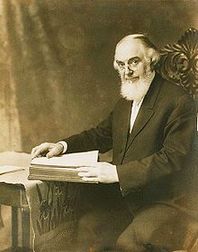 "Find a Grave Memorial ID 5591" "Find a Grave Memorial ID 5591"
"Charles Taze Russell (February 16, 1852–October 31, 1916) was a prominent early 20th century Christian [Restoration] minister from Pittsburgh, Pennsylvania, USA, and founder of what is now known as the Bible Student movement, from which Jehovah's Witnesses and numerous independent Bible Student groups emerged after his death. Charles Taze Russell was born to Scotch-Irish parents, immigrant Joseph Lytel Russell and Ann Eliza Birney on February 16, 1852 in Allegheny, Pennsylvania, USA. Russell was the second of five children, and was one of only two to survive into adulthood. His mother died when he was 9 years old. The Russells lived in Philadelphia, as well as Allegheny, before moving to Pittsburgh, where they became members of the Presbyterian Church. In his early teens, Charles' father made him partner of his Pittsburgh haberdashery store. By age twelve, Russell was writing business contracts for customers and given charge of some of his father's other clothing stores. At age thirteen, Russell left the Presbyterian Church to join the Congregational Church. In his youth he was known to chalk Bible verses on fence boards and city sidewalks to draw attention to the punishment of hell awaiting the unfaithful in an attempt to convert unbelievers. On March 13, 1879, Russell married Maria Frances Ackley after a few months' acquaintance. The couple separated in 1897. Russell blamed the marriage breakup on disagreements over Maria Russell's insistence for a greater editorial role in Zion's [Watchtower] magazine, though a later court judgment noted that he had labelled the marriage "a mistake" three years before the dispute over her editorial ambitions had arisen. Maria Russell died at the age of 88 in St. Petersburg, Florida on March 12, 1938 from complications related to Hodgkin's disease. In 1897 Russell's wife, Maria, left him after a disagreement over the management of [Zion's Watchtower] magazine. She believed that, as his wife, she should have equal control over its administration and equal privilege in writing articles, preaching, and traveling abroad as his representative. In 1903 she filed for legal separation on the grounds of mental cruelty, because of what she considered to be forced celibacy and frequent cold, indifferent treatment. The separation was granted in 1906, with Russell charged to pay alimony. During the trial Mrs. Russell's attorney alleged that in 1894 Mr. Russell had engaged in "improper intimacy" with Rose Ball, by then a 25-year old woman whom the Russell's had previously cared for as a foster daughter after claiming to be an orphan. Mrs. Russell alleged that Ball had told her Mr. Russell claimed to be an amorous "jellyfish floating around" to different women until someone responded to his advances. Mr. Russell denied the accusations and stated that he had never used such terminology to describe himself. When the judge asked Mrs. Russell if she was accusing her husband of adultery, she replied, "No." Russell directed the production of a worldwide roadshow presentation entitled The Photo-Drama of Creation, an innovative eight-hour religious film in four parts, incorporating sound, moving film, and color slides. It was the first major screenplay to synchronize sound with moving film. Production began as early as 1912, and the Drama was introduced in 1914 by the [Watchtower, Bible and Tract Society of Pennsylvania, Inc] A book by the same name was also published. The project's expenses put the organization under some financial pressures; the full cost was estimated at about US$300,000 (current value $6,990,000). Russell's health had become increasingly poor in the last three years leading up to his death. During his final ministerial tour of the western and southwestern United States he became increasingly ill with cystitis, but ignored advice to abandon the tour. He suffered severe chills during his last week, and at times had to be held in position in bed to prevent suffocation. He was forced to deliver some of his Bible discourses sitting in a chair, and on a few occasions his voice was so weak as to be barely audible. Russell, aged 64 died on October 31, 1916, near Pampa, Texas, while returning to Brooklyn by train. An associate of Russell's stated that at age 64 his body was more worn out than that of his father who died at age 89. He was buried in Rosemont United Cemetery, Pittsburgh. The [grave-site] is marked by a headstone; nearby stands a 7-foot-tall pyramid memorial erected by the [Watchtower, Bible and Tract Society] in 1921."
Source: Wikipedia.org | Tuesday, November 28, 2017, 12:00AM 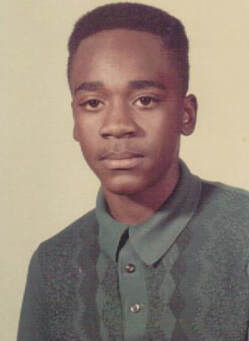 “Find a Grave Memorial ID 208192632” “Find a Grave Memorial ID 208192632”
James Johnson was born on Friday, September 14, 1951 and parted ways with everything under the sun on Saturday, November 9, 2019, at the age of 68. He was likely named by his parents after his Late uncle "James Johnson" and is the second male child born to the now Late Mr. Jessie James Johnson (1912-1989) and the now Late Ms. Nancy Johnson (1918-2001). Although Jessie Johnson's lifelong nickname carried the sound of "Poke" or "Polk," a 1920 census document partly listing all of the children of our paternal grandparents "Simial" and "Elvira" "Johnson" actually spelled Jessie's nickname "Porke." As for our Late uncle "James Johnson," he was known by some as "Red Cap." Yet, we called him "Uncle Brother." Uncle Brother literally died in his nephew James Johnson's arms while he lay on a sofa at his sister's home in East Baton Rouge Parish, LA. Uncle Brother's oldest sister and our aunt's name spelled "Christeen Johnson Bonds." The Late Mr. Raymond Johnson (1938-1955) was the first male child born to Jessie and Nancy prior to the couple's celebration of their marital vows on Sunday, March 24, 1940. Raymond's life was tragically and brutally taken away from him on Sunday, July 24, 1955. The couple's marital rites were also celebrated just prior to the "Sixteenth Census of the United States" of April 1, 1940. Even though for the first time all "48" states allegedly had a population above "100,000" the census was, in my opinion, a flawed "Roll Call" as Colored People may not have been accurately counted, or named. In 1951, James Johnson was born in Prairieville, LA in a little farm house located on a three(3) acre tract of land in the rural section of Ascension Parish, LA. The land was purchased for the private use of this couple, used primarily for farming and for the couple to raise their family. In short, with their own sweat and sometimes tears, they made good use of the resources acquired by the hard work of two people working together and the two worked wonders considering the limited freedoms afforded to Colored People. Although neither of the two had a racist bone in their bodies, it was, no doubt, a hard fought, uphill battle while laboring under the constant disheartening, debilitating racial strife of those days. Yet, Jessie and Nancy steadied the course, braved the storms, farmed their land together and they done it well. A Mr. Sammy Johnson, that's me, is the last surviving, male child of only three(3) male children born to Jessie and Nancy, according to my mother's own signature(s). Later in his adult life, James aspired to be one of "Jehovah’s Witnesses." On or about November 9, 2019, he allegedly lost the battle to a sudden illness that surfaced after December 24, 2018. He eventually passed away at his home in Geismar, LA. However, his demise and death is not without its own, unique set of problems. Thus, it may not be without consequence. His remains were cremated and spread among several individuals.
Source: Ancestry.com | Ascension Parish Clerk of Court | East Baton Rouge Parish Clerk of Court | Social Security Death Index | U. S. Federal Census, 1940 | Wikipedia.org | Sunday, September 20, 2020, 12:00 AM CDT | Revised Thursday, October 1, 2020, 5:30 AM CDT, Sunday, November 15, 2020, 8:44 AM CDT | Thursday, December 24, 2020, 11:59 PM CDT | Monday, January 30, 2023, 12:00 AM CDT 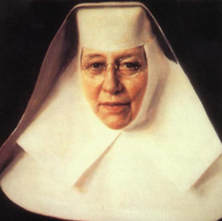 “Find a Grave Memorial ID 6796233” “Find a Grave Memorial ID 6796233”
"Saint Katharine Drexel, S. B. S., (November 26, 1858–March 3, 1955) was an American heiress, philanthropist, religious sister, educator, and foundress. She was canonized by the Roman Catholic Church in 2000; her feast day is observed on March 3. She was the second canonized saint to have been born in the United States and the first to have been born a U. S. citizen. Katharine Mary Drexel was born Catherine Mary Drexel in Philadelphia on November 26, 1858, the second child of investment banker Francis Anthony Drexel and Hannah Langstroth. Hannah died five weeks after her baby's birth. For two years Katharine and her sister, Elizabeth, were cared for by their aunt and uncle, Ellen and Anthony Drexel. When Francis married Emma Bouvier in 1860 he brought his two daughters home. A third daughter, Louisa, was born in 1863. Louisa would marry General Edward Morrell. The Morrells, "actively promoted and advanced the welfare of African Americans throughout the country. The Morrells used their wealth to build magnificent institutions that served and aided the education and upward mobility of African Americans. Gen. Morrell took charge of the Indian work, while Katharine Drexel was in her novitiate." Private tutors educated the girls at their home. They toured parts of the United States and Europe with their parents. Twice weekly, the Drexel family distributed food, clothing, and rent assistance from their family home at 1503 Walnut Street in Philadelphia. When widows or lonely single women were too proud to come to the Drexels for assistance, the family sought them out, but always quietly. As Emma Drexel taught her daughters, "Kindness may be unkind if it leaves a sting behind." As a young and wealthy woman, Drexel made her social debut in 1879. However, watching her stepmother's three-year struggle with terminal cancer taught her the Drexel money could not buy safety from pain or death. Her life took a profound turn. She had always been interested in the plight of Native Americans, having been appalled by what she read in Helen Hunt Jackson’s A Century of Dishonor. When her family traveled to the Western states in 1884, Katharine Drexel saw the plight and destitution of the Native Americans. She wanted to do something specific to help. Thus began her lifelong personal and financial support of numerous missions and missionaries in the United States. After her father died in 1885, Katharine and her sisters had contributed money to help the St. Francis Mission on South Dakota’s Rosebud Reservation. For many years she took spiritual direction from a longtime family friend, Father James O’Connor, a Philadelphia priest who later was appointed vicar apostolic of Nebraska. When Kate wrote him of her desire to join a contemplative order, Bishop O’Connor suggested, "Wait a while longer....... Wait and pray." Katharine and her sisters Elizabeth and Louise were still mourning their father when they sailed to Europe in 1886. Their high-powered banker father left behind a $15.5 million estate and instructions to divide it among his three daughters—Elizabeth, Katherine, and Louisa-after expenses and specific charitable donations. However, to prevent his daughters from falling prey to "fortune hunters," Francis Drexel crafted his will so that his daughters controlled income from his estate, but upon their deaths, their inheritance would flow to their children. The will stipulated that if there were no grandchildren, upon his daughters’ deaths, Drexel's estate would be distributed to several religious orders and charities—the Society of Jesus, the Christian Brothers, the Religious of the Sacred Heart, a Lutheran hospital and others. Because their father's charitable donations totaled about $1.5 million, the sisters shared the income produced by $14 million—about $1,000 a day for each woman. In current dollars, the estate would be worth about $400 million. On February 12, 1891, Drexel professed her first vows as a religious, dedicating herself to work among the American Indians and African-Americans in the western and southwestern United States. She took the name Mother Katharine, and joined by thirteen other women, soon established a religious congregation, the Sisters of the Blessed Sacrament. Mother Frances Cabrini had advised Drexel about the "politics" of getting her new Order’s Rule approved by the Vatican bureaucracy in Rome. A few months later, Philadelphia Archbishop Ryan blessed the cornerstone of the new motherhouse under construction in Bensalem, Pennsylvania. In the first of many incidents that indicated Drexel's convictions for social justice were not shared by all, a stick of dynamite was discovered near the site. In all, Drexel established 145 missions, 50 schools for African Americans, and 12 schools for Native Americans. Xavier University of Louisiana, the only historically black Catholic college in the US, also owes its existence to Drexel and the Sisters. Mother Katharine Drexel died at the age of 96, on March 3, 1955, at her order's motherhouse, where she is buried. Because neither of her biological sisters had children, after Mother Katharine's death, pursuant to their father's will, the Sisters of the Blessed Sacrament no longer had the Drexel fortune available to support their ministries. Nonetheless, the order continues to pursue their original apostolate, working with African-Americans and Native Americans in 21 states and Haiti."
Source: Wikipedia.org | Tuesday, November 28, 2017, 12:00AM 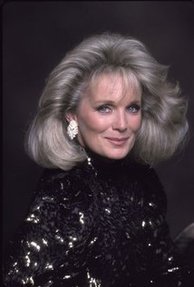
"Linda Evans (born on November 18, 1942) is an American actress known primarily for her roles on television. In the 1960s, she gained notice for playing Audra Barkley in the Western television series, The Big Valley. However, she is most prominently known for the role of Krystle Carrington in the 1980s ABC prime time soap opera Dynasty, a role she played from 1981 to 1989. Evans, the second of three daughters, was born Linda Evenstad in Hartford, Connecticut to Arlene Dart and Alba Evenstad both of whom were professional dancers. "Evenstad" was the name of the small farm in Nes, Hedmark in Norway from where her paternal great-grandmother emigrated to the United States in 1884 with her young son, Evans' grandfather and a couple of relatives. When Evans was six months old, the family moved from Hartford to North Hollywood. She attended Hollywood High School, where she was a sorority sister of future actress Carole Wells. Her introduction to drama came through classes that she took "as a form of therapy, to cure her of her shyness." When she started her professional career, she changed her last name to "Evans." Evans' first guest-starring role was on a 1960 episode of Bachelor Father, which starred her future screen husband, John Forsythe. She would co-star with him 20 years later on Dynasty. After several guest roles in The Adventures of Ozzie and Harriet between 1960–62, and guest appearances on television series such as Wagon Train and Outlaws, Evans gained her first regular role in 1965 in The Big Valley. Playing Audra Barkley, daughter of Victoria Barkley Evans was credited in the series until it ended in 1969, though she was only a semi-regular cast member during the last two seasons. Then came her breakthrough role in television. In 1980, Evans was cast as John Forsythe's wife, Krystle Carrington, in Aaron Spelling's opulent new primetime soap opera, Dynasty. Intended as ABC Television's answer to the hit CBS series Dallas, the show first aired in January 1981. Although initially sluggish in the ratings, audience figures improved after the show was revamped and British actress Joan Collins was brought in to play opposite Evans and Forsythe as the evil Alexis Carrington. By the 1984-85 season, Dynasty was the number one show on American television, even outranking Dallas. Audiences became enthralled by the onscreen rivalry and infamous catfights between Krystle and Alexis, and Evans and Collins became two of the most celebrated television stars of the decade. In her late teens, Evans was engaged to Patrick Curtis, who later became a press agent and married Raquel Welch. Evans has been married and divorced twice. Her first marriage was to actor, photographer and film director John Derek. They married in 1968 and separated in 1974 when Derek disclosed his affair with Bo Derek, who was 30 years his junior, and was 16 years old when the relationship began. Evans' second marriage was to Stan Herman, a property executive, from 1975 to 1980. In 1989, she began a relationship with new age musician Yanni, which lasted until 1998. She is close with her ex-stepdaughter Sean Catherine Derek, who has a summer house next to Evans' property in Washington state, and with John's Europe-based second wife, Ursula Andress, a frequent house guest at her home in Beverly Hills. After being diagnosed with idiopathic edema, Evans began investigating alternative healing, delving into Eastern philosophy and naturopathy. In 1985, she became involved with controversial metaphysical teacher J. Z. Knight and her Ramtha's School of Enlightenment and eventually moved to Rainier, Washington to be closer to Knight and her school. Evans appeared in Playboy magazine at the behest of her then-husband John Derek in 1971. As she gained tremendous fame on Dynasty, the photos were published a second time in 1982. Evans has a star on the Hollywood Walk of Fame at 6834 Hollywood Boulevard in Hollywood, California."
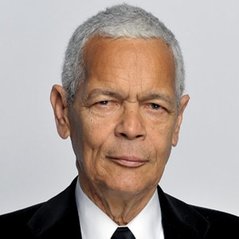 “Find a Grave Memorial ID 150809160” “Find a Grave Memorial ID 150809160”
"Horace Julian Bond (January 14, 1940–August 15, 2015) was an American social activist and leader in the Civil Rights Movement, politician, professor and writer. While a student at Morehouse College in Atlanta, Georgia, during the early 1960s, he helped to establish the Student Nonviolent Coordinating Committee. Bond was elected to four terms in the Georgia House of Representatives and later to six terms in the Georgia State Senate, serving a combined twenty years in both legislative chambers. From 1998 to 2010, he was chairman of the National Association for the Advancement of Colored People and the first president of the Southern Poverty Law Center. Bond was born at Hubbard Hospital in Nashville, Tennessee, to parents Julia Agnes Washington and Horace Mann Bond. His father was an educator who went on to serve as the president of Lincoln University. His mother, Julia, was a former librarian at Clark Atlanta University. At the time, the family resided on campus at Fort Valley State College, where Horace was president. The house of the Bonds was a frequent stop for scholars, activists, and celebrities passing through, such as W. E. B. Du Bois and Paul Robeson. In 1945 his father accepted the position of president of Lincoln University—becoming its first African-American president—and the family moved North. In 1957, Bond graduated from George School, a private Quaker preparatory boarding school near Newtown in Bucks County, Pennsylvania. On April 17, 1960, Bond helped co-found the Student Nonviolent Coordinating Committee. He served as the communications director of SNCC from January 1961 to September 1966, when he traveled around Georgia, Alabama, Mississippi, and Arkansas, to help organize civil rights and voter registration drives. Bond left Morehouse College in 1961 to work on civil rights in the South. From 1960 to 1963, he led student protests against segregation in public facilities and the Jim Crow laws of Georgia. In 1965, Bond was one of eleven African Americans elected to the Georgia House of Representatives after passage of the Civil Rights Act of 1964 and Voting Rights Act of 1965 had opened voter registration to blacks. By ending the disfranchisement of blacks through discriminatory voter registration, African Americans regained the ability to vote and entered the political process. Bond became the first president of the Southern Poverty Law Center in 1971. He served until 1979, remaining a board member and president emeritus for the rest of his life. He was a strong critic of policies that contribute to anthropogenic climate change and was amongst a group of protesters arrested at the White House for civil disobedience in opposition to the Keystone XL pipeline in February 2013. On July 28, 1961, Bond married Alice Clopton, a student at Spelman College. They divorced on November 10, 1989. They had five children; Phyllis Jane Bond-McMillan, Horace Mann Bond II, Michael Julian Bond, Jeffrey Alvin Bond and Julia "Cookie" Louise Bond. He married Pamela Sue Horowitz, a former SPLC staff attorney, in 1990. Bond died from complications of vascular disease on August 15, 2015, in Fort Walton Beach, Florida, aged 75, cremated, ashes scattered at sea."

"Vanessa Lynn Williams (born March 18, 1963) known professionally as Vanessa L. Williams or Vanessa Williams, is an American singer, actress, producer and former fashion model. In 1983, she became the first African-American woman crowned Miss America, but a scandal arose when Penthouse magazine bought and published nude photographs of her. She relinquished her title early and was succeeded by the first runner-up, Suzette Charles of New Jersey. Williams rebounded by launching a career as an entertainer, earning multiple Grammy, Emmy, and Tony Award nominations. She is arguably the most successful former Miss America winner in the field of entertainment. Williams was born in Millwood, New York, the daughter of music teachers Helen L. Tinch and Milton Augustine Williams, Jr. She is of African American, Welsh and Native American descent. Williams and her younger brother Chris, who is also an actor, grew up in Millwood, a predominantly white middle-class suburban area. Prophetically, her parents put "Here she is: Miss America" on her birth announcement."
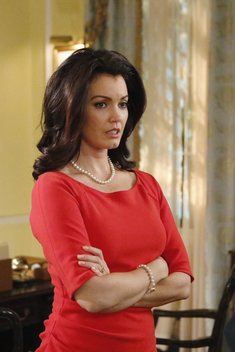
"Bellamy Young (born Amy Maria Young; February 19, 1970) is an American actress, singer and producer, best known for her role as President Melody "Mellie" Grant in the ABC drama series Scandal (2012–present). In 2014, for her portrayal of Mellie, Young won the Critics' Choice Television Award for Best Supporting Actress in a Drama Series. Young was born as Amy Maria Young in Asheville, North Carolina, and raised by adoptive parents. Her mother was her teacher from sixth grade through eighth grade. She had to change her name to join the Screen Actors Guild since there was another Amy Young registered and chose the name Bellamy as a tribute to her late father's best friend, Bill, who had helped to raise her after her father died. She graduated from Asheville High School in 1987. She attended Yale University, majoring initially in Physics but ultimately studying English and Theatre, and graduated in 1991. Young spent a summer during college at the British American Drama Academy at Oxford University in England. Young was a regular cast member in the USA Network series Peacemakers in 2003. The show was cancelled after one season of nine episodes. She had recurring roles in the Lifetime legal drama series For the People as Deputy District Attorney Agnes Hunt in 2002; on NBC period drama American Dreams as Diane Shaw in 2003; on NBC's Scrubs as Dr. Grace Miller in 2004; as Assistant State Attorney Monica West on CBS's CSI: Miami and on ABC primetime soap opera Dirty Sexy Money as Ellen Darling, the eldest daughter-in-law of the Darling family. She also had a recurring role in Criminal Minds as Beth Clemmons from 2011 to 2013. In 2011 Shonda Rhimes cast Young in the recurring role of First Lady, then 2016 Republican Presidential nominee, Melody "Mellie" Grant on the ABC political thriller television series Scandal. Before Scandal, Young appeared in Shonda Rhimes' Grey's Anatomy and Private Practice. She appeared in every episode of the first season of Scandal and was upgraded to a series regular as of season two. Young later said that originally her part was a minor role for the three episode recurring arc. Young has received critical acclaim for her performance as Melody Grant throughout her time on the show. On May 15, 2015, Young released her first album, Far Away So Close, on iTunes. The 10-song album covers songs from Pink to Fleetwood Mac. Young is a Feminist and a registered Democrat. Young is pro choice and in 2016, was one of seven actresses to campaign for "draw the line," which aims to draw the line against attacks on safe and legal abortion. Via social media, Young has stated she is in favour of gun control in the United States. Young is the honorary chair for the domestic violence nonprofit organization 'Helpmate' and has helped raise funds for victims of domestic violence. In 2015, Young won Celebrity Jeopardy! and as a result won $50,000 for Operation Blankets of Love–a charity which donates blankets to animals in shelters. At the 2015 GMHC AIDS Walk New York, Young gave a speech at the opening ceremony. As a Yale alumni, Young was given the opportunity to endow a scholarship to a student attending Yale each year, beginning in 2016. As a teenager, Young began to suffer from migraines and still suffers from them to this day. She became a partner with GlaxoSmithKline for Treximet, in 2015, to spread migraine awareness. Young partnered with Merck & Co., in November 2016, to help educate people on the importance of biomarker testing in non-small cell lung cancer–a cause dear to Young as her adopted father was diagnosed with lung cancer in August 1984 and died 10 months later. Young is close friends with ex-boyfriend Joshua Leonard whom she dated from 2000 to 2002. Young dated British actor Ed Weeks the two went public with their relationship at the Elton John AIDS Foundation Academy Award Party. In an interview with Larry King in 2017, Young revealed that she had not wanted to get married until recent years and thinks being a wife would be a beautiful job. Young resides in Los Angeles and has 1 dog and 3 cats."
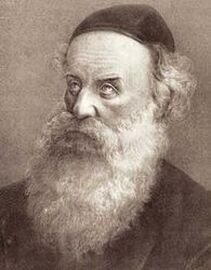 Find a Grave Memorial ID unavailable Find a Grave Memorial ID unavailable
"Shneur Zalman of Liady (September 4, 1745–December 15, 1812) was an Orthodox rabbi and the founder and first Rebbe of Chabad, a branch of Hasidic Judaism, then based in Liadi in the Russian Empire. He was the author of many works, and is best known for Shulchan Aruch HaRav, Tanya and his Siddur Torah Or compiled according to the Nusach Ari. Shneur Zalman was born in 1745 in the small town of Liozna, Polish–Lithuanian Commonwealth. He was the son of Baruch, great-grandson of the mystic and philosopher Judah Loew ben Bezalel, the "Maharal of Prague." He displayed extraordinary talent while still a child. By the time he was eight years old, he wrote an all-inclusive commentary on the Torah based on the works of Rashi, Nahmanides and Abraham ibn Ezra. Until the age of twelve, he studied under Issachar Ber in Lyubavichi; he distinguished himself as a Talmudist, such that his teacher sent him back home, informing his father that the boy could continue his studies without the aid of a teacher. At the age of twelve, he delivered a discourse concerning the complicated laws of Kiddush Hachodesh, to which the people of the town granted him the title "Rav" At age fifteen he married Sterna Segal, the daughter of Yehuda Leib Segal, a wealthy resident of Vitebsk, and he was then able to devote himself entirely to study. During these years, Shneur Zalman was introduced to mathematics, geometry and astronomy by two learned brothers, refugees from Bohemia, who had settled in Liozna. One of them was also a scholar of the Kabbalah. Thus, besides mastering rabbinic literature, he also acquired a fair knowledge of the sciences,philosophy, and Kabbalah. He became an adept in Isaac Luria's system of Kabbalah, and in 1764 he became a disciple of Dov Ber of Mezeritch. In 1767, at the age of 22, he was appointed maggid of Liozna, a position he held until 1801. Rabbi Shneur Zalman's sons were: Dovber Schneuri who eventually succeeded him, Chaim Avraham, and Moshe, who allegedly converted to Catholicism. Moshe's apostasy is negated by Chabad sources, but supported by Belarusian State archives in Minsk uncovered by historian Shaul Stampfer. Rabbi Shneur Zalman's daughters were named Freida, Devorah Leah and Rochel. Other families have lore telling that they are also descendants of the Alter Rebbe, but they are undocumented in existing family records of the Alter Rebbe's descendants. In 1797 following the death of the Gaon, leaders of the Vilna community falsely accused the Hasidim of subversive activities-on charges of supporting the Ottoman Empire, since Rabbi Shneur Zalman advocated sending charity to support Jews living in the Ottoman territory of Palestine. In 1798 he was arrested on suspicion of treason and brought to St. Petersburg where he was held in the Petropavlovski fortress for 53 days, at which time he was subjected to an examination by a secret commission. Ultimately he was released by order of Paul I of Russia. The Hebrew day of his acquittal and release, 19 Kislev, 5559 on the Hebrew calendar, is celebrated annually by Chabad Hasidim, who hold a festive meal and make communal pledges to learn the whole of the Talmud; this practice is known as "Chalukat HaShas." Rabbi Shneur Zalman was a prolific writer. He produced works of both mysticism and Jewish law. Chabad tradition recasts his Yiddish name "Shneur" as the two Hebrew words "Shnei Ohr" referring to Schneur Zalman's mastery of both the outer dimensions of Talmudic Jewish study, and the inner dimensions of Jewish mysticism. His works form the cornerstone of Chabad philosophy. His ability to explain even the most complex issues of Torah made his writings popular with Torah scholars everywhere. Rabbi Shneur Zalman composed a number of Hassidic melodies. Some accompany certain prayers, others are sung to Biblical verses or are melodies without words. Depending on the tune they are meant to arouse joy, spiritual ecstasy or teshuvah. One special melody, commonly referred to as The Alter Rebbe's Niggun or Dalet Bovos, is reserved by Chabad Hassidim for ushering a groom and bride to their wedding canopy and other select occasions. When Schneur Zalman died, many of his followers flocked to one of his top students, Rabbi Aharon HaLevi of Strashelye. He had been Shneur Zalman’s closest disciple for over thirty years. While many more became followers of Dovber Shneuri, known to his followers as the Mittler Rebbe, the Strashelye school of Chassidic thought was the subject of many of Dovber's discourses."
Source: Wikipedia.org | Friday, March 2, 2018, 11:59PM CDT 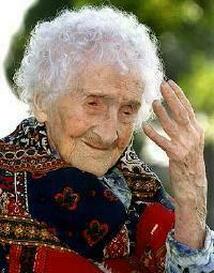 Find a Grave Memorial ID 1864 Find a Grave Memorial ID 1864
"Jeanne Louise Calment (21 February 1875–4 August 1997) was a French super-centenarian and the oldest human whose age is well-documented, with a reputed lifespan of 122 years and 164 days. Her longevity attracted media attention and medical studies of her health and lifestyle. According to census records, Calment outlived both her daughter and grandson. In 1988, at age 112, she was widely reported to have been the oldest living person, and in 1995, at age 120, was declared the oldest person to have ever lived. During her life and after her death, medical researchers have taken many studies into her health and lifestyle, and how it may have affected her statistically anomalous age. Jeanne Louise Calment was born on 21 February 1875 in Arles, Bouches-du-Rhône, Provence. Her father, Nicolas Calment (8 November 1837–28 January 1931), was a shipbuilder, and her mother, Marguerite Gilles (20 February 1838–18 September 1924), was from a family of millers. She had an older brother, François. Some of her close family members also lived an above-average lifespan: her brother lived to the age of 97, her father to 93, and her mother to 86. From the age of seven until her first communion, she attended Mrs Benet's church primary school in Arles, and then the local collège, finishing at 16 with the brevet classique diploma (O-level). Asked about her daily routine while at primary school, she replied that "when you are young, you get up at eight o'clock." In lieu of a solid breakfast, she would have either coffee with milk, or hot chocolate, and at noon her father would pick her up from school to have lunch at home before she returned to school for the afternoon. In the following years, she continued to live with her parents, awaiting marriage, painting, and improving her piano skills. On 8 April 1896, at the age of 21, she married her double second cousin, Fernand Nicolas Calment. Their paternal grandfathers were brothers, and their paternal grandmothers were sisters. He had reportedly started courting her when she was 15, but she was "too young to be interested in boys." Fernand was heir to a drapery business located in a classic Provençal-style building in the center of Arles, and the couple moved into a spacious apartment above the family store. Jeanne employed servants and never had to work; she led a leisurely lifestyle within the upper society of Arles, pursuing hobbies such as fencing, cycling, tennis, swimming, roller-skating ("I fell flat on my face") playing the piano and making music with friends. In the summer, the couple would stay at Uriage for mountaineering on the glacier. ("Even at 16, I had good legs.") They also went hunting for rabbits and wild boars in the hills of Provence, using an "18mm rifle." Calment said she disliked shooting birds. She gave birth to her only child, a daughter named Yvonne Marie Nicolle Calment, on 19 January 1898. Yvonne married army officer Joseph Billot on 3 February 1926, and their only son, Frédéric, was born on 23 December of the same year. Yvonne Calment died of pleurisy on 19 January 1934, her 36th birthday, after which Jeanne raised Frédéric, although he lived with his father in the neighbouring apartment. World War II had little effect on Jeanne's life. She said that German soldiers slept in her rooms but "did not take anything away," so that she bore no grudge against them. In 1942, her husband Fernand died, aged 73, reportedly of cherry poisoning. By the 1954 census, she was still registered in the same apartment, together with her son-in-law, retired Colonel Billot, Yvonne's widower; the census documents list Jeanne as "mother" in 1954 and "widow" in 1962. Frédéric Billot lived next door with his wife Renée. Her brother François died in 1962, aged 97. Her son-in-law Joseph died in January 1963, and her grandson Frédéric died in an automobile accident in August of the same year. In 1965, aged 90 and with no heirs left, Calment signed a life estate contract on her apartment with notary public André-François Raffray, selling the property in exchange for a right of occupancy and a monthly revenue of 2,500 francs until her death. Raffray died in 1995, by which time Calment had received more than double the apartment's value from him, and his family had to continue making payments. Calment commented on the situation by saying, "in life, one sometimes makes bad deals." In 1985, she moved into a nursing home, having lived on her own until age 110. A documentary film about her life, entitled Beyond 120 Years with Jeanne Calment, was released in 1995. In 1986, Calment became the oldest living person in France at the age of 111. Her profile increased during the centennial of Vincent van Gogh's move to Arles, which occurred from February 1888 to April 1889 when she was 13–14 years old. Calment claimed to reporters that she had met Van Gogh at that time, introduced to him by her (future) husband in her uncle's shop. She remembered the meeting as a disappointment, and described him as ugly and "very disagreeable," adding that he "reeked of alcohol." She was recognised by Guinness World Records as the world's oldest living person when she was 112. At the age of 114, she briefly appeared in the 1990 documentary film Vincent and Me, walking outside and answering questions. Her profile further increased when Guinness named her the oldest person ever in 1995. Far exceeding any other verified human lifespan, Calment was widely reckoned the best-documented super-centenarian ever recorded. For example, she was listed in fourteen census records, beginning in 1876 as a one-year-old infant. After Calment's death, at 122 years and 164 days, 116-year-old Marie-Louise Meilleur became the oldest validated living person. Several claims to have surpassed Calment's age were made, but no such case was proven. For over two decades, Calment has held the status of the oldest-ever human being whose age was validated by modern standards. In 1994, the city of Arles inquired about Calment's personal documents, in order to contribute to the city archives. However, reportedly on Calment's instructions, her documents and family photographs were selectively burned by a distant family member, Josette Bigonnet, a cousin of her grandson. The verification of her age began in 1995 when she turned 120, and was conducted over a full year. She was asked questions about documented details concerning relatives, and about people and places from her early life, for instance teachers or maids. A great deal of emphasis was put on a series of documents from population censuses, in which Calment was named from 1876 to 1975. The family's membership in the local Catholic bourgeoisie helped researchers find corroborating chains of documentary evidence. Calment's father had been a member of the city council, and her husband owned a large drapery and clothing business. The family lived in two apartments located in the same building as the store, one for Calment, her husband and his mother, one for their daughter Yvonne, her husband and their child. Several house servants were registered in the premises as well. Calment's remarkable health presaged her later record. On television she stated "J'ai jamais été malade, jamais, jamais" (I have never been ill, never ever). At age 20, incipient cataracts were discovered when she suffered a major episode of conjunctivitis. She married at 21, and her husband's wealth allowed her to live without ever working. All her life she took care of her skin with olive oil and a puff of powder. At an unspecified time in her youth, she had suffered from migraines. Her husband introduced her to smoking, offering cigarettes or cigars after meals, but she did not smoke more. Calment continued smoking in her elderly years, until she was 117. At "retirement age" she broke her ankle, but before that had never suffered any major injuries. She continued cycling until her hundredth birthday. Around age 100, she fractured her leg, but recovered quickly and was able to walk again. After her brother, her son-in-law and her grandson died in 1962–63, Calment had no remaining family members. She lived on her own from age 88 until shortly before her 110th birthday, when she decided to move to a nursing home. Her move was precipitated by the winter of 1985 which froze the water pipes in her house (she never used heating in the winter) and caused frostbite to her hands. According to one of her doctors, she had been quite healthy until she moved to the nursing home, and only began showing signs of ageing during her stay. Calment died of unspecified causes on 4 August 1997 around 10 a.m. The New York Times quoted Robine as stating that she had been in good health, though almost blind and deaf, as recently as a month before her death."
Source: Wikipedia.org | Monday, February 22, 2021, 12:00 AM CDT | This person's profile was originally showcased on 12/3/2017 on Galleria 1. "This is a list of tables of the oldest people in the world in ordinal ranks. To avoid including false or unconfirmed claims of old age, names here are restricted to those people whose ages have been validated by an international body dealing in longevity research, such as the Gerontology Research Group (GRG) or Guinness World Records (GWR), and others who have otherwise been reliably sourced." |

"Jennifer Lopez," born "Jennifer Lynn Lopez" on Thursday, July 24, 1969, is an American actress, dancer, entrepreneur, fashion designer, film producer, philanthropist, recording artist and spokeswoman. Jennifer was born in the Castle Hill neighborhood of The Bronx, New York. The middle child of Puerto Rican parents Guadalupe Rodriguez and David Lopez, she has an elder sister, Leslie, and a younger sister, Lynda. David worked the night shift at the Guardian Insurance Company, before becoming a computer technician at the firm, while Guadalupe was a homemaker. When Lopez was born, the family was living in a small apartment. A few years later, her parents had saved up enough money to be able to purchase a two-story house, which was considered a big deal for the relatively poor family. At the age of five, Lopez began taking singing and dancing lessons. She toured New York with her school when she was seven years old. Her parents stressed the importance of work ethic and being able to speak English. They encouraged their three daughters to put on performances at home; singing and dancing in front of each other and their friends so that they would stay "out of trouble." While attending her final year of high school, Lopez learned about a film casting that was seeking several teenage girls for small roles. She auditioned and was cast in My Little Girl, a low-budget film co-written and directed by Connie Kaiserman. Lopez acted as Myra, a young woman at a center for troubled girls. After she finished filming her role in the film, Lopez realized that she wanted to become a "famous movie star." Following her break-up with Affleck in January 2004, Lopez began dating longtime friend Marc Anthony, real name, Marco Antonio Muñiz. The couple wed that June and lived in Brookville, New York. Lopez, who is a Roman Catholic, has stated that her faith discouraged her from pursuing in vitro fertilization treatment while trying to get pregnant. Lopez gave birth to a son, Maximilian David, and a daughter, Emme Maribel, in Long Island, New York, on February 22, 2008. The twins were introduced in the March 11, 2008, issue of People, for which the magazine paid a reported $6 million; the photographs of the twins became the most expensive celebrity picture ever taken at the time. Three years later in July 2011, the couple announced their split, with Anthony filing for divorce in April 2012. Their divorce was finalized on June 16, 2014, with Lopez retaining primary physical custody of the two children. On December 31, 2014, she legally changed her name back to Jennifer Lopez, dropping Anthony's last name Muñiz. In October 2011, Lopez began dating her former backup dancer Casper Smart. They temporarily split in June 2014, but reconciled several months later. The couple ended their relationship again in August 2016. Lopez endorsed President Barack Obama's 2012 presidential campaign, speaking in television advertisements and attending a fundraising event for Obama in Paris. She endorsed Democratic presidential nominee Hillary Clinton in 2016, headlining a free concert in Florida in support of her that October; she urged Latinos in particular to vote for Clinton. Lopez had an on-off relationship with her former backup dancer Casper Smart from October 2011 to August 2016.She dated New York Yankees baseball player Alex Rodriguez from February 2017 to early 2021. They became engaged in March 2019 but postponed their wedding twice due to the COVID-19 pandemic. In response to tabloid speculation about the state of their relationship, they released a statement in March 2021, saying they were "working through some things." They announced the end of their relationship in April 2021. In April 2021, Lopez and Affleck were reported to be dating again, with Lopez publicly confirming their rekindled relationship that July. In the years after their breakup, they had remained in contact and spok[e] highly of each other in the press. Both Affleck and Lopez have spoken of the gift of a second chance with each other since reuniting. On April 8, 2022, Lopez announced their second engagement, 20 years after the first proposal. They were married in Las Vegas on July 16, 2022. The following month, they held a wedding celebration for family and friends."
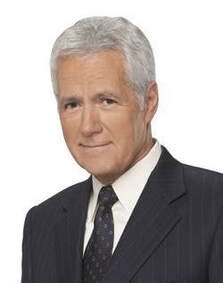 “Find a Grave Memorial ID 218166392” “Find a Grave Memorial ID 218166392”
"George Alexander Trebek July 22, 1940–November 8, 2020) was a Canadian-American game show host and television personality. He was the host of the syndicated game show Jeopardy! for 37 seasons from its revival in 1984 until his death in 2020. He also hosted a number of other game shows, including The Wizard of Odds, Double Dare, High Rollers, Battlestars, Classic Concentration, and To Tell the Truth. Trebek also made appearances in numerous television series, in which he usually played himself. A native of Canada, Trebek became a naturalized United States citizen in 1998. He received the Daytime Emmy Award for Outstanding Game Show Host seven times for his work on Jeopardy!. He died on November 8, 2020 at age 80 after a nearly two-year battle with pancreatic cancer. He had been contracted to host Jeopardy! until 2022. Trebek was born in Sudbury, Ontario, Canada, on July 22, 1940, the son of George Edward Trebek, a chef who had emigrated from Ukraine as a child, and Lucille Marie Lagacé (born April 14, 1921), a Franco-Ontarian. Trebek also had roots in Renfrew County, Ontario where his grandmother on his mother's side was born in Mount St. Patrick near Renfrew. He grew up in a bilingual French-English household. Trebek's first job was when he was 13; he was a bellhop at the hotel where his father worked as a chef. Trebek attended Sudbury High School (now Sudbury Secondary School) and then attended the University of Ottawa. Trebek graduated from the University of Ottawa with a degree in philosophy in 1961. While a university student, he was a member of the English Debating Society. At the time, he was interested in a career in broadcast news. Trebek married broadcaster Elaine Callei in 1974. The couple had no children although Trebek adopted Callei's daughter Nicky; they divorced in 1981. In 1990, he married Jean Currivan, a real estate project manager from New York. They had two children, Matthew and Emily. In 1996, Trebek ran the Olympic torch in Jacksonville, Florida, through a leg of its journey to Atlanta. He became anaturalized citizen of the United States in 1998. In late 2001 during Jeopardy!'s 18th season, Trebek shaved the mustache that he had worn for over 30 years. He wore a fake mustache for the first half of the April 1, 2008, episode as an April Fools' joke. In summer 2014, Trebek regrew the mustache for the 31st season of Jeopardy!, only to shave it off again a month into the season. Trebek grew out a full beard at the beginning of the 2018 season, shaving it down to a goatee for the second episode and a mustache by the second week, and the next day was clean-shaven again. On January 30, 2004, Trebek escaped major injury after falling asleep behind the wheel of his pickup truck while driving alone on a rural road in the Central Coast town of Templeton, California, returning from a family home in Lake Nacimiento. The truck sideswiped a string of mailboxes, flew 45 feet over an embankment, and came to rest against a utility pole in a ditch. Trebek was not cited for the accident and returned to work taping Jeopardy! four days later. Trebek owned and managed a 700-acre (283 ha) ranch near Paso Robles in Creston, California, known as Creston Farms, where he bred and trained thoroughbred racehorses. His colt Reba's Gold is the stakes-winning son of Slew o' Gold. Trebek sold the operation in 2008 and the property is now an event center called Windfall Farms. In a 2018 interview with Vulture, Trebek said he was a political moderate and registered independent, neither conservative nor liberal, with some libertarian leanings. Trebek stated he believed in God as a Christian. During a 2018 gubernatorial debate, he said he was raised Catholic during his childhood and adolescence. On March 6, 2019, Trebek announced that he had been diagnosed with stage IV pancreatic cancer. He had been experiencing a persistent stomach ache before the diagnosis but did not recognize it as a symptom of the disease. In a prepared video announcement of the diagnosis, Trebek noted that his prognosis was poor but said that he would aggressively fight the cancer in hopes of beating the odds and would continue hosting Jeopardy! for as long as he was able, joking that his contract obligated him to do so for three more years. Trebek updated the situation in May 2019, stating that he was responding exceptionally well to treatment and that some of the tumors had shrunk to half their previously observed size; he credited the prayers and well wishes of his fans for the better-than-usual results and planned to undergo several more rounds of chemotherapy. Trebek finished that round of chemotherapy treatments in time to resume taping of the show in August 2019. Follow-up immunotherapy was ineffective, and Trebek resumed chemotherapy in September. In March 2020, Trebek announced he had survived one year of cancer treatment (noting that his prognosis had given him only an 18% chance to survive that long) and that, though the chemotherapy treatments were often worse than the cancer symptoms themselves, he was confident that he would survive another year, saying that ending treatment would be a "betrayal" to his family, supporters, and to the God in whom he has faith.[96] As a precautionary measure, Jeopardy! was to tape episodes without a studio audience, as protection from the ongoing COVID-19 pandemic; Trebek, because of both his age and his condition, was particularly at risk of death from the particular strain of coronavirus circulating.[97] Soon afterward, production of the show was suspended altogether.[98] The show resumed taping in August, in time for the season 37 premiere. On July 16, 2020, Trebek gave an update regarding his cancer. He said that, while he still felt fatigued, the chemotherapy was "paying off." He also stated that he was looking forward to taping again. On July 21, 2020, he published his memoir The Answer Is...: Reflections on My Life. Trebek underwent surgery related to his cancer treatment in October. He returned to the show two weeks after the surgery, but was unable to handle his full workload because of pain from the surgery and had to split his usual five-episode taping session over two days; these five episodes would be his last. He taped his final episode on October 29, 2020. Trebek died at his home in Los Angeles on November 8, 2020, at the age of 80, after more than 18 months fighting pancreatic cancer. His remains were cremated and given to his wife."
Source: Wikipedia.org | FindAGrave.com | Thursday, December 24, 2020, 11:59 PM CDT 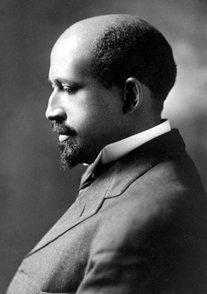 “Find a Grave Memorial ID 6876927” “Find a Grave Memorial ID 6876927”
"William Edward Burghardt Du Bois (February 23, 1868–August 27, 1963) was an American sociologist, historian, civil rights activist, Pan-Africanist, author, and editor. Born in Great Barrington, Massachusetts, Du Bois grew up in a relatively tolerant and integrated community. After completing graduate work at the University of Berlin and Harvard, where he was the first African American to earn a doctorate, he became a professor of history, sociology and economics at Atlanta University. Du Bois was one of the co-founders of the National Association for the Advancement of Colored People in 1909. Racism was the main target of Du Bois's polemics, and he strongly protested against lynching, Jim Crow laws, and discrimination in education and employment. William Edward Burghardt Du Bois was born on February 23, 1868, in Great Barrington, Massachusetts, to Alfred and Mary Silvina Burghardt Du Bois. Mary Silvina Burghardt's family was part of the very small free black population of Great Barrington and had long owned land in the state. She was descended from Dutch, African and English ancestors. William Du Bois's paternal great-grandfather was James Du Bois of Poughkeepsie, New York, an ethnic French-American who fathered several children with slave mistresses. One of James' mixed-race sons was Alexander. He traveled and worked in Haiti, where he fathered a son, Alfred, with a mistress. Alexander returned to Connecticut, leaving Alfred in Haiti with his mother. The 1910s were a productive time for Du Bois. In 1911 he attended the First Universal Races Congress in London and he published his first novel, The Quest of the Silver Fleece. Two years later, Du Bois wrote, produced, and directed a pageant for the stage, The Star of Ethiopia. In 1915, Du Bois published The Negro, a general history of black Africans, and the first of its kind in English. The book rebutted claims of African inferiority, and would come to serve as the basis of much Afro centric historiography in the 20th century. The Negro predicted unity and solidarity for colored people around the world, and it influenced many who supported the Pan-African movement. Du Bois was organized and disciplined: His lifelong regimen was to rise at 7:15, work until 5, eat dinner and read a newspaper until 7, then read or socialize until he was in bed, invariably before 10. He was a meticulous planner, and frequently mapped out his schedules and goals on large pieces of graph paper. Many acquaintances found him to be distant and aloof, and he insisted on being addressed as "Dr. Du Bois." Du Bois was something of a dandy, he dressed formally, carried a walking stick, and walked with an air of confidence and dignity. He was relatively short 5 feet 5.5 inches and always maintained a well-groomed mustache and goatee. He was a good singer and enjoyed playing tennis. Du Bois was married twice, first to Nina Gomer, with whom he had two children, a son Burghardt who died as an infant and a daughter Yolande, who married Countee Cullen. As a widower, he married Shirley Graham, an author, playwright, composer and activist. She brought her son David Graham to the marriage. David grew close to Du Bois and took his stepfather's name; he also worked for African American causes. When asked to lead public prayers, Du Bois would refuse. In his autobiography, Du Bois wrote, "When I became head of a department at Atlanta, the engagement was held up because again I balked at leading in prayer. I flatly refused again to join any church or sign any church creed. I think the greatest gift of the Soviet Union to modern civilization was the dethronement of the clergy and the refusal to let religion be taught in the public schools." Du Bois accused American churches of being the most discriminatory of all institutions. He also provocatively linked African-American Christianity to indigenous African religions. Du Bois occasionally acknowledged the beneficial role religion played in African American life–as the "basic rock" which served as an anchor for African American communities–but in general disparaged African American churches and clergy because he felt they did not support the goals of racial equality and hindered activists' efforts. Although Du Bois was not personally religious, he infused his writings with religious symbology, and many contemporaries viewed him as a prophet. His 1904 prose poem, "Credo," was written in the style of a religious creed and widely read by the African-American community."
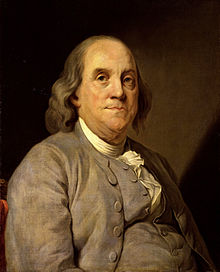 "Find a Grave Memorial ID 364" "Find a Grave Memorial ID 364"
"Benjamin Franklin (January 17, 1706 or January 6, 1705–April 17, 1790) was one of the Founding Fathers of the United States. A renowned polymath, Franklin was a leading author, printer, political theorist, politician, free-mason, postmaster, scientist, inventor, civic activist, statesman, and diplomat. As a scientist, he was a major figure in the American Enlightenment and the history of physics for his discoveries and theories regarding electricity. As an inventor, he is known for the lightning rod, bifocals, and the Franklin stove, among other inventions. He facilitated many civic organizations, including Philadelphia's fire department and a university. Franklin earned the title of "The First American" for his early and indefatigable campaigning for colonial unity, first as an author and spokesman in London for several colonies. As the first United States Ambassador to France, he exemplified the emerging American nation. Franklin was foundational in defining the American ethos as a marriage of the practical values of thrift, hard work, education, community spirit, self-governing institutions, and opposition to authoritarianism both political and religious, with the scientific and tolerant values of the Enlightenment. He played a major role in establishing the University of Pennsylvania and was elected the first president of the American Philosophical Society. Franklin became a national hero in America when as agent for several colonies he spearheaded the effort to have Parliament in London repeal the unpopular Stamp Act. An accomplished diplomat, he was widely admired among the French as American minister to Paris and was a major figure in the development of positive Franco-American relations. His efforts to secure support for the American Revolution by shipments of crucial munitions proved vital for the American war effort. For many years he was the British postmaster for the colonies, which enabled him to set up the first national communications network. He was active in community affairs, colonial and state politics, as well as national and international affairs. From 1785 to 1788, he served as governor of Pennsylvania. Toward the end of his life, he freed his own slaves and became one of the most prominent abolitionists. His colorful life and legacy of scientific and political achievement, and status as one of America's most influential Founding Fathers, have seen Franklin honored on coinage and the $100 bill; warships; the names of many towns; counties; educational institutions; corporations; and, more than two centuries after his death, countless cultural references. During Franklin's lifetime slaves were numerous in Philadelphia. In 1750, half the persons in Philadelphia who had established probate estates owned slaves. Dock workers in the city consisted of 15% slaves. Franklin owned as many as seven slaves, two males of whom worked in his household and his shop. Franklin posted paid ads for the sale of slaves and for the capture of runaway slaves and allowed the sale of slaves in his general store. Franklin profited from both the international and domestic slave trade, even criticizing slaves who had run off to join the British Army during the colonial wars of the 1740s and 1750s. Franklin, however, later became a "cautious abolitionist" and became an outspoken critic of landed gentry slavery. In 1758, Franklin advocated the opening of a school for the education of black slaves in Philadelphia. After returning from England in 1762, Franklin became more anti-slavery, in his view believing that the institution promoted black degradation rather than the idea blacks were inherently inferior. By 1770, Franklin had freed his slaves and attacked the system of slavery and the international slave trade. Franklin, however, refused to publicly debate the issue of slavery at the 1787 Constitutional Convention. Franklin tended to take both sides of the issue of slavery, never fully divesting himself from the institution."
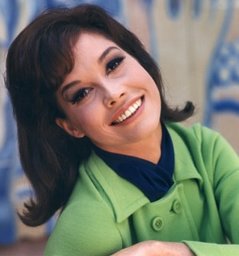 “Find a Grave Memorial ID 175697586” “Find a Grave Memorial ID 175697586”
"Mary Tyler Moore (December 29, 1936–January 25, 2017) was an American actress, known for her roles in the television sitcoms The Mary Tyler Moore Show in which she starred as Mary Richards, a single woman working as a local news producer in Minneapolis, and The Dick Van Dyke Show, in which she played Laura Petrie, a former dancer turned Westchester homemaker, wife and mother. Her film work includes 1967's Thoroughly Modern Millie and 1980's Ordinary People, in which she played a role that was very different from the television characters she had portrayed, and for which she was nominated for an Academy Award for Best Actress. Due to her roles on both The Mary Tyler Moore Show and The Dick Van Dyke Show, in which her characters often broke from stereotypical images of women and pushed gender norms, Moore became a cultural icon and served as an inspiration for many younger actresses, professional women, and feminists. She was later active in charity work and various political causes, particularly the issues of animal rights and diabetes. She was diagnosed with type 1 diabetes early in the run of The Mary Tyler Moore Show. She also suffered from alcoholism, which she wrote about in her first of two memoirs. In May 2011, Moore underwent elective brain surgery to remove a benign meningioma. Moore was born in Brooklyn, New York, to George Tyler Moore, a clerk, and his wife Marjorie Hackett. Moore was the oldest of three children, her siblings were John and Elizabeth. Moore's family lived on Ocean Parkway in the Flatbush section of Brooklyn. Her paternal great-grandfather, Lieutenant Colonel Lewis Tilghman Moore, owned the house which is now the Stonewall Jackson's Headquarters Museum in Winchester, Virginia. When she was eight years old, Moore's family moved to Los Angeles. She was raised Catholic and attended St. Rose of Lima Parochial School in Brooklyn until the third grade. She then attended Saint Ambrose School in Los Angeles, followed by Immaculate Heart High School in Los Feliz, California. Moore's sister, Elizabeth, died at age 21 "from a combination of painkillers and alcohol" while her brother died at age 47 from kidney cancer. At age 18 in 1955, Moore married Richard Carleton Meeker, whom she described as "the boy next door" and within six weeks she was pregnant with her only child, Richard Jr. Meeker and Moore divorced in 1961. Moore married Grant Tinker, a CBS executive in 1962, and in 1970 they formed the television production company MTM Enterprises, which created and produced the company's first television series, The Mary Tyler Moore Show. Moore and Tinker divorced in 1981. On October 14, 1980, at the age of 24, Moore's son Richard died of an accidental gunshot to the head while handling a sawed-off shotgun. The model was later taken off the market because of its "hair trigger." Moore married Robert Levine on November 23, 1983, at the Pierre Hotel in New York City. They met when her mother was treated by him in New York City on a weekend house call, after Moore and her mother returned from a visit to the Vatican where they had had a personal audience with Pope John Paul II. Moore was diagnosed with Type I diabetes when she was 33. In 2011, she had surgery to remove a meningioma, a benign brain tumor. In 2014, friends reported that she had heart and kidney problems and was nearly blind. Moore died at the age of 80 on January 25, 2017, at Greenwich Hospital in Greenwich, Connecticut from cardiopulmonary arrest complicated by pneumonia after having been placed on a respirator the previous week. In addition to her acting work, Moore was the International Chairman of JDRF. In this role, she used her celebrity to help raise funds and awareness of diabetes mellitus type 1. Moore received a total of six Emmy Awards. On Broadway, Moore received a special Tony Award for her performance in "Whose Life Is It Anyway?" Also in 1980, Moore was nominated for a Drama Desk Award, as well. In 1986, she was inducted into the Television Hall of Fame. In 1987, she received a Lifetime Achievement Award in Comedy from the American Comedy Awards. Moore's contributions to the television industry were recognized in 1992 with a star on the Hollywood Walk of Fame."
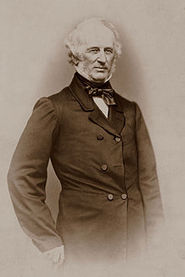 “Find a Grave Memorial ID 1058” “Find a Grave Memorial ID 1058”
"Cornelius Vanderbilt (May 27, 1794–January 4, 1877) also known informally as "Commodore Vanderbilt," was an American business magnate and philanthropist who built his wealth in railroads and shipping. Born poor and having but a mediocre education, he used perseverance, intelligence and luck to work into leadership positions in the inland water trade, and invest in the rapidly growing railroad industry. He is best known for building the New York Central Railroad. As one of the richest Americans in history and wealthiest figures overall, Vanderbilt was the patriarch of a wealthy, influential family. He provided the initial gift to found Vanderbilt University in Nashville, Tennessee. Cornelius Vanderbilt was born in Staten Island, New York on May 27, 1794 to Cornelius van Derbilt and Phebe Hand. He began working on his father's ferry in New York Harbor as a boy, quitting school at the age of 11. At the age of 16, Vanderbilt decided to start his own ferry service. According to one version of events, he borrowed $100 from his mother to purchase a periauger, a shallow draft, two-masted sailing vessel, which he christened the Swiftsure. However, according to the first account of his life, published in 1853, the periauger belonged to his father and the younger Vanderbilt received half the profit. He began his business by ferrying freight and passengers between Staten Island and Manhattan. Such was his energy and eagerness in his trade that other captains nearby took to calling him The Commodore in jest - a nickname that stuck with him all his life. While many Vanderbilt family members had joined the Episcopal Church, Cornelius Vanderbilt remained a member of the Moravian Church to his death. In fact, he, along with other members of the Vanderbilt family, helped erect a local Moravian parish church in his city. On December 19, 1813, at age 19 Vanderbilt married his first cousin, Sophia Johnson, daughter of Nathaniel Johnson and Elizabeth Hand. They moved into a boarding house on Broad Street in Manhattan. They had 13 children together. In addition to running his ferry, Vanderbilt bought his brother-in-law John De Forest's schooner Charlotte and traded in food and merchandise in partnership with his father and others. But on November 24, 1817, a ferry entrepreneur named Thomas Gibbons asked Vanderbilt to captain his steamboat between New Jersey and New York. Although Vanderbilt kept his own businesses running, he became Gibbons's business manager. After Thomas Gibbons died in 1826, Vanderbilt worked for Gibbons' son William until 1829. Though he had always run his own businesses on the side, he now worked entirely for himself. Step by step, he started lines between New York and the surrounding region. On November 8, 1833, Vanderbilt was nearly killed in the Hightstown rail accident on the Camden and Amboy Railroad in New Jersey. Also on the train was former president John Quincy Adams. When the Civil War began in 1861, Vanderbilt attempted to donate his largest steamship, the Vanderbilt, to the Union Navy. Secretary of the Navy Gideon Welles refused it, thinking its operation and maintenance too expensive for what he expected to be a short war. Vanderbilt had little choice but to lease it to the War Department, at prices set by ship brokers. Vanderbilt also paid to outfit a major expedition to New Orleans. He suffered a grievous loss when George Washington Vanderbilt I, his youngest and favorite son, and heir apparent, a graduate of the United States Military Academy, fell ill and died without ever seeing combat. Following his wife Sophia's death in 1868, Vanderbilt went to Canada. On August 21, 1869, in London, Ontario, he married a cousin from Mobile, Alabama with the unusual name for a woman of Frank Armstrong Crawford. Frank was 45 years younger than her husband. Her cousin's husband, Holland Nimmons McTyeire, convinced Vanderbilt to endow what would become Vanderbilt University, named in his honor. Vanderbilt gave$1 million, the largest charitable gift in American history to that date. He also bought a church for $50,000 for his second wife's congregation, the Church of the Strangers. In addition, he donated to churches around New York, including a gift to the Moravian Churchon Staten Island of 8½ acres for a cemetery, the Moravian Cemetery. He chose to be buried there. Cornelius Vanderbilt died on January 4, 1877, at his residence, No. 10 Washington Place, after having been confined to his rooms for about eight months. The immediate cause of his death was exhaustion, brought on by long suffering from a complication of chronic disorders. At the time of his death, aged 82, Vanderbilt had a fortune estimated at $100 million. In his will, he left 95% of his $100 million estate to his son William and to William's four sons. The Commodore said that he believed William was the only heir capable of maintaining the business empire. Cornelius Vanderbilt was buried in the family vault in the Moravian Cemetery at New Dorp on Staten Island. He was later reburied in a tomb in the same cemetery constructed by his son Billy. Three of his daughters and son, Cornelius Jeremiah Vanderbilt, contested the will on the grounds that their father was of unsound mind and under the influence of his son Billy and of spiritualists whom he consulted on a regular basis. The court battle lasted more than a year and was ultimately won outright by Billy, who increased the bequests to his siblings and paid their legal fees. A living descendant is his great-great-granddaughter Gloria Vanderbilt, a renowned fashion designer. Her youngest son is Anderson Cooper, a television news anchor. Through Billy's daughter Emily Thorn Vanderbilt, another descendant is actorTimothy Olyphant."
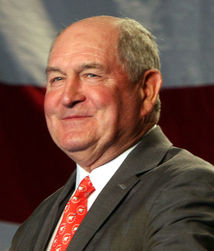
"George Ervin Perdue III (born December 20, 1946) is an American politician who is the 31st United States Secretary of Agriculture, in office since 2017. Perdue previously served as the 81st Governor of Georgia from 2003 to 2011. Upon his inauguration as Governor on January 13, 2003, he became the first Republican Governor of Georgia since Reconstruction. Perdue currently serves on the Governors’ Council of the Bipartisan Policy Center in Washington, DC, and is Secretary of Agriculture in the Cabinet of Donald Trump. Perdue is only the second Secretary of Agriculture from the Deep South. The first was Mike Espy of Mississippi, who served under President Bill Clinton from January 1993 to December 1994. On January 18, 2017, Donald Trump announced that he would nominate Perdue to be Secretary of Agriculture. His nomination was transmitted to the Senate on March 9, 2017. His nomination was approved by the United States Senate Committee on Agriculture, Nutrition and Forestry on March 30, by a 19-1 voice vote and by the entire Senate in a vote of 87-11 on April 24. Perdue was born in Perry, Georgia, the son of Ophie Viola Holt, a teacher, and George Ervin Perdue Jr., a farmer. He grew up and still lives in Bonaire, an unincorporated area between Perry and Warner Robins. Perdue has been known as Sonny since childhood and prefers to be called by that name; he was sworn in and signs official documents as "Sonny Perdue." Perdue is the first cousin of U. S. Senator David Perdue. Perdue played quarterback at Warner Robins High School and was a walk-on at the University of Georgia, where he was also a member of the Beta-Lambda chapter of Kappa Sigma Fraternity. In 1971, Perdue earned his Doctor of Veterinary Medicine (DVM) from the University of Georgia College of Veterinary Medicine and worked as a veterinarian before becoming a small business owner, eventually starting three small businesses. Perdue is not related to the family that owns and operates Perdue Farms. Perdue served in the U. S. Air Force, rising to the rank of captain before his discharge. In December 2001, Perdue resigned as State Senator and devoted himself entirely to running for the office of Governor. He won the 2002 Georgia gubernatorial election, defeating Democratic incumbent Roy Barnes, 51% to 46%, with Libertarian candidate Garrett Michael Hayes taking 2% of the vote. He became the first Republican governor of Georgia in over 130 years since Benjamin F. Conley. In 2006, Perdue was re-elected to a second term in the 2006 Georgia gubernatorial election, winning nearly 58% of the vote. His Democratic opponent was Lieutenant Governor Mark Taylor. Libertarian Garrett Michael Hayes was also on the ballot. On November 13, 2007, while Georgia suffered from one of the worst droughts in several decades, Perdue led a group of several hundred people in a prayer on the steps of the state Capitol. Perdue addressed the crowd, saying "We’ve come together here simply for one reason and one reason only: To very reverently and respectfully pray up a storm" and "God, we need you; we need rain." On January 18, 2017, President Donald Trump nominated Perdue to be United States Secretary of Agriculture. The Senate committee on Agriculture, Nutrition and Forestry overwhelmingly approved his nomination on March 30, with a 19-1 vote. The sole vote against him came from Kirsten Gillibrand (D-NY). Senator David Perdue (R-GA) abstained, as he is the nominee's first cousin. He was confirmed by the Senate on April 24, and sworn in by Supreme Court Associate Justice Clarence Thomas. Perdue and his wife, Mary Ruff were married in 1972 after dating for four years. They have four children, Leigh, Lara, Jim, and Dan, fourteen grandchildren (six boys and eight girls), and have also been foster parents for many children. Perdue lives in Bonaire, Georgia. Perdue is an avid sportsman. He enjoys flying and, in a 2003 incident, was accused of flying a state helicopter without a license. In 2006, Perdue's financial disclosure forms revealed that he had a net worth of approximately $6 million and received compensation of $700,000 that year."
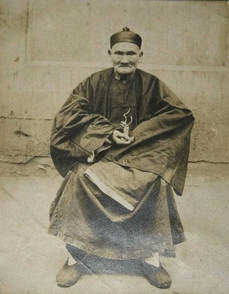 Find a Grave Memorial ID unavailable Find a Grave Memorial ID unavailable
"Li Ching-Yuen or Li Ching-Yun (died 6 May 1933) was a Chinese herbalist, martial artist and tactical advisor, known for his supposed extreme longevity. He claimed to be born in 1736, while disputed records suggest 1677. Both claimed lifespans, of 197 and 256 years, far exceed the longest confirmed life span of 122 years and 164 days of French woman Jeanne Calment. His true date of birth was never determined and his claims have been dismissed by gerontologists as a myth. Li Ching-Yuen was born at an uncertain date in Qijiang Xian, Sichuan, Qing Empire. He spent most of his life in the mountains and was skilled in Qigong. He worked as an herbalist, selling lingzhi, goji berry, wild ginseng, he shou wu andgotu kola along with other Chinese herbs, and lived off a diet of these herbs and rice wine. It was generally accepted in Sichuan, that Li was fully literate as a child, and that by his tenth birthday had travelled to Gansu, Shanxi, Tibet, Vietnam, Thailand and Manchuria with the purpose of gathering herbs, continuing with this occupation for a century, before beginning to purvey instead herbs gathered by others. It was after this he relocated to Kai Xian and there Li supposedly, at 72 years of age, in 1749, joined the army of provincial Commander-in-Chief Yeuh Jong Chyi as a teacher of martial arts and as a tactical advisor. In 1927, the National Revolutionary Army General Yang Sen invited him to his residence in Wan Xian, Sichuan. The Chinese Warlord Wu Peifu took him into his home in an attempt to discover the secret of living 250 years. He died from natural causes on 6 May 1933 in Kai Xian, Sichuan, Republic of China and was survived by his 24th wife, a woman of 60 years. Li supposedly produced over 200 descendants during his lifespan, surviving 23 wives. Other sources credit him with 180 descendants, over 11 generations, living at the time of his death and 14 marriages. In Qijiang County, Sichuan province, in the year 1677 Li Qingyun was born. By age thirteen he had embarked upon a life of gathering herbs in the mountains with three elders. At age fifty-one, he served as a tactical and topography advisor in the army of General Yu Zhongqi. When seventy-eight he retired from his military career after fighting in a battle at Golden River, and returned to a life of gathering herbs on Snow Mountain in Sichuan province. Due to his military service in the army of General Yu Zhongqi, the imperial government sent a document congratulating Li on his one hundredth year of life, as was subsequently done on his 150th and 200th birthdays. Researchers have called his claim "fantastical" and also noted that his claimed age at death, 256 years, is a multiple of 8, which is considered good luck in China, and therefore is indicative of fabrication. Additionally, the connection of Li's claimed age to his spiritual practices has been pointed to as another reason for doubt; researchers perceived that "these types of myths [that certain philosophies or religious practices allow a person to live to extreme old age] are most common in the Far East."
Source: Wikipedia.org | Sunday, December 3, 2017, 2:00AM 
"Ludmya Bourdeau Love (born December 6, 1975) is an American politician, and representative-elect for Utah's 4th congressional district. She was the former mayor of Saratoga Springs, Utah and was the 2012 Republican Party nominee for the United States House of Representatives in Utah's 4th congressional district. In 2012 she ran on a fiscally conservative platform of limited government and placed a heavy emphasis on personal responsibility during her campaign. She was also a speaker at the 2012 Republican National Convention. On May 18, 2013, Love said that she would run again in 2014. Love won the Republican nomination in the 4th Congressional district at the April 26th, 2014 Utah Republican convention. She won election to the House of Representatives on November 4, 2014, defeating Democratic opponent Doug Owens. Upon being sworn in as a member of the United States Congress, she will be the first Haitian American and first black female Republican ever elected to Congress. Love was born Ludmya Bourdeau on December 6, 1975, to Mary and Jean Maxine Bourdeau in Brooklyn, New York. Both of her parents emigrated fromHaiti in 1973, leaving their two children behind. According to Love, her birth occurred just before an immigration law would expire in 1976. Her father had been threatened by the Tonton Macoute, the secret police in Haiti, and came to the United States on a tourist visa. After the family moved to Norwalk, Connecticut, her parents brought her older siblings from Haiti. Love attended Norwalk High School. Love graduated from the University of Hartford with a degree in the performing arts. While at the University of Hartford she was part of the Hartt School's Music Theatre program. She worked at Sento Corp. and the Ecopass Corporation. She was also a flight attendant with Continental Airlines. Love won a seat on the Saratoga Springs City Council in 2003, becoming the first female Haitian-American elected official inUtah County, Utah; she took office in January 2004. After six years on the Council she was elected Mayor winning with 861 votes to 594 for her opponent Jeff Francom. Love served as Mayor of Saratoga Springs from January 2010-December 2013. Love was part of the city council that approved a transition from the agriculture tax to municipal tax. She also worked with other city council members to cut expenses, reducing the city’s shortfall during the economic downturn from $3.5 million to $779,000. Saratoga Springs now has the highest possible bond rating for a city of its size. Also during her time as mayor Love led the city through natural disasters of a wild fire and a mudslide shortly later."
|

"Ciara Princess Harris (born October 25, 1985) known mononymosly as Ciara is an American singer, songwriter, dancer, actress and fashion model. Born in Austin, Texas, she traveled around the world during her childhood, eventually moving to Atlanta, Georgia where she joined the girl group Hearsay. However, the group disbanded after having differences; it was at this time Ciara was noticed for her songwriting. In 2002 Ciara met music producer Jazze Pha. With his help, she signed a record deal with LaFace Records. Ciara has also ventured into acting in 2006 she made her film debut it All You've Got, followed by Mama, I Want to Sing! and That's My Boy. As of 2013 Ciara also had a recurring role in the US TV Series The Game. Since making her musical debut in 2004, Ciara has attained eight Billboard Hot 100 top-ten singles, including a number one. She has also earned numerous awards and accolades, including three BET Awards, three MTV Video Music Awards, three MOBO Awards, and one Grammy Award. Ciara has sold over seven million albums worldwide, and more than 4.3 million albums and 6.9 million digital singles in the United States alone. Ciara was born in Austin, Texas on October 25, 1985, as the only child of Jackie and Carlton Harris. Since her father was in the United States Army, throughout her childhood, Ciara grew up on army bases in Germany, New York, Utah, California, Arizona, and Nevada. In speaking of this, Ciara states that while she hated to lose good friends, this helps her in her career when she has to travel all over the world. During her teens, Ciara and her family moved to Atlanta. In her mid-teens, Ciara formed the all girl group Hearsay with two of her friends. The group recorded demos, but as time went on, they began to have differences and eventually parted ways. Despite this setback, Ciara was still determined to reach her goal and signed a publishing deal as a songwriter. Her first success was the song, "Got Me Waiting" for R&B singer Fantasia Barrino's debut album, Free Yourself. In 2005, Ciara began dating rapper Bow Wow. In April 2006, Bow Wow and Ciara ended their relationship. Although the two never confirmed the reason for the break-up, it was revealed that Bow Wow cheated on Ciara. In early 2013, there were numerous reports and rumors revealing that rapper Future and Ciara were in a relationship. Later on, Future eventually confirmed himself in an interview that he and she are in fact happily dating. Since then they have made their relationship public and have shown up to numerous events together hand in hand. Ciara has a capital N tattooed on her ring finger, the 'N' stands for Future's name, Nayvadius. On October 28, 2013, Ciara announced her engagement to Future with a fifteen carat diamond ring. On January 14, 2014 during an interview with US daytime program The View, Ciara announced her and Future are expecting their first baby together."
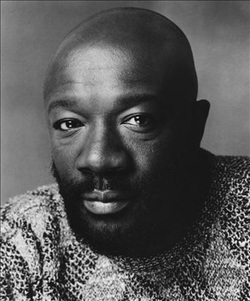 "Find a Grave Memorial ID 28919897" "Find a Grave Memorial ID 28919897"
"Isaac Lee Hayes, Jr. (August 20, 1942–August 10, 2008) was an American songwriter, musician, singer, actor, and voice actor. Hayes was one of the creative influences behind the southern soul music label Stax Records, where he served both as an in-house songwriter and as a record producer, teaming with his partner David Porter during the [mid] 1960s. Hayes, Porter, Bill Withers, the Sherman Brothers, Steve Cropper and John Fogerty were inducted into the Songwriters Hall of Fame in 2005 in recognition of writing scores of notable songs for themselves, the duo Sam & Dave, Carla Thomas, and others. Isaac Hayes, Jr. was born in Covington, Tennessee, in Tipton County. He was the second child of Eula Wade and Isaac Hayes, Sr. After his mother died young and his father abandoned his family, Isaac, Jr., was raised by his maternal grandparents, Mr. and Mrs. Willie Wade, Sr. The child of a sharecropper family, he grew up working on farms in Shelby County, Tennessee and in Tipton County. Hayes dropped out of high school, but his former teachers at Manassas High School in Memphis encouraged him to complete his diploma, which he did at age 21. After graduating from high school, Hayes was offered several music scholarships from colleges and universities. He turned down all of them to provide for his immediate family, working at a meat-packing plant in Memphis by day and playing nightclubs and juke joints several evenings a week in Memphis and nearby northern Mississippi. At age five Hayes began singing at his local church; he taught himself to play the piano, the Hammond organ, the flute, and the saxophone. His first professional gigs, in the late 1950s, were as a singer at Curry's Club in North Memphis, backed by Ben Branch's houseband. Hayes has 12 children, and has 14 grandchildren and three great-grandchildren. His fourth wife, Adjowa, gave birth to a son named Nana Kwadjo Hayes on April 10, 2006. He also had one son and is his namesake, Isaac Hayes III, known as rap producer Ike Dirty. Hayes's eldest daughter is named Jackie also named co-executor of his estate and other children to follow Veronica, Felicia, Melanie, Nikki, Lili, Darius and Vincent and he also had a daughter named Heather Hayes. Hayes's first marriage, in 1960, ended in divorce. Hayes's second marriage was to Emily Ruth Watson on November 24th, 1965. This marriage ended in divorce in 1972. Children from this marriage included Vincent Eric Hayes, Melanie Mia Hayes and Nicole A. Hayes (McGee). He married bank teller Mignon Harley on April 18, 1973, and they divorced in 1986; they had two children. For her wedding gift, Hayes gave her a matching convertible Jaguar. The couple resided in a mansion with maid service. Hayes and his wife were forced into bankruptcy, owing over $6 million. Over the years, Isaac Hayes was able to recover financially. On March 20, 2006, Roger Friedman of Fox News reported that Hayes had suffered a minor stroke in January. Hayes's spokeswoman, Amy Harnell, denied this, but on October 26, 2006, Hayes himself confirmed that he had suffered a stroke. Hayes was found unresponsive in his home located just east of Memphis on August 10, 2008, ten days before his 66th birthday, as reported by the Shelby County, Tennessee Sheriff's Department. A Shelby County Sheriff's deputy and an ambulance from Rural Metro responded to his home after three family members found him unresponsive on the floor next to a still-operating treadmill. Hayes was taken to Baptist Memorial Hospital in Memphis, where he was pronounced dead at 2:08 p.m. The cause of death was not immediately clear, though the area medical examiners later listed a devastating recurrence of stroke as the cause of death. The Tennessee General Assembly enacted legislation in 2010 to honor Hayes by naming a section of Interstate 40 the "Isaac Hayes Memorial Highway." The name was applied to the stretch of highway in Shelby County from Sam Cooper Boulevard in Memphis east to the Fayette County line. The naming was made official at a ceremony held on Hayes's birth anniversary in August 2010."
 "Find a Grave Memorial ID 3735" "Find a Grave Memorial ID 3735"
"Tupac Amaru Shakur (June 16, 1971–September 13, 1996) also known by his stage names 2Pac and briefly as Makaveli, was an American rapper and actor. Shakur has sold over 75 million records worldwide, making him one of the best-selling music artists of all time. MTV ranked him at number two on their list of The Greatest MCs of All Time and Rolling Stone named him the 86th Greatest Artist of All Time. His double disc album All Eyez on Me is one of the best selling hip hop albums of all time. On September 7, 1996, Shakur was shot multiple times in a drive-by shooting at the intersection of Flamingo Road and Koval Lane in Las Vegas, Nevada. He was taken to the University Medical Center of Southern Nevada, where he died six days later. Shakur, according to relatives real name Lesane Parish Crooks, was born on June 16, 1971, in the East Harlem section of Manhattan in New York City. He was named after Túpac Amaru, an 18th-century South American revolutionary who was executed after leading an indigenous uprising against Spanish rule. His mother, Afeni Shakur, and his father, Billy Garland, were active members of the Black Panther Party in New York in the late 1960s and early 1970s. The infant boy was born a month after his mother was acquitted of more than 150 charges of "Conspiracy against the United States government and New York landmarks" in the New York "Panther 21" court case. Shakur lived from an early age with people who were convicted of serious criminal offences and who were imprisoned. His godfather, Elmer "Geronimo" Pratt, a high ranking Black Panther, was convicted of murdering a school teacher during a 1968 robbery, although his sentence was later overturned. His stepfather, Mutulu, spent four years at large on the FBI's Ten Most Wanted Fugitives list beginning in 1982. Mutulu was wanted for having helped his sister Assata Shakur to escape from a penitentiary in New Jersey. She had been imprisoned for killing a state trooper in 1973. Mutulu was caught in 1986 and imprisoned for the robbery of a Brinks armored truck in which two police officers and a guard were killed. Shakur had a half-sister, Sekyiwa, two years his junior, and an older stepbrother, Mopreme "Komani" Shakur, who appeared in many of his recordings. Upon his release from Clinton Correctional Facility in 1995, Shakur immediately went back to song recording. He began a new group called Outlaw Immortalz. Shakur began recording his first album with Death Row and released the single "California Love" soon after. Shakur was a voracious reader. Shakur never professed following a particular religion, but his lyrics in singles such as "Only God Can Judge Me" and poems such as The Rose That Grew from Concrete suggest he believed in God. This means many analysts currently describe him as a deist. He believed in Karma, but rejected a literal afterlife and organized religion. In October 1991, Tupac filed a $10 million civil suit against the Oakland Police Department, alleging they brutally beat him for jaywalking. Shakur received approximately $43,000 in settlement money, much of which went to pay his lawyer."
 “Find a Grave Memorial ID 38746353” “Find a Grave Memorial ID 38746353”
"Michael Joseph Jackson (August 29, 1958–June 25, 2009) was an American singer, songwriter, and dancer. Dubbed the "King of Pop," he was one of the most popular entertainers in the world, and was the best-selling music artist at the time of his death. Jackson's contributions to music, dance, and fashion along with his publicized personal life made him a global figure in popular culture for over four decades. The eighth child of the Jackson family, Michael made his professional debut in 1964 with his elder brothers Jackie, Tito, Jermaine, and Marlon as a member of the Jackson 5. He began his solo career in 1971 while at Motown Records. In the early 1980s, Jackson became a dominant figure in popular music. His music videos, including those of "Beat It,""Billie Jean" and "Thriller" from his 1982 album Thriller, are credited with breaking racial barriers and transforming the medium into an art form and promotional tool. Michael Joseph Jackson was born on August 29, 1958. He was the eighth of ten children in the Jackson family, a working-class African-American family living in a two-bedroom house on Jackson Street in Gary, Indiana, an industrial city in the Chicago metropolitan area. His mother, Katherine Esther Scruse, was a devout Jehovah's Witness. She played clarinet and piano and once aspired to be a country-and-western performer, but worked part-time at Sears to support the family. Michael's father, Joseph Walter "Joe" Jackson, a former boxer, was a steelworker at U.S. Steel. Joe performed on guitar with a local rhythm and blues band, the Falcons, to supplement the family's income. Michael grew up with three sisters (Rebbie, La Toya, and Janet) and five brothers (Jackie, Tito, Jermaine, Marlon, and Randy). A sixth brother, Marlon's twin Brandon, died shortly after birth. It is estimated that Michael Jackson earned about $750 million in his lifetime. Sales of his recordings through Sony's music unit earned him an estimated $300 million in royalties. He may have also earned an additional $400 million from concerts, music publishing (including his share of the Beatles catalog), endorsements, merchandising and music videos. Estimating how much of these earnings Jackson was able to personally pocket is difficult because one has to account for taxes, recording costs and production costs. There have also been several detailed estimates of Jackson's net worth during his life, which range from negative $285 million to positive $350 million for the years 2002, 2003 and 2007. On July 26, 2013, the executors of the Estate of Michael Jackson filed a petition in the United States Tax Court as a result of a dispute with the Internal Revenue Service (IRS) over U. S. federal estate taxes imposed on the value of Jackson's Estate at the time of his death. The executors claim that the Estate was worth about $7 million. The IRS asserts that the Estate was worth over $1.1 billion, and that over $700 million in federal estate taxes (including penalties) are due. A trial was held from February 6 to 24, 2017. As of early July 2017, no decision has been rendered. In 2016, Forbes magazine estimated annual gross earnings by the Jackson Estate at $825 million, the largest ever recorded for a celebrity. The majority was due to the sale of the Sony/ATV catalog. It marked the eighth consecutive year since his death where Jackson's annual earnings were over $100 million."
Source: Wikipedia.org | Thursday, September 14, 2017, 12:00AM 

"Janet Damita Jo Jackson (born May 16, 1966) is an American recording artist and actress. Known for a series of sonically innovative, socially conscious and sexually provocative records, as well as elaborate stage shows, television appearances, and film roles, she has been a prominent figure in popular culture since the early 1970s. Janet Jackson was born in Gary, Indiana, the youngest of ten children, born to ["Katherine Ester Jackson and Joseph Walter Jackson. Katherine, who was born Kattie B. Screws on May 4, 1930 was raised a Baptist, discovered the Jehovah's Witness faith. After her conversion in 1965, all of her children followed her into the faith. While Joseph Walter Jackson, who was brought up in the Lutheran faith, also practiced the religion, it was often said he decided not to convert."] ["Janet"] Jackson stated that although she was raised as a Jehovah's Witness, she eventually stopped practicing organized religion and views her relationship with God as "one-on-one."
|
"Robyn Rihanna Fenty (born February 20, 1988) known by her stage name Rihanna is a Barbadian recording artist, actress, and fashion designer. She was born in Saint Michael, Barbados, and her career began when she met record producer Evan Rogers through mutual friends in late 2003 and recorded demo tapes under Rogers's guidance. Rihanna is known for consistently reinventing her style and image, most notably since her third album Good Girl Gone Bad. Her work has earned her numerous awards and accolades, including seven Grammy Awards, eight American Music Awards, 22 Billboard Music Awards, and two BRIT Awards. She has sold over 30 million albums and 120 million singles worldwide, which makes her one of the best-selling artists of all time. She has achieved thirteen number one singles on the Billboard Hot 100 chart, becoming the youngest and fastest solo artist to achieve the feat. Billboard named her the Digital Songs Artist of the 2000s decade and the top Hot 100 artist of the 2010s decade. In 2012, Forbes ranked her the fourth most powerful celebrity of the year, with earnings of $53 million between May 2011 and May 2012. The same year, TIME named Rihanna one of the 100 Most Influential People in the World. On November 24, 2013, Rihanna was presented with the first ever American Music "Icon" Award. Robyn Rihanna Fenty was born on February 20, 1988, in Saint Michael, Barbados. Her mother is Monica Braithwaite, a retired Afro-Guyanese accountant, and her father is Ronald Fenty, a warehouse supervisor of Barbadian and Irish descent. Rihanna has two brothers, Rorrey and Rajad Fenty, and two half-sisters and a half-brother from her father's side, each born to different mothers from his previous relationships. She grew up in a three-bedroom bungalow in Bridgetown and sold clothes with her father in a stall on the street. Rihanna's childhood was deeply affected by her father's addiction to crack cocaine, alcohol, and marijuana, and her parents' turbulent marriage ended when she was 14. Rihanna grew up listening to reggae music and began singing at around the age of seven. She attended Charles F. Broome Memorial Primary School and Combermere High School, where she formed a musical trio with two of her classmates. Rihanna was an army cadet in a sub-military programme; the singer-songwriter Shontelle was her drill sergeant. Although she initially wanted to graduate from high school, she chose to pursue a musical career instead. Forbes magazine began reporting on Rihanna's earnings in 2012, calculating that she earned $53 million between May 2011 and May 2012, for her music, tour and endorsements. In 2013 Rihanna came in at number thirteen on the list with a total earning of $43 million due to endorsements such as vita coco. Rihanna's total net-worth is an estimated $90 million. From December 2009 to 2010, Rihanna dated Los Angeles Dodgers baseball star Matt Kemp. Canadian rapper Drake has also admitted to dating the singer. In a January 2013 interview with Rolling Stone, Rihanna confirmed that she had rekindled her relationship with Chris Brown, though he remained under probation for the 2009 domestic violence incident. The confirmation followed persistent media speculation throughout 2012 regarding the pair's reunion. In a May 2013 interview, Brown stated that he and Rihanna had broken up again. On May 19, 2021, American rapper ASAP Rocky confirmed during an interview with GQ that he and Rihanna were in a relationship. On January 31, 2022, it was revealed that the couple was expecting their first child. On May 19, 2022, it was confirmed that Rihanna had given birth to a son. On February 12, 2023, during the Super Bowl LVII halftime show performance, Rihanna revealed she is pregnant with her second child, becoming the first person to headline a Super Bowl halftime show while pregnant. The pregnancy was confirmed in a British Vogue cover story featuring her family, which was released days after the Super Bowl appearance."
"Edward Regan Murphy (born April 3, 1961) is an American comedian, actor, writer, singer, director, and musician. Box-office takes from Murphy's films make him the second-highest grossing actor in the United States. He was a regular cast member on Saturday Night Live from 1980 to 1984 and has worked as a stand-up comedian. He was ranked no. 10 on Comedy Central's list of the 100 Greatest Stand-ups of All Time. Murphy grew up in the Brooklyn neighborhood of Bushwick. His mother, Lillian, was a telephone operator, and his father, Charles Edward Murphy, was a transit police officer and an amateur actor and comedian. His father died when he was young. When Murphy's single mother became ill, the eight-year-old and his older brother lived in foster care for one year. In interviews, the actor and comedian says that his time in foster care was influential in developing his sense of humour. Later Murphy and his older brother Charlie were raised in Roosevelt, New York by his mother and stepfather Vernon Lynch, a foreman at an ice cream plant. Around the age of 15, Murphy was writing and performing his own routines, which were heavily influenced by Bill Cosby and Richard Pryor. Murphy is also a singer and musician, having frequently provided background vocals to songs released by The Bus Boys, which their song "The Boys Are Back in Town" was featured in 48 Hrs. and Murphy's comedy special Eddie Murphy Delirious. As a solo artist, Murphy had two hit singles, "Party All the Time" (which was produced by Rick James) and "Put Your Mouth on Me" in the mid-1980s (although he actually started singing earlier in his career, with the songs "Boogie in Your Butt" and "Enough Is Enough," the latter being a parody of Barbra Streisand and Donna Summer's 1979 song, "No More Tears. In 2013 he released his first single in years titled Red Light, a reggae song featuring Snoop Lion. He is also working on a new album titled 9. Murphy began a longtime romantic relationship with Nicole Mitchell after meeting her in 1988 at an NAACP Image Awards show. They lived together for almost two years before getting married at the Grand Ballroom of The Plaza Hotel in New York City on March 18, 1993. Murphy and Mitchell had five children together: Bria L. Murphy, Myles Mitchell, Shayne Audra, Zola Ivy and Bella Zahra. In August 2005, Mitchell filed for divorce, citing "irreconcilable differences." The divorce was finalized on April 17, 2006. He also has a child by Tamara Hood, [a] son Christian Murphy and another child by Paulette McNeely, [a] son Eric Murphy. Murphy as of 2008 resided in Long Island, New York. Following his divorce from Mitchell, in 2006, Murphy began dating former Spice Girl Melanie Brown, who became pregnant and stated that the child was Murphy's. When questioned about the pregnancy in December 2006, by RTL Boulevard, Murphy told Dutch reporter Matthijs Kleyn, "I don't know whose child that is until it comes out and has a blood test. You shouldn't jump to conclusions, sir." Brown gave birth to a baby girl, Angel Iris Murphy Brown, on Murphy's 46th birthday, April 3, 2007. On June 22, 2007, representatives for Brown announced in People that a DNA test had confirmed that Murphy was the father. Brown had stated in an interview that Murphy has not sought a relationship with Angel, although it was later reported in 2010 that Murphy was getting to know her. Murphy exchanged marriage vows with film producer Tracey Edmonds, former wife of Kenneth "Babyface" Edmonds, on January 1, 2008, in a private ceremony on an island off Bora Bora. On January 16, 2008, the couple released a statement saying, "After much consideration and discussion, we have jointly decided that we will forgo having a legal ceremony as it is not necessary to define our relationship further," and called the Bora Bora wedding a "symbolic union." The two had planned on having a legal ceremony upon their return to the U. S. but did not, and their wedding was never official. Murphy has donated money to the AIDS Foundation, cancer, education, creative arts, family/parent support, health and homeless charities."
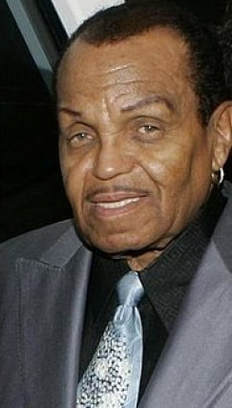 “Find a Grave Memorial ID 190926678” “Find a Grave Memorial ID 190926678”
"Joseph Walter Jackson (July 26, 1928-June 27, 2018) is a talent manager and the father of the Jackson family of entertainers which includes music superstars Michael Jackson and Janet Jackson. Jackson was born to Crystal Lee King and Samuel Jackson, a schoolteacher, in Fountain Hill, Arkansas, on July 26, 1928. Jackson was the eldest of five children, which included sisters Verna Mae and Lula Mae, and brothers Lawrence and Luther. Jackson recalled from early childhood that his father was domineering and strict and he described himself as a "lonely child" in his memoirs, The Jacksons. Jackson's family moved to East Chicago, Indiana while he was still a toddler. At eleven, his parents divorced and for a while he lived with his mother at their East Chicago home with a stepfather. In his teen years, he spent a few years in Oakland where his father relocated. He returned to East Chicago where he eventually began working at East Chicago's Inland Steel Company, where he became an overhead crane operator. He also had a second job at the American Foundries food store. Jackson first became acquainted with Katherine Scruse in 1948. Within a year, the couple married on November 5, 1949. In January 1950, they purchased a three-room house in Gary, Indiana. During the early 1950s, Jackson briefly performed with his own blues band, The Falcons, playing guitar. Despite their efforts, the Falcons failed to get a recording deal and subsequently broke up. Joseph's image as a father became tarnished from the late 1980s onward, as the media reported stories told by his children that he was heavily abusive towards them. When he managed his family, he ordered each of them to call him "Joseph," which contributed to several siblings being estranged from their father. In 2010 while being interviewed by Oprah Winfrey, Katherine again reiterated her denial of the rumors that she and Joseph were separated. Mr. Jackson was inducted into the Rhythm & Blues Music Hall of Fame in 2014. In July 2015, Jackson was rushed into [a] hospital after suffering a stroke and heart arrhythmia while celebrating his birthday in Brazil. He was not stable enough to fly out of the country for further treatment until two weeks later. The stroke reportedly left him temporarily blind. Upon his arrival to Los Angeles, California on August 11, he was treated at the Cedars-Sinai Medical Center to correct his blurred vision following the stroke. In 2011, Jackson was inducted into the Arkansas Black Hall of Fame. In [2014] Jackson accepted the award on behalf of his son Michael, when he was inducted into the Rhythm & Blues Music Hall of Fame with a Lifetime Achievement Award. The following year he was awarded The Rhythm & Blues 2015 Humanitarian Award. In June 2015, Jackson appeared at the BET Awards 2015 with daughter Janet Jackson as she accepted the Ultimate Icon Award. Jackson has had ten children with his wife Katherine Scruse. In January 2017, Jackson's brother Lawrence died. On June 22, 2018, TMZ reported that Jackson was hospitalized in Las Vegas in the final stages of terminal pancreatic cancer. He died five days later."
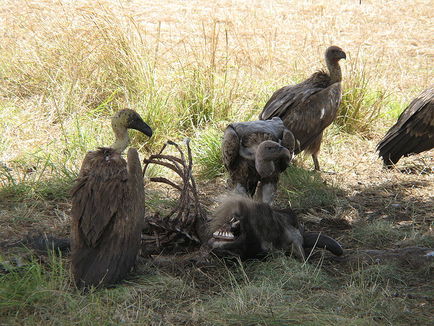
So, without any invite at all, you and the gang just decided to make a call?
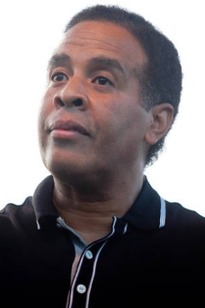
"Stanley Clarke (born June 30, 1951) is an American jazz musician and composer known for his innovative and influential work on double bass and electric bass as well as for his numerous film and television scores. He is best known for his work with the fusion band Return to Forever, and his role as a bandleader in several trios and ensembles. Clarke was born in Philadelphia, Pennsylvania. He was introduced to the bass as a schoolboy when he arrived late on the day instruments were distributed to students and acoustic bass was one of the few remaining selections. He is a graduate of Roxborough High School in Philadelphia. Having graduated from the Philadelphia Musical Academy he moved to New York City in 1971 and began working with famous bandleaders and musicians including Horace Silver, Art Blakey, Dexter Gordon,Gato Barbieri, Joe Henderson, Chick Corea, Pharoah Sanders, Gil Evans and Stan Getz. Clarke was a member of the Church of Scientology, but is no longer involved. In his earlier musical productions would reference L. Ron Hubbard on most of his LP sleeves. During the 1970s he joined the jazz fusion group Return to Forever led by pianist and synth player Chick Corea. The group became one of the most important fusion groups and released several albums that achieved both mainstream popularity and plaudits from critics. The big master piece by Return to forever was the Romantic Warrior with Al Di Meola on the guitar, Lenny white on drums, Chick Corea on all keyboards and Stanley Clarke on bass, released in 1976. Clarke also started his solo career in the early 1970s and released a number of albums under his own name. His most well-known solo album is School Days which, along with Jaco Pastorius's self-titled debut, is one of the most influential solo bass recordings in fusion history. His albums Stanley Clarke and Journey to Love are also notable."
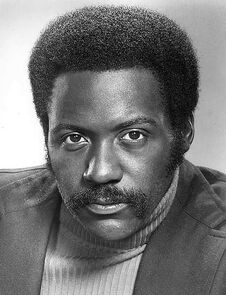 “Find a Grave Memorial ID 260934908” “Find a Grave Memorial ID 260934908”
"Richard Arnold Roundtree (July 9, 1942-October 24, 2023) is an American actor and former fashion model. He is best known for his portrayal of private detective John Shaft in the 1971 film Shaft and in its two sequels, Shaft's Big Score and Shaft in Africa. Born in New Rochelle, New York, Richard Roundtree graduated from New Rochelle High School in 1961 and starred on New Rochelle High's undefeated and nationally ranked football team in 1960. He attended Southern Illinois University Carbondale. Roundtree was diagnosed with the rare disease male breast cancer in 1993 and underwent a double mastectomy and chemotherapy. Roundtree was a leading man in early 1970s blaxploitation films, his best-known role being Detective John Shaft in the hugely popular action movie Shaft. Roundtree also appeared opposite Laurence Olivier and Ben Gazzara in Inchon. On television he played the slave Sam Bennett in the 1977 television series Roots and Dr. Daniel Reubens on Generations from 1989-1991. Prior to becoming an actor, he was a football player and a model. Although Roundtree worked through the 1990s, many of his more recent films were not well-received, but he was able to find success in stage plays. Roundtree was married and divorced twice and had five children. He first got married to Mary Jane Grant in 1963: the couple had two children, before divorcing in December 1973. He dated actress and TV personality Cathy Lee Crosby shortly thereafter. Roundtree later married Karen M. Ciernia in September 1980; they had three children together, before divorcing in 1998. In 1993, Roundtree was diagnosed with breast cancer, and subsequently underwent a double mastectomy and chemotherapy. Roundtree died of pancreatic cancer at his home in Los Angeles on October 24, 2023, at the age of 81."
Source: Wikipedia.org | Thursday, October 26, 2023, 1:11 PM CDT |
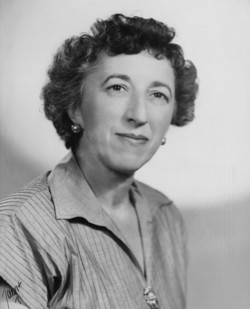 “Find a Grave Memorial ID 3146” “Find a Grave Memorial ID 3146”
"Margaret Brainard Hamilton (December 9, 1902–May 16, 1985) was an American film character actress best known for her portrayal of the Wicked Witch of the West in Metro-Goldwyn-Mayer's classic film The Wizard of Oz. A former schoolteacher, she worked as a character actress in films for seven years before she was offered the role that defined her public image. The Wicked Witch of the West was eventually ranked No. 4 in the American Film Institute's 2003 list of the 50 Best Movie Villains of All Time, making her the top-ranking female villain. In later years, Hamilton made frequent cameo appearances on television sitcoms and commercials. She also gained recognition for her work as an advocate of causes designed to benefit children and animals, and retained a lifelong commitment to public education. Hamilton was born to Walter J. Hamilton, and his wife, Jennie Adams, in Cleveland, Ohio, and was the youngest of four children. She later attended Hathaway Brown School, while the school was located at 1945 East 93rd Street in Cleveland. Drawn to the theater at an early age, Hamilton made her stage debut in 1923. Hamilton also practiced her craft doing children's theater while she was a Junior League of Cleveland member. She later moved to Painesville, Ohio. Before she turned to acting exclusively, her parents insisted that she attend Wheelock College in Boston, which she did, later becoming a kindergarten teacher. Hamilton remained lifelong friends with Wizard of Oz castmate Ray Bolger. She married Paul Boynton Meserve on June 13, 1931, and made her debut on the New York stage the following year. While her acting career developed, her marriage began failing; the couple divorced in 1938. They had one son, Hamilton Wadsworth Meserve whom she raised on her own. She had three grandchildren, Christopher, Scott, and Margaret. Hamilton never remarried. In 1939, Hamilton played the role of the Wicked Witch, opposite Judy Garland's Dorothy Gale in The Wizard of Oz, creating not only her most famous role, but also one of the screen's most memorable villains. Hamilton was cast after Gale Sondergaard, who was first considered for the role, albeit as a more glamorous witch with a musical scene, declined the role when the decision was made that the witch should appear ugly. She suffered a second-degree burn on her face and a third-degree burn on her hand during a second take of her fiery exit from Munchkin land, in which the trap door's drop was delayed to eliminate the brief glimpse of it seen in the final edit. Hamilton had to recuperate in a hospital and at home for six weeks after the accident before returning to the set to complete her work on the now-classic film, and refused to have anything further to do with fire for the rest of the filming. After she recuperated, she said, "I won't sue, because I know how this business works, and I would never work again. I will return to work on one condition—no more fireworks!" Garland visited Hamilton while the latter recuperated at home looking after her son. Hamilton's early experience as a teacher fueled a lifelong interest in educational issues. Hamilton served on the Beverly Hills Board of Education from 1948 to 1951, and was a Sunday school teacher during the 1950s. She lived in Manhattan for most of her adult life. She later moved to Millbrook, New York. She died in her sleep following a heart attack on May 16, 1985, in Salisbury, Connecticut. She was cremated at Poughkeepsie Rural Cemetery. Her ashes were scattered in Amenia, New York."
|
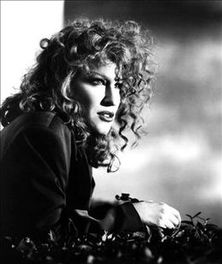
"Bette Midler (born December 1, 1945) also known by her informal stage name, The Divine Miss M, is an American singer-songwriter, actress, comedian, film producer and entrepreneur. In a career spanning almost half a century, Midler has been nominated for two Academy Awards, and won three Grammy Awards, four Golden Globes, three Emmy Awards, and a special Tony Award. She has sold over 30 million albums worldwide. Midler was born in Honolulu, Hawaii. Her parents moved from Paterson, New Jersey to Honolulu before she was born, and hers was one of the few Jewish families in a mostly Asian neighborhood. Her mother, Ruth Schindel, was a seamstress and housewife, and her father, Fred Midler, worked at a Navy base in Hawaii as a painter, and was also a house painter. She was named after actress Bette Davis, though Davis pronounced her first name in two syllables, and Midler uses one. She was raised in Aiea and attended Radford High School, in Honolulu. Midler married artist Martin von Haselberg on December 16, 1984, about six weeks after their first meeting. Their daughter, Sophie Frederica Alohilani Von Haselberg, was born on November 14, 1986 Midler performed on USA for Africa's 1985 fundraising single "We Are the World", and participated at the Live Aid event at JFK Stadium in Philadelphia. Midler relocated to New York City in the summer of 1965, using money from her work in the film Hawaii. She landed her first professional onstage role in Tom Eyen's Off-Off-Broadway plays in 1965, Miss Nefertiti Regrets and Cinderella Revisited, a children's play by day and an adult show by night. Midler founded the New York Restoration Project in 1995, a non-profit organization with the goal of revitalizing neglected neighborhood parks in economically disadvantaged neighborhoods of New York City. These include Highbridge Park, Fort Washington Park, and Fort Tryon Park in upper Manhattan and Roberto Clemente State Park and Bridge Park in the Bronx."
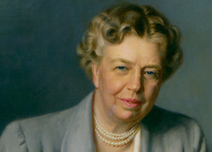 "Find a Grave Memorial ID 896" "Find a Grave Memorial ID 896"
"Anna Eleanor Roosevelt (October 11, 1884–November 7, 1962) was an American politician. She was the longest-serving First Lady of the United States, holding the post from March 1933 to April 1945 during her husband President Franklin D. Roosevelt's four terms in office. President Harry S. Truman later called her the "First Lady of the World" in tribute to her human rights achievements. A member of the Roosevelt and Livingston families, Eleanor had an unhappy childhood, suffering the deaths of both parents and one of her brothers at a young age. At 15, she attended Allenwood Academy in London, and was deeply influenced by its feminist head mistress Marie Souvestre. Returning to the US, she married her fifth cousin, Franklin Delano Roosevelt, in 1905. The Roosevelt’s' marriage was complicated from the beginning by Franklin's controlling mother, Sara, and after discovering Franklin's affair with Lucy Mercer in 1918, Eleanor resolved to seek fulfillment in a public life of her own. Eleanor Roosevelt was born at 56 West 37th Street in New York City, to socialites Elliott Bulloch Roosevelt and Anna Rebecca Hall. From an early age, she preferred to be called by her middle name Eleanor. Through her father, she was a niece of President Theodore "T. R." Roosevelt, Jr. Through her mother, she was a niece of tennis champions Valentine Gill "Vallie" Hall III and Edward Ludlow Hall. She acted in such an old-fashioned manner as a child that her mother nicknamed her "Granny." Despite becoming pregnant and giving birth six times, Eleanor disliked sex. She once told her daughter Anna that it was an "ordeal to be borne." She also considered herself ill-suited to motherhood, later writing, "It did not come naturally to me to understand little children or to enjoy them. In April 1960, Roosevelt was diagnosed with a plastic anemia. In 1962, she was given steroids which activated a dormant case of bone marrow tuberculosis. Roosevelt died of resulting cardiac failure at her Manhattan home at 55 East 74th Street on the Upper East Side on November 7, 1962, at the age of 78. President John F. Kennedy and former Presidents Truman and Eisenhower attended Roosevelt's funeral at Hyde Park."
|

"Carrie Ann Inaba (born January 5, 1968) is an American dancer, choreographer, television dance competition judge, actress, game show host, and singer. She started her career as a singer in Japan, but became best known for her dancing, first introducing herself to American audiences as one of the original Fly Girls on the sketch comedy series In Living Color. She has appeared as one of three, later four judges on the ABC television series Dancing with the Stars. Inaba was born and raised in Honolulu, Hawaii, graduating from Punahou School in 1986. She is of Chinese, Japanese, and Irish descent. She attended Sophia University and University of California, Irvine before graduating from the University of California, Los Angeles with a B. A. degree in world arts and cultures. Inaba is the founder and President of EnterMediArts, Inc., a video production company. She directs, writes, and edits films. Inaba dated Artem Chigvintsev, a dancer and former So You Think You Can Dance contestant, from 2006 to 2008. On the March 31, 2011 episode of Live with Regis and Kelly, Regis Philbin was "answering" a letter asking for advice on how to propose. The lights dimmed just before Inaba's boyfriend, Jesse Sloan, appeared on stage. With violinists playing in the background, Sloan, bent on one knee, asked for Inaba's hand, to which she responded "Yes! I will marry you!" Inaba and Jesse met on online dating site eHarmony. In an interview with US Weekly in 2011, Inaba stated that she and Sloan would marry in the summer of that year. In September 2012, a representative for Dancing with the Stars announced that Inaba and Sloan had amicably ended their engagement. In a 2011 interview with Prevention, Inaba claims that she is legally blind, having a vision of 20/750 which is corrected with glasses and contact lenses. The American Foundation for the Blind defines legal blindness as vision worse than 20/200 with the best possible correction (even with glasses) She also revealed that she suffers from spinal stenosis. Inaba has expressed a great love and respect for animals, supporting organizations such as the Humane Society of the United States and PETA, and launching the Carrie Ann Animal Foundation in 2012."
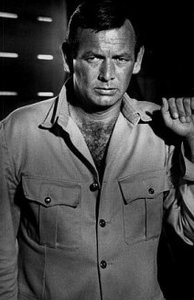 "Find a Grave Memorial ID 1672" "Find a Grave Memorial ID 1672"
"David Janssen (March 27, 1931–February 13, 1980) was an American film and television actor who is best known for his starring role as Dr. Richard Kimble in the television series The Fugitive. Janssen was born as David Harold Meyer in Naponee, a village in Franklin County in southern Nebraska, to Harold Edward Meyer, a banker and Berniece Graf. Janssen was of Irish and Jewish descent. Following his parents' divorce in 1935, his mother moved with five-year-old David to Los Angeles, California, and later married Eugene Janssen in 1940 in Los Angeles. Young David used his stepfather's name after he entered show business as a child. He attended Fairfax High School in Los Angeles. His first film part was at the age of thirteen, and by the age of twenty-five he had appeared in twenty films and served two years as an enlisted man in the United States Army. During his Army days, Janssen became friends with fellow enlistees Martin Milner and Clint Eastwood while posted at Fort Ord, California. The final episode of The Fugitive held the record for the greatest number of American homes with television sets to watch a series finale, at 72 percent in August 1967. Janssen was married twice. His first marriage was to model and interior decorator Ellie Graham, whom he married in Las Vegas on August 25, 1958. They divorced in 1968. In 1975, he married actress and model Dani Crayne Greco. They remained married until Janssen's death. Janssen died of a heart attack on February 13, 1980, at his home in Malibu, California. At the time of his death, Janssen was filming the television movie Father Damien. Janssen was buried at the Hillside Memorial Park Cemetery in Culver City, California. A non-denominational funeral was held at the Jewish chapel of the cemetery on February 17. Suzanne Pleshette delivered the eulogy at the request of Janssen's widow. Johnny Carson, Rod Stewart and Gregory Peck were among Janssen's pallbearers. Honorary pallbearers included Jack Lemmon, George Peppard, James Stewart and Danny Thomas. Los Angeles coroner Thomas Noguchi reportedly found high levels of morphine, cocaine, and alcohol in Janssen's body. For his contribution to the television industry, David Janssen has a star on the Hollywood Walk of Fame located on the 7700 block of Hollywood Boulevard."
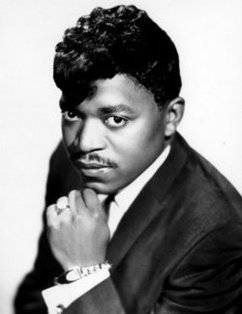 “Find a Grave Memorial ID 144998457” “Find a Grave Memorial ID 144998457”
"Percy Tyrone Sledge (November 25, 1940-April 14, 2015) Sledge was an African American R&B, soul, gospel, and traditional pop singer. He is best known for the song "When a Man Loves a Woman," a No. 1 hit on both the Billboard Hot 100 and R&B singles charts in 1966. It was awarded a million-selling, Gold-certified disc from the RIAA. Having previously worked as a hospital orderly in the early 1960s, Sledge achieved his strongest success in the late 1960s and early 1970s with a series of emotional soul songs. In later years, Percy received the Rhythm and Blues Foundation's Career Achievement Award. He was inducted into the Rock & Roll Hall of Fame in 2005. Sledge was born on November 25, 1940 in Leighton, Alabama. He worked in a series of agricultural jobs in the fields in Leighton before taking a job as an orderly at Colbert County Hospital in Sheffield, Alabama. Through the mid-1960s, he toured the Southeast with the Esquires Combo on weekends, while working at the hospital during the week. A former patient and mutual friend of Sledge and record producer Quin Ivy introduced the two. An audition followed, and Sledge was signed to a recording contract. Sledge's soulful voice was perfect for the series of soul ballads produced by Ivy and Marlin Greene, which rock critic Dave Marsh called "emotional classics for romantics of all ages." "When a Man Loves a Woman" was Sledge's first song recorded under the contract, and was released in March 1966. According to Sledge, the song's inspiration came when his girlfriend left him for a modeling career after he was laid off from a construction job in late 1965, and, because bassist Calvin Lewis and organist Andrew Wright helped him with the song, he gave all the songwriting credits to them. It reached No. 1 in the US and went on to become an international hit. "When a Man Loves a Woman" was a hit twice in the UK, reaching No. 4 in 1966 and, on reissue, peaked at No. 2 in 1987. The song was also the first gold record released by Atlantic Records. Sledge charted with "I'll Be Your Everything" and "Sunshine" during the 1970s, and became an international concert favorite throughout the world, especially in the Netherlands, Germany, and on the African continent; he averaged 100 concerts a year in South Africa. In May 2007, Percy was inducted into The Louisiana Music Hall Of Fame in his home city of Baton Rouge, LA. Sledge married twice and was survived by his second wife, Rosa Sledge, whom he married in 1980. He had 12 children, two of whom became singers. Sledge died of liver cancer at his home in Baton Rouge on April 14, 2015 at the age of 74."
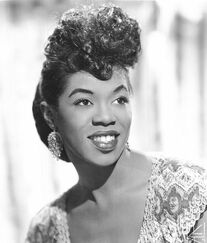 “Find a Grave Memorial ID 2224” “Find a Grave Memorial ID 2224”
"Sarah Lois Vaughan (March 27, 1924–April 3, 1990) was an American jazz singer. Nicknamed "Sassy" and "The Divine One," she won four Grammy Awards, including the Lifetime Achievement Award. She was given an NEA Jazz Masters Award in 1989. Critic Scott Yanow wrote that she had "one of the most wondrous voices of the 20th century." Vaughan's father, Asbury "Jake" Vaughan, was a carpenter by trade and played guitar and piano. Her mother, Ada Vaughan, was a laundress who sang in the church choir. The Vaughans lived in a house on Brunswick Street in Newark for Vaughan's entire childhood. Jake was deeply religious. The family was active in New Mount Zion Baptist Church at 186 Thomas Street. Vaughan began piano lessons at age 7, sang in the church choir, and played piano for rehearsals and services. She developed an early love for popular music on records and the radio. In the 1930s, she frequently saw local and touring bands at the Montgomery Street Skating Rink. By her mid-teens, she began venturing illegally into Newark's night clubs and performing as a pianist and singer at the Piccadilly Club and the Newark Airport. Vaughan attended East Side High School, then transferred to Newark Arts High School, which opened in 1931. As her nocturnal adventures as a performer overwhelmed her academic pursuits, she dropped out of high school during her junior year to concentrate on music. Vaughan was married three times: to George Treadwell, to Clyde Atkins and to Waymon Reed. Unable to bear children, Vaughan adopted a baby girl (Debra Lois) in 1961. Debra worked in the 1980s and 1990s as an actress under the name Paris Vaughan. In 1977, Vaughan ended her personal and professional relationship with Marshall Fisher. Although Fisher is occasionally referenced as Vaughan's third husband, they were never legally married. Vaughan began a relationship with Waymon Reed, a trumpet player 16 years her junior who was playing with the Count Basie band. Reed joined her working trio as a musical director and trumpet player, and became her third husband in 1978. She was a member of the Zeta Phi Beta sorority. In 1989, Vaughan's health began to decline, although she rarely revealed any hints of this in her performances. She canceled a series of engagements in Europe in 1989, citing the need to seek treatment for arthritis of the hand, although she was able to complete a series of performances in Japan. During a run at New York's Blue Note Jazz Club in 1989, she was diagnosed with lung cancer and was too ill to finish the last day of what would turn out to be her final series of public performances. Vaughan returned to her home in California to begin chemotherapy and spent her final months alternating stays in the hospital and at home. She grew weary of the struggle and demanded to be taken home, where at the age of 66 she died on the evening of April 3, 1990, while watching a television movie featuring her daughter. Her funeral was held at Mount Zion Baptist Church, 208 Broadway in Newark, New Jersey. Following the ceremony, a horse-drawn carriage transported her body to Glendale Cemetery, Bloomfield in New Jersey."
Source: Wikipedia.org | Monday, April 1, 2019, 12:00 PM CDT 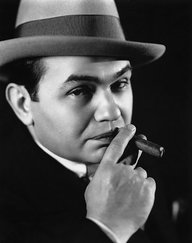 “Find a Grave Memorial ID 880” “Find a Grave Memorial ID 880”
"Edward Goldenberg Robinson, born Emanuel Goldenberg (December 12, 1893–January 26, 1973) was a Romanian-born American actor. A popular star on stage and screen during Hollywood's Golden Age, he appeared in 40 Broadway plays and more than 100 films during a 50-year career. He is best remembered for his tough-guy roles as a gangster, such as his star-making film Little Caesar and Key Largo. During the 1930s and 1940s, he was an outspoken public critic of fascism and Nazism which was then growing in Europe. His activism included contributing over $250,000 to more than 850 organizations involved in war relief, along with cultural, educational and religious groups. During the 1950s, he was called to testify at the House Un-American Activities Committee during the Red Scare, but was cleared of any Communist involvement. Robinson's character portrayals have covered a wide range, with such roles as an insurance investigator in the film noir Double Indemnity, Dathan in The Ten Commandments, and his final performance in the science-fiction story Soylent Green. Robinson received an Honorary Academy Award for his work in the film industry, which was posthumously awarded two months after the actor's death in 1973. He is ranked #24 in the American Film Institute's list of the 25 greatest male stars of Classic American cinema. Robinson was born as Emanuel Goldenberg to a Yiddish-speaking Romanian Jewish family in Bucharest, the son of Sarah Guttman and Morris Goldenberg, a builder. After one of his brothers was attacked by an anti-semitic mob, the family decided to emigrate to the United States. Robinson arrived in New York City on February 14, 1903. "At Ellis Island I was born again," he wrote. "Life for me began when I was 10 years old." He grew up on the Lower East Side, had his Bar Mitzvah at First Roumanian-American Congregation, and attended Townsend Harris High School and then the City College of New York, planning to become a criminal attorney. An interest in acting and performing in front of people led to him winning an American Academy of Dramatic Arts scholarship, after which he changed his name to Edward G. Robinson, the G. standing for his original surname. He served in the US Navy during World War I, but was never sent overseas. Robinson married his first wife, stage actress Gladys Lloyd, born Gladys Lloyd Cassell, in 1927; she was the former wife of Ralph L. Vestervelt and the daughter of Clement C. Cassell, an architect, sculptor and artist. The couple had one son, Edward G. Robinson, Jr., as well as a daughter from Gladys Robinson's first marriage. In 1956 he was divorced from his wife. In 1958 he married Jane Bodenheimer, a dress designer professionally known as Jane Arden. Thereafter he also maintained a home in Palm Springs, California. In noticeable contrast to many of his onscreen characters, Robinson was a sensitive, softly-spoken and cultured man, who spoke seven languages. Remaining a liberal Democrat despite his difficulties with HUAC, he attended the 1960 Democratic Convention in Los Angeles, California. He was a passionate art collector, eventually building up a significant private collection. In 1956, however, he was forced to sell his collection to pay for his divorce settlement with Gladys Robinson; his finances had also suffered due to underemployment in the early 1950s. Robinson died at Mount Sinai Hospital in Los Angeles of bladder cancer in 1973. Services were held at Temple Israel in Los Angeles where Charlton Heston delivered the eulogy. Over 1,500 friends of Robinson attended, with another crowd of 500 people outside. His body was then flown to New York where it was entombed in a crypt in the family mausoleum at Beth-El Cemetery in Brooklyn. In October 2000, Robinson's image was imprinted on a U. S. postage stamp, its sixth in its Legends of Hollywood series."
|

"Ferocactus species, a cactoid, in its native Arizona habitat"
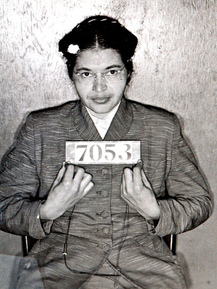 “Find a Grave Memorial ID 12149998” “Find a Grave Memorial ID 12149998”
"Rosa Louise McCauley Parks (February 4, 1913–October 24, 2005) Rosa Parks was born Rosa Louise McCauley in Tuskegee, Alabama, on February 4, 1913, to Leona Edwards, a teacher, and James McCauley, a carpenter. She was of African ancestry, though one of her great-grandfathers was Scots-Irish and one of her great-grandmothers was a slave of Native American descent. She was small as a child and suffered poor health with chronic tonsillitis. When her parents separated, she moved with her mother to Pine Level, just outside the state capital, Montgomery. She grew up on a farm with her maternal grandparents, mother, and younger brother Sylvester. They all were members of the African Methodist Episcopal Church, a century-old independent black denomination founded by free blacks in Philadelphia in the early nineteenth century. "The modern American civil rights movement is generally considered to have started on 01 December 1955. That was the day that a black woman from Alabama refused to give up her seat on a city bus to a white passenger. Her name—Rosa Parks—is now an important part of American history and she is one of many to serve as a pioneer for the civil rights movement. Along with Rosa Parks, we have census documents for Medgar Evers and Martin Luther King. Rosa Parks was born Rosa Louise McCauley on 04 Feb 1913 at Tuskegee, Alabama. She was the daughter of James and Leona McCauley. On Thursday, 01 Dec 1955, 42-year old Mrs. Parks, a seamstress in Montgomery, Alabama, refused to give up her bus seat to a white passenger and in so doing launched the modern civil rights movement in the United States. Following her death on 24 Oct 2005, at the age of 92, Rosa Parks became the first woman in history to lie in state at the U. S. Capitol building." "Civil Rights Pioneer and Social Activist. An African-American working woman, she became most famous for her refusal in 1955 to give up a bus seat to a white man who was getting on the bus, an incident that led to her arrest and inspired Dr. Martin Luther King, Jr to led the Montgomery, Alabama bus boycott, one of his first Civil Rights actions. Because of this action, she was called the "Mother of the Modern Civil Rights Movement." She was also the first woman to ever lie in state in the United States Capitol, and the United States Flag was flown at half-staff in her honor over all public buildings on the day of her funeral. Born Rosa Louise McCauley in Tuskegee, Alabama, she was the daughter of James and Leona McCauley, a carpenter and a school teacher. When her parents separated, she moved with her mother to Pine Level, Alabama, outside Montgomery, where she grew up on a farm. Initially home schooled, she enrolled in the Industrial School for Girls in Montgomery when she was 11, later dropping out to care for her ill mother and grandmother. In 1932, she married Raymond Parks, a barber, who helped her earn her high school diploma. Raymond was a member of the NAACP, which she later joined in 1943, becoming elected secretary of the local Montgomery chapter. In 1944, she worked at Maxwell Air Force Base, where segregation was not permitted in federal facilities, and it made her realize that racial integration was possible. In 1955, Rosa was not the first African-American to refuse to give up her seat to a white person; however, it was her refusal that sparked the Civil Rights movement into becoming a significant movement for creating change in America. Parks was fined $10 plus $4 in court costs for violating local city law, and immediately, with civil rights movement support, appealed her conviction. The bus boycott lasted 381 days, and placed Dr. Martin Luther King firmly into the national headlines. In January 1956, a lawsuit entered into federal court against the city of Montgomery struck down the city law as unconstitutional, forcing integration on the buses, and with that ruling the bus boycott ended. After her arrest, Rosa became famous in the growing civil rights movement, however, she was fired from her job. In 1957, she and Raymond moved to Hampton, Virginia, both to find work and because of disagreements with Dr. King and other leaders over civil rights strategy. After several months in Virginia, they moved to Detroit, Michigan, where she worked as a seamstress, until Congressman John Conyers hired her in 1965 to work as his secretary. She continued to work for him until 1988, when she retired. Her husband died in 1977 from cancer. In 1992, she published her autobiography, "Rosa Parks: My Story," and in 1995, published a revised autobiography, "Quiet Strength." She died in her apartment in a Detroit nursing home at the age of 92. She was the 31st person, the first woman, and the second African-American to lie in state in the Capitol Rotunda. She was interred next to her husband and her mother at the Detroit Woodlawn Cemetery's mausoleum. She has been the recipient of numerous honors and awards, including a Congressional Gold Medal, the Presidential Medal of Freedom, and the Alabama Governor's Medal of Honor for Extraordinary Courage, in addition to over two dozen honorary doctorate degrees from various universities and colleges."
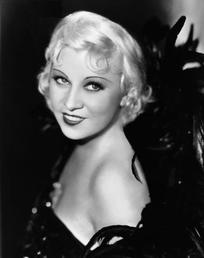 “Find a Grave Memorial ID 1089” “Find a Grave Memorial ID 1089”
"Mary Jane West (August 17, 1893–November 22, 1980) was an American actress, singer, playwright, screenwriter, comedian, and sex symbol whose entertainment career spanned seven decades, well-known for her lighthearted bawdy double entendres and breezy sexual independence. West made a name for herself in vaudeville and on the stage in New York City before moving to Hollywood to become a comedian, actress and writer in the motion picture industry, as well as appearing on radio and television. The American Film Institute named her 15th among the greatest female stars of classic American cinema. West was one of the more controversial movie stars of her day and encountered many problems, especially censorship. She bucked the system, making comedy out of conventional mores, and the Depression-era audience admired her for it. When her cinematic career ended, she wrote books and plays and continued to perform in Las Vegas, in the United Kingdom, on radio and television and to record rock and roll albums. She was once asked about the various efforts to impede her career, to which she replied: "I believe in censorship. I made a fortune out of it." Mary Jane West was born to Protestant parents in the Greenpoint section of Kings County, New York later Brooklyn, New York after NYC was consolidated in 1898, on August 17, 1893. She was delivered at home by an aunt who was a midwife. She was the eldest surviving child of John Patrick West and Matilda Delker. West's parents married on January 18, 1889, in Brooklyn, to the pleasure of the groom's parents and the displeasure of the bride's parents and raised their children as Protestants, although John West was of mixed Catholic–Protestant descent and Tillie was of at least partial Jewish descent. West's father was a prizefighter known as "Battlin' Jack West" who later worked as a "special policeman" and later had his own private investigations agency. Her mother was a former corset and fashion model. Her paternal grandmother, Mary Jane Copley, for whom she was named, was of Irish Catholic descent and West's paternal grandfather, John Edwin West, was of English–Scots descent and a ship's rigger. Her eldest sibling, Katie, died in infancy. During her childhood, West's family moved to various parts of Woodhaven, as well as the Williamsburg and Greenpoint neighborhoods of Brooklyn. In Woodhaven, at Neir's Social Hall West supposedly first performed professionally. Mae West was a shrewd investor, produced her own stage acts, and invested her money in large tracts of land in Van Nuys, a thriving suburb of Los Angeles. With her considerable fortune, she could afford to do as she liked. West had a relationship with James Timony in 1916 when she was a vaudeville actress, an attorney 15 years her senior. Timony was also her manager. By the time that she was an established movie actress in the mid-1930s, they were no longer a couple. West and Timony remained extremely close, living in the same building, working together, and providing support for each other until Timony's death in 1954. She became romantically involved at age 61 with one of the muscle men in her Las Vegas stage show named Chester Rybinski, a wrestler, former Mr. California, and former merchant marine. He was 30 years younger than she, and later changed his name to Paul Novak. He moved in with her, and their romance continued until her death in 1980 at age 87. Novak once commented, "I believe I was put on this Earth to take care of Mae West." West was a Presbyterian and her funeral was held at the First Presbyterian Church in Beverly Hills, California."
Source: Wikipedia.org, Sunday, April 22, 2018, 2:00AM 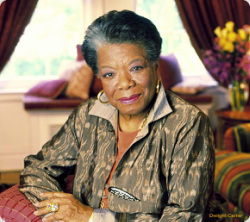 "Find a Grave Memorial ID 130492881" "Find a Grave Memorial ID 130492881"
"Marguerite Ann Johnson (April 4, 1928-May 28, 2014) Maya Angelou who was born Marguerite Ann Johnson is an American author and poet. She has published six autobiographies, five books of essays, several books of poetry, and is credited with a list of plays, movies, and television shows spanning more than fifty years. She has received dozens of awards and over thirty honorary doctoral degrees. Angelou is best known for her series of autobiographies, which focus on her childhood and early adult experiences. In 1968, Martin Luther King asked Angelou to organize a march. She agreed, but "postpones again," and in what Gillespie calls "a macabre twist of fate," he was assassinated on her 40th birthday (April 4) The first, I Know Why the Caged Bird Sings (1969) tells of her life up to the age of seventeen, and brought her international recognition and acclaim. Marguerite Johnson was born in St. Louis, Missouri, on April 4, 1928, the second child of Bailey Johnson, a doorman and a navy dietitian, and Vivian (Baxter) Johnson, a nurse and card dealer. Angelou's older brother, Bailey Jr., nicknamed Marguerite "Maya," shortened from "My" or "Mya Sister." When Angelou was three, and her brother four, their parents' "calamitous marriage" ended. Their father sent them to Stamps, Arkansas, alone by train to live with their paternal grandmother, Annie Henderson. In "an astonishing exception" to the harsh economics of African Americans of the time, Angelou's grandmother prospered financially during the Great Depression and World War II because the general store she owned sold needed basic commodities and because "she made wise and honest investments." Evidence suggests that Angelou was partially descended from the Mende people of West Africa. Angelou died on the morning of May 28, 2014, according to a family statement. She was found by her caregiver. She had reportedly been in poor health and had canceled recent scheduled appearances."
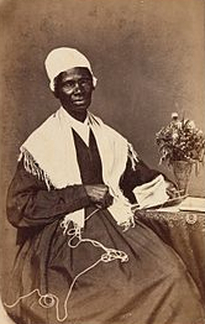 "Find a Grave Memorial ID 1044" "Find a Grave Memorial ID 1044"
"Sojourner Truth (born Isabella Baumfree c. 1797–November 26, 1883) was an African American abolitionist and women's rights activist. Truth was born into slavery in Swartekill, Ulster County, New York, but escaped with her infant daughter to freedom in 1826. After going to court to recover her son, in 1828 she became the first black woman to win such a case against a white man. She gave herself the name Sojourner Truth in 1843. Her best-known speech was delivered extemporaneously, in 1851, at the Ohio Women's Rights Convention in Akron, Ohio. The speech became widely known during the Civil War by the title "Ain't I a Woman?" a variation of the original speech re-written by someone else using a stereotypical Southern dialect; whereas Sojourner Truth was from New York and grew up speaking Dutch as her first language. During the Civil War, Truth helped recruit black troops for the Union Army; after the war, she tried unsuccessfully to secure land grants from the federal government for former slaves. In 2014, Truth was included in Smithsonian magazine's list of the "100 Most Significant Americans of All Time." Truth was one of the ten or twelve children born to James and Elizabeth Baumfree or Bomefree. Colonel Hardenbergh bought James and Elizabeth Baumfree from slave traders and kept their family at his estate in a big hilly area called by the Dutch name Swartekill in the town of Esopus, New York, 95 miles north of New York City. Charles Hardenbergh inherited his father's estate and continued to enslave people as a part of that estate's property. When Charles Hardenbergh died in 1806, nine-year-old Truth was sold at an auction with a flock of sheep for $100 to John Neely, near Kingston, New York. Until that time, Truth spoke only Dutch. Around 1815, Truth met and fell in love with a slave named Robert from a neighboring farm. Robert's owner Charles Catton, Jr., a landscape painter forbade their relationship; he did not want the people he enslaved to have children with people he was not enslaving, because he would not own the children. One day Robert sneaked over to see Truth. When Catton and his son found him, they savagely beat Robert until Dumont finally intervened, and Truth never saw Robert again. He later died as a result of the injuries, and the experience haunted Truth throughout her life. Several days before Sojourner Truth died, a reporter came from the Grand Rapids Eagle to interview her. "Her face was drawn and emaciated and she was apparently suffering great pain. Her eyes were very bright and mind alert although it was difficult for her to talk." Truth died at her Battle Creek home on November 26, 1883. On November 28 her funeral was held at the Congregational-Presbyterian Church officiated by its pastor, the Reverend Reed Stuart. Some of the prominent citizens of Battle Creek acted as pall-bearers. Truth was buried in the city's Oak Hill Cemetery. On April 20, 2016 Treasury Secretary Jacob Lew announced that several denominations of United States currency would be redesigned prior to 2020, the 100th anniversary of the 19th Amendment. The newly designed $10 bill will include images which will pay homage to the women's suffrage movement and feature the images of Truth, Lucretia Mott, Susan B. Anthony, Elizabeth Cady Stanton, and Alice Paul."
|
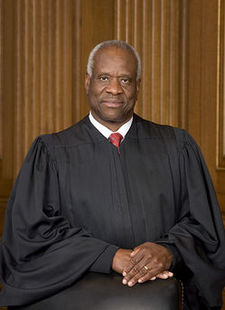
"Clarence Thomas (born June 23, 1948) is an Associate Justice of the Supreme Court of the United States. Succeeding Thurgood Marshall, Thomas is the second African American to serve on the Court. On July 1, 1991, after 16 months of service as a judge, Thomas was nominated by Bush to fill Marshall's seat on the United States Supreme Court. Thomas's confirmation hearings were bitter and intensely fought, centering on an accusation that he had made unwelcome sexual comments to attorney Anita Hill, a subordinate at the Department of Education and subsequently at the EEOC. The U. S. Senate ultimately confirmed Thomas by a vote of 52–48. Clarence Thomas was born in 1948 in Pin Point, Georgia, a small, predominantly black community founded by freedmen after the American Civil War. When he was a child, the town lacked a sewage system and paved roads. He was the second of three children born to M. C. Thomas, a farm worker, and Leola Williams, a domestic worker. They were descendants of American slaves, and the family spoke Gullah as a first language. Thomas's first-known ancestors were slaves named Sandy and Peggy who were born around the end of the 18th century and owned by wealthy Liberty County, Georgia planter Josiah Wilson. M. C. Thomas left his family when Thomas was two years old. Thomas's mother worked hard but was sometimes paid only pennies per day. She had difficulty putting food on the table and was forced to rely on charity. After a house fire left them homeless, Thomas and his younger brother Myers were taken to live with his mother's parents in Savannah, Georgia. Thomas was seven when the family moved in with his maternal grandfather, Myers Anderson, and Anderson's wife, Christine Hargrove, in Savannah. Living with his grandparents, Thomas enjoyed amenities such as indoor plumbing and regular meals for the first time in his life. His grandfather Myers Anderson had little formal education, but had built a thriving fuel oil business that also sold ice.Thomas was the only black person at his high school in Savannah, where he was an honor student. He was raised Roman Catholic. Toward the end of the confirmation hearings, an FBI interview with Anita Hill was leaked. Hill, an attorney, had worked for Thomas at the Department of Education and had subsequently moved with Thomas to the EEOC. After the leak, Hill was called to testify at Thomas's confirmation hearings. She testified that Thomas had subjected her to comments of a sexual nature, which she felt constituted sexual harassment or at least "behavior that is unbefitting an individual who will be a member of the Court." Hill's testimony included lurid details, and some Senators aggressively questioned her. Thomas denied the allegations, saying: "This is not an opportunity to talk about difficult matters privately or in a closed environment. This is a circus. It's a national disgrace. And from my standpoint, as a black American, it is a high-tech lynching for uppity blacks who in any way deign to think for themselves, to do for themselves, to have different ideas, and it is a message that unless you kowtow to an old order, this is what will happen to you. You will be lynched, destroyed, caricatured by a committee of the U. S. Senate rather than hung from a tree."
|
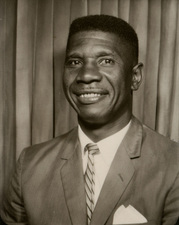 "Find a Grave Memorial ID 322" "Find a Grave Memorial ID 322"
"Medgar Wiley Evers (July 2, 1925–June 12, 1963) was an African-American civil rights activist from Mississippi involved in efforts to overturn segregation at the University of Mississippi. After returning from overseas military service in World War II and completing his secondary education, he became active in the civil rights movement. He became a field secretary for the NAACP. Evers was assassinated by Byron De La Beckwith, a member of the White Citizens' Council. As a veteran, Evers was buried with full military honors at Arlington National Cemetery. His murder and the resulting trials inspired civil rights protests, as well as numerous works of art, music, and film. Evers was born July 2, 1925, in Decatur, Mississippi, third of the five children including older brother Charlie Evers, [born] of Jesse Wright and James Evers; the family also included Jesse's two children from a previous marriage. The Everses owned a small farm and James worked at a sawmill. Evers walked twelve miles to go to school, and earned his high school diploma. From 1943 to 1945 he fought in the European Theater and the Battle of Normandy with the United States Army during World War II, and was discharged honorably as a sergeant. In 1948 Evers enrolled at Alcorn College majoring in business administration. He also competed on the debate, football, and track teams, sang in the choir, and was junior class president. He earned his Bachelor of Arts in 1952. On December 24, 1951, he married classmate Myrlie Beasley. Together they had three children: Darrell Kenyatta, Reena Denise, and James Van Dyke. Darrell died in February 2001 of colon cancer. Evers applied to the then-segregated University of Mississippi Law School in 1954 but his application was rejected. He submitted his application in concert with the NAACP as a test case. In late 1954 Evers was named the NAACP's first field secretary for Mississippi. In this position, he helped organize boycotts and set up new local chapters of the NAACP. He was involved with James Meredith's efforts to enroll in the University of Mississippi in the early 1960s. Evers also helped Dr. Gilbert Mason, Sr., organize the Biloxi Wade-Ins, protests against segregation efforts on the Mississippi Gulf Coast beaches. Evers’ civil rights leadership and investigative work made him a target of white supremacists. In the weeks leading up to his death, the hostility directed towards him grew. His public investigations into the murder of Emmett Till and his vocal support of Clyde Kennard had made him a prominent black leader. On May 28, 1963, a Molotov cocktail was thrown into the carport of his home. On June 7, 1963, Evers was nearly run down by a car after he emerged from the Jackson NAACP office. In the early morning of June 12, 1963, just hours after President John F. Kennedy's speech on national television in support of civil rights, Evers pulled into his driveway after returning from a meeting with NAACP lawyers. Emerging from his car and carrying NAACP T-shirts that read "Jim Crow Must Go," Evers was struck in the back with a bullet fired from an Enfield 1917 rifle; the bullet ripped through his heart. He staggered 30 feet before collapsing. He was taken to the local hospital in Jackson where he was initially refused entry because of his color, until it was explained who he was; he died in the hospital 50 minutes later. Mourned nationally, Evers was buried on June 19 in Arlington National Cemetery, where he received full military honors before a crowd of more than 3,000. On June 21, 1963, Byron De La Beckwith, a fertilizer salesman and member of the White Citizens' Council and later of the Ku Klux Klan was arrested for Evers' murder. District Attorney and future governor Bill Waller prosecuted De La Beckwith. Juries composed solely of white men twice that year deadlocked on De La Beckwith's guilt. In 1994, 30 years after the two previous trials had failed to reach a verdict, De La Beckwith was brought to trial based on new evidence. Bobby DeLaughter was the prosecutor. During the trial, the body of Evers was exhumed from his grave for an autopsy. De La Beckwith was convicted of murder on February 5, 1994, after having lived as a free man for much of the three decades following the killing. [H]e was imprisoned from 1977 to 1980 for conspiring to murder A. I. Botnick. De La Beckwith appealed unsuccessfully and died at age 80 in prison in January 2001."
|
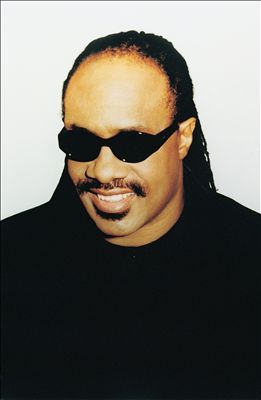
"Stevland Hardaway Morris (born May 13, 1950) as Steveland Hardaway Judkins known by his stage name Stevie Wonder, is an American musician, singer-songwriter, record producer, and multi-instrumentalist. A child prodigy, he developed into one of the most creative and loved musical figures of the late 20th century. Wonder signed with Motown's Tamla label at the age of eleven and continues to perform and record for Motown as of the early 2010s. He has been blind since shortly after birth. Stevie Wonder was born in Saginaw, Michigan, in 1950, the third of six children to Calvin Judkins and Lula Mae Hardaway. Owing to his being born six weeks premature, the blood vessels at the back of his eyes had not yet reached the front and their aborted growth caused the retinas to detach. The medical term for this condition is retinopathy of prematurity, or ROP, and it was exacerbated by the oxygen therapy given while in his hospital incubator. When Stevie Wonder was four, his mother left his father and moved to Detroit with her children. She changed her name back to Lula Hardaway and later changed her son's surname to Morris, partly because of relatives. Morris has remained Stevie Wonder's legal surname ever since. He began playing instruments at an early age, including piano, harmonica, drums and bass. During childhood he was active in his church choir. Wonder has been married twice: to Motown singer/songwriter and frequent collaborator Syreeta Wright from 1970 until their amicable divorce in 1972; and since 2001 to fashion designer Kai Millard Morris. He has seven children from his second marriage and several relationships. In August 2012, it was revealed that Wonder had filed for divorce from Kai Millard, agreeing to pay Millard for spousal support as well as child support for their two children, asking for joint custody. Wonder and his wife had been separated since October 2009. Wonder met Yolanda Simmons when she applied for a job as his secretary for his publishing company. Simmons bore Wonder a daughter on February 2, 1975: Aisha Morris. According to Wonder, the name Aisha is "African for strength and intelligence." After she was born, Stevie said "she was the one thing that I needed in my life and in my music for a long time. It was this in mind, she was the inspiration for his hit single "Isn't She Lovely." Aisha Morris is a singer who has toured with her father and accompanied him on recordings, including his 2005 album, A Time 2 Love. Wonder has two sons with Kai Millard Morris; the older is named Kailand and he occasionally performs as a drummer on stage with his father. The younger son, Mandla Kadjay Carl Stevland Morris, was born May 13, 2005, his father's 55th birthday. In May 2006, Wonder's mother died in Los Angeles, at the age of 76. During his September 8, 2008 UK concert in Birmingham, he spoke of his decision to begin touring again following his loss. "I want to take all the pain that I feel and celebrate and turn it around. Wonder's Taxi Productions owns Los Angeles radio station KJLH."
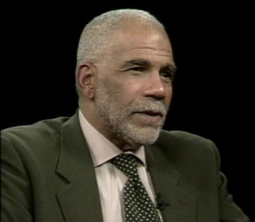 “Find a Grave Memorial ID 16562721” “Find a Grave Memorial ID 16562721”
"Edward Rudolph Bradley, Jr. (June 22, 1941–November 9, 2006) was an American journalist, best known for 26 years of award-winning work on the CBS News television program 60 Minutes. During his earlier career he also covered the fall of Saigon, was the first black television correspondent to cover the White House, and anchored his own news broadcast, CBS Sunday Night News with Ed Bradley. He received several awards for his work including the Peabody, the National Association of Black Journalists Lifetime Achievement Award, and 19 Emmy Awards. Bradley was born in Philadelphia, Pennsylvania. His parents divorced when he was 2, after which he was raised by his mother, Gladys, who worked two jobs to make ends meet. Bradley, who was referred to with the childhood name of "Butch Bradley," was able to see his father, who was in the vending machine business and owned a restaurant in Detroit, in the summertime. When he was 9, his mother enrolled him in the Holy Providence School, an all-black Catholic boarding school run by the Sisters of the Blessed Sacrament at Cornwells Heights, Pennsylvania. He attended Mount Saint Charles Academy, in Woonsocket, Rhode Island. He graduated in 1959 from Saint Thomas More Catholic Boys High School in West Philadelphia and then another historically black school, Cheyney State College now Cheyney University of Pennsylvania in Cheyney, Pennsylvania, graduating in 1964 with a degree in education. His first job was teaching sixth grade at the William B. Mann Elementary School in Philadelphia's Wynnefield community. While he was teaching, he moonlighted at the old WDAS studios on Edgley Drive in Philadelphia's Fairmount Park, working for free and, later, for minimum wage. He programmed music, read news, and covered basketball games and other sports. Bradley's introduction to news reporting came at WDAS-FM during the riots in Philadelphia in the 1960s. In 1967 he landed a full-time job at the CBS-owned New York radio station WCBS. In 1971, he moved to Paris, France. Initially living off his savings, he eventually ran out of money and began working as a stringer for CBS News, covering the Paris Peace Talks. In 1972 he volunteered to be transferred to Saigon to cover the Vietnam War, as well as spending time in Phnom Penh covering the war in Cambodia. It was there that he was injured by a mortar round, receiving shrapnel wounds to his back and arm. Bradley was known for his sense of style. He was the first male correspondent to regularly wear an earring on the air. He had his left ear pierced in 1986 and says he was inspired to do it after receiving encouragement from Liza Minnelli following an interview with the actress. He is also thus far the only male 60 Minutes anchor to do so, though male correspondents from other network programs, including Jim Vance, Jay Schadler, and Harold Dow, later wore earrings on camera. Bradley never had children, but was married to Haitian-born artist Patricia Blanchet, whom he had met at a museum where she was working as a docent. Despite the age difference, she was 24 years younger than he, Bradley pursued her, and they dated for 10 years before marrying in a private ceremony in Woody Creek, Colorado, where they had a home. Bradley also maintained two homes in New York, one in East Hampton, and the other in New York City. In the early 1970s, Bradley had a brief romantic relationship with Jessica Savitch, who at that time was an administrative assistant for CBS News and later became an NBC News anchor. After the relationship ended, Bradley and Savitch continued to have a non-romantic social and professional relationship until her death in 1983. Bradley was known for loving all kinds of music, but he was especially a jazz music enthusiast. He hosted the Peabody Award–winning Jazz at Lincoln Center on National Public Radio for over a decade until just before his death. A big fan of the Neville Brothers, Bradley performed on stage with the bunch, and was known as "the fifth Neville brother." Bradley was also friends with Jimmy Buffett, and would often perform onstage with him, under the name "Teddy". Bradley had limited musical ability and did not have an extensive repertoire, but would usually draw smiles by singing the 1951 classic by Billy Ward and the Dominoes, "Sixty Minute Man." Bradley died on November 9, 2006, at Mount Sinai Hospital, in Manhattan of complications from lymphocytic leukemia. He was 65 years old."
|
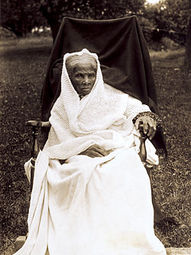 “Find a Grave Memorial ID 1247” “Find a Grave Memorial ID 1247”
"Harriet Tubman (born Araminta Ross c. 1822–March 10, 1913) was an African American abolitionist, humanitarian, and, during the American Civil War, a Union spy. Born into slavery, Tubman escaped and subsequently made some thirteen missions to rescue approximately seventy enslaved family and friends, using the network of antislavery activists and safe houses known as the Underground Railroad. She later helped abolitionist John Brown recruit men for his raid on Harpers Ferry, and in the post-war era struggled for women's suffrage. Born a slave in Dorchester County, Maryland, Tubman was beaten and whipped by her various masters as a child. Early in life, she suffered a traumatic head wound when an irate slave owner threw a heavy metal weight intending to hit another slave and hit her instead. The injury caused dizziness, pain, and spells of hypersomnia, which occurred throughout her life. She was a devout Christian and experienced strange visions and vivid dreams, which she ascribed to premonitions from God. In 1849, Tubman escaped to Philadelphia, then immediately returned to Maryland to rescue her family. Slowly, one group at a time, she brought relatives with her out of the state, and eventually guided dozens of other slaves to freedom. Traveling by night and in extreme secrecy, Tubman or "Moses," as she was called "never lost a passenger." Her actions made slave owners anxious and angry, and they posted rewards for her capture. When a far-reaching United States Fugitive Slave Law was passed in 1850, she helped guide fugitives further north into Canada, and helped newly freed slaves find work. When the US Civil War began, Tubman worked for the Union Army, first as a cook and nurse, and then as an armed scout and spy. The first woman to lead an armed expedition in the war, she guided the raid at Combahee Ferry, which liberated more than seven hundred slaves. After the war, she retired to the family home on property she had purchased in 1859 in Auburn, New York, where she cared for her aging parents. She was active in the women's suffrage movement until illness overtook her and she had to be admitted to a home for elderly African-Americans that she had helped to establish years earlier. After she died in 1913, she became an icon of American courage and freedom. Tubman was born Araminta "Minty" Ross to slave parents, Harriet Green and Ben Ross. Rit was owned by Mary Pattison Brodess and later her son Edward. Ben was held by Anthony Thompson, who became Mary's second husband, and who ran a large plantation near Blackwater River in Madison, Maryland. As with many slaves in the United States, neither the exact year nor place of Araminta's birth is known, and historians differ as to the best estimate. Kate Larson records the year as 1822, based on a midwife payment and several other historical documents, including her runaway advertisement, while Jean Humez says "the best current evidence suggests that Tubman was born in 1820, but it might have been a year or two later." Catherine Clinton notes that Tubman reported the year of her birth as 1825, while her death certificate lists 1815 and her gravestone lists 1820. In her Civil War widow's pension records, Tubman claimed she was born in 1820, 1822, and 1825, an indication, perhaps, that she had only a general idea of when she was born. As a child in Dorchester County, Maryland, Tubman was beaten by masters to whom she was hired out. Early in her life, she suffered a severe head wound when hit by a heavy metal weight. The injury caused disabling epileptic seizures, headaches, powerful visions, and dream experiences, which occurred throughout her life. A devout Christian, Tubman ascribed the visions and vivid dreams to revelations from God."
 Find a Grave Memorial ID unavailable Find a Grave Memorial ID unavailable
"Anna Mae Violet McCabe Hays (February 16, 1920–January 7, 2018) was chief of the U. S. Army Nurse Corps and the first woman in the U. S. Armed Forces to be promoted to a general officer rank; in 1970, she was promoted to the rank of brigadier general. Hays was born in 1920 in Buffalo, New York as the middle of three children in the family. Her father's name was Daniel Joseph McCabe while her mother's name is Mattie McCabe, and both her parents were members of The Salvation Army. During Hays' childhood the family moved several times in the western New York and eastern Pennsylvania areas, but settled in Allentown, Lehigh County, Pennsylvania, in 1932. She had a brother, Daniel and a sister, Katherine. Hays attended Allentown High School, now William Allen High School, graduating with honors in 1938. Hays had a love of music, playing the piano, the organ and the French horn, and wanted to go to Juilliard School to study music but due to a lack of funds for tuition she decided to pursue nursing instead. Following her high school studies, Hays enrolled in 1939 at the Allentown General Hospital School of Nursing, from which she graduated in 1941, having obtained a diploma in nursing. In May 1942, she joined the Army Nurse Corps and was sent to India in January 1943, serving with the 20th Field Hospital and [also] to the town of Ledo in Assam. The living and working conditions were somewhat primitive; the buildings were made of bamboo, and dysentery, leeches and snakes were common, particularly during monsoon seasons. Just over two years later, in April 1945, she was promoted to the rank of first lieutenant. After serving two and a half years in India, Hays was on leave in the United States when the war ended. Remaining with the Corps, she served as an operating room nurse and later as a head nurse at Tilton General Hospital at Fort Dix, New Jersey; as obstetrics supervisor at Valley Forge General Hospital in Phoenixville, Pennsylvania; and as a head nurse at Fort Myer, Virginia. During the Vietnam War Hays traveled to Vietnam three times to monitor American nurses stationed there. She also managed the development of new training programs and a significant increase in the number of nurses serving overseas. Hays was promoted to the rank of brigadier general on June 11, 1970, after being appointed by President Richard Nixon on May 15 of that year. The Army Chief of Staff, General William C. Westmoreland, and the Secretary of the Army, Stanley R. Resor, officiated at the ceremony; following Hays' promotion, Elizabeth P. Hoisington, Director of the Women’s Army Corps, was also promoted to the rank of brigadier general. In her address to the gathering, Hays said that the general stars "reflected the dedicated, selfless, and often heroic efforts of Army nurses throughout the world since 1901 in time of peace and war." Hays made a number of recommendations to the military regarding the treatment of women which were accepted into policy, including to not automatically discharge officers for becoming pregnant and to not determine appointments to the Army Nurse Corps Reserve based on the age of the nurse's dependents. In addition, regulations were changed to allow spouses of female service members to claim similar privileges to spouses of male service members. She retired on August 31, 1971. In addition to the military honors Hays received, her service was also recognized in the community; in 2015, Lehigh and Northampton counties named the Coplay-Northampton Bridge after her. In 2012, she was named to Lehigh County’s Hall of Fame. In November 2017, she was presented with a Flag of Valor quilt during a Veterans Day ceremony at Knollwood. She married William A. Hays, in July 1956, who directed the Sheltered Workshops in Washington D.C. and passed away in 1963. Hays died at a retirement home in Washington, D. C. on January 7, 2018 of complications from a heart attack, at the age of 97. She could have been buried at Arlington National Cemetery, but she had chosen instead to be buried with her father in Grandview Cemetery in South Whitehall Township."
|
 "Find a Grave Memorial ID 248320288" "Find a Grave Memorial ID 248320288"
"Lisa Marie Presley (February 1, 1968-January 12, 2023) is an American singer-songwriter and actress. She is the daughter of musician-actor Elvis Presley and actress and business magnate Priscilla Presley, and is Elvis's only child. As sole heir to her father's estate, Presley is the owner of Graceland, the Memphis mansion where her father lived, now a major tourist attraction. She has conducted a long career in the music business and has issued several albums and videos. Her work as a vocalist and lyricist has ranged across rock, country, blues and folk. Presley has been married four times. In 1988, she married musician Danny Keough, with whom she had a son and a daughter. She was then married to singer Michael Jackson and briefly to actor Nicolas Cage, before marrying music producer Michael Lockwood, father of her twin girls. In 2010, they moved to Coe's Hall, Rotherfield, East Sussex, in the United Kingdom. Lisa Marie Presley was born on 1 February, 1968, to Elvis and Priscilla Presley at Baptist Memorial Hospital in Memphis,Tennessee, exactly nine months after her parents' wedding. After her parents divorced, she lived with her mother. When her father died, 9-year-old Lisa Marie became joint heir to his estate with her grandfather Vernon Presley and her great-grandmother Minnie Mae Presley. Following the deaths of Vernon in 1979 and Minnie Mae in 1980, Lisa became the sole heir and inherited Graceland. In 1993, on her 25th birthday, she inherited the estate, which had grown to an estimated $100 million. It is reported that Lisa sold 85% of her father's estate. On January 5, 2002, Presley received the Humanitarian Award from the World Literacy Crusade for her efforts to help children across America learn valuable skills for study and improve their lives. Lisa Marie Presley received her award from Isaac Hayes, Chaka Khan and Yolanda King, daughter of the late Martin Luther King Jr. World Literacy Crusade is also regarded by critics as a front group for the Church of Scientology. On June 24, 2011, Presley was officially honored by the Governor of Tennessee, Bill Haslam, who proclaimed a day of recognition for her in recognition her charitable efforts. As stated in a proclamation received from the City of Memphis on June 18, 2011, "Lisa Marie Presley is a humanitarian and philanthropist who continues to focus her efforts on the hometown she knows and loves, Memphis. Through her efforts and time she has improved homelessness, literacy, and raised funds for local charities and organizations. She raises awareness for Memphis and continues to set an example of what one person can do when they put their mind to it. "Now, Therefore, I, A. C. Wharton, Jr., Mayor of Memphis, TN, do hereby recognize the lifelong service of this illustrious humanitarian and philanthropist." Presley married musician Danny Keough on October 3, 1988. They had two children, son Benjamin and daughter Danielle Riley, an actress and model known professionally as Riley Keough. Presley obtained a quickie divorce in the Dominican Republic on May 6, 1994. Twenty days after her divorce from Keough, Presley married singer Michael Jackson. They had first met in 1975 when a seven-year-old Presley attended several of his concerts in Las Vegas. According to a friend of Presley's, "their adult friendship began in November 1992 in L.A." They stayed in contact every day over the telephone. In an October 2010 interview with talk-show host Oprah Winfrey, Lisa Marie told Oprah that she and Michael Jackson spent the four years following their divorce together, on and off, in an attempt to reconcile and said that she had traveled to different parts of the world in order to be with him. Presley was engaged in 2000 to rocker John Oszajca. She broke off the engagement after meeting Nicolas Cage at a party. Presley's third marriage was to Cage. They were married on August 10, 2002, in an ocean-side ceremony near the Mauna Lani Bay Hotel on the Big Island of Hawaii. Cage had proposed just ten days earlier. Cage filed for divorce after 108 days of marriage, on November 25, 2002, and the divorce was finalized on May 16, 2004. The divorce proceeding lasted longer than the marriage. Presley married for a fourth time on January 22, 2006, to Michael Lockwood, her guitarist, music producer and director. Keough served as best man at the couple's wedding, held in Japan. Priscilla Presley walked her down the aisle in front of sixteen guests. After Elvis' death at Graceland on 16 August 1977, his will appointed his father, Vernon Presley, executor and trustee. His fortune had dwindled to only $5 million. The beneficiaries of the trust were Vernon, Elvis' grandmother Minnie Mae Presley, and his nine-year-old daughter Lisa Marie Presley, whose inheritance was to be held in trust until her 25th birthday. After Vernon's death in 1979, Elvis' ex-wife Priscilla Presley was named as one of three trustees in his will; the others being the National Bank of Commerce in Memphis, and Joseph Hanks, who had been Elvis and Vernon's accountant. With Minnie Mae's passing in 1980, Lisa Marie became the only surviving beneficiary named in Elvis's will. On her 25th birthday in 1993, Lisa Marie inherited Elvis' estate, which, thanks largely to the stewardship of her mother, Priscilla, had grown to an estimated $100 million. In February 2012, Lisa Marie Presley opened a new exhibit, "Elvis...Through His Daughter's Eyes." It is now included in the Graceland VIP Tour, and features 200 items assembled by Lisa Marie and the Graceland Archives team. The personal exhibit looks at Lisa Marie's experience of growing up with a famous father. Home movies, toys and rarely seen family mementos are among the many items on display. In November 1975, her father named one of his private aircraft, a converted Convair 880 jet, original passenger capacity 100, after her. Elvis spent upwards of $1,000,000 refurbishing it to use as his main transport while on tour. The "Lisa Marie" and one of Elvis' other planes, "Hound Dog II," are currently on exhibit at the Graceland mansion museum of Elvis Presley in Memphis, Tennessee. In January 2015 it was reported that both planes are for sale. They are no longer airworthy but their current undisclosed owner is hoping to gain $10 M in total. The buyer has an option to purchase land adjacent to Graceland to exhibit them independently from Graceland. On January 12, 2023, Presley suffered cardiac arrest at her home in Calabasas, California. Presley's heart was restarted after CPR was administered, en route to a hospital. She died later that day. Her last public appearance was at the 80th Golden Globe Awards, which she attended with her mother, Priscilla Presley, on January 10, 2023."
Source: Wikipedia.org | January 12, 2023, 10:20PM CDT  “Find a Grave Memorial ID 114738638” “Find a Grave Memorial ID 114738638”
"Michael George Ansara (April 15, 1922–July 31, 2013) was a Syrian-born American stage, screen, and voice actor who portrayed Cochise in the American television series Broken Arrow, Kane in the 1979–1981 series Buck Rogers in the 25th Century, Commander Kang on three different Star Trek television series, Deputy U. S. Marshal Sam Buckhart on the NBC series Law of the Plainsman, and provided the voice for Mr. Freeze in Batman: The Animated Series and several of its spin-offs. Michael George Ansara was born in a small village in the French Mandate for Syria and the Lebanon to American parents, and his family emigrated to the United States when he was two years old. They lived in Lowell, Massachusetts, for a decade before moving to California. He originally wanted to be a physician, but developed a passion for becoming a performer after he began taking acting classes to overcome his shyness. He was educated at the Los Angeles City College, from which Ansara earned an Associate of Arts degree. During the 1950s, Ansara appeared in several episodes of Alfred Hitchcock Presents. He appeared in a 1951 episode of The Lone Ranger titled "Trouble at Black Rock." However, the popular television series Broken Arrow wherein he played the lead role of Cochise, raised Ansara's profile and made him a household name. While making the series, the 20th Century-Fox publicity department arranged a date between Ansara and actress Barbara Eden. The two later married and Ansara guest-starred on Eden's I Dream of Jeannie series as the Blue Djinn, who had imprisoned Jeannie in a bottle. He also played King Kamehameha in the Jeannie episode "The Battle of Waikiki," and in the final season, he played Major Biff Jellico in the episode "My Sister, the Home Wrecker." Michael Ansara and Barbara Eden divorced in 1974. The couple had one son together, actor Matthew Ansara, who died on June 25, 2001, of a heroin overdose. Ansara starred in his own ABC-TV series, Law of the Plainsman with Gina Gillespie and Robert Harland. He performed as an Apache Indian named Sam Buckhart, who had been appointed as a U. S. Marshal. The series began as an episode of The Rifleman. In 1961, he appeared as Carl in the episode "Night Visitors" of the NBC anthology series The Barbara Stanwyck Show. Ansara also played in the Biblical epics The Robe as Judas Iscariot, The Ten Commandments as a taskmaster and The Greatest Story Ever Told as Herod's commander. He also appeared as Belshazzarin Columbia's 1953 movie Slaves of Babylon. Ansara was nominated for an Academy of Science Fiction Award and has won a Western Heritage Award for Rawhide, and received a star on the Hollywood Walk of Fame for both films and television. Ansara was married three times, first to Jean Byron in 1955; after a year of marriage, the couple divorced in 1956. In 1958, Ansara married Barbara Eden, who is best known for the I Dream of Jeannie sitcom series. The couple had a son named Matthew born in 1965. Ansara and Eden divorced in 1974, and he married actress Beverly Kushida in 1977. On June 25, 2001, his son Matthew died from a drug overdose in Monrovia, California. Ansara died from complications of Alzheimer's disease at his home in Calabasas on July 31, 2013, at the age of 91. His interment is at Forest Lawn Memorial Park in Hollywood Hills, next to his son Matthew."
 “Find a Grave Memorial ID 67312270” “Find a Grave Memorial ID 67312270”
"Dame Elizabeth Rosemond Taylor, (February 27, 1932–March 23, 2011) was a British-American actress, businesswoman and humanitarian. She began as a child actress in the early 1940s, and was one of the most popular stars of classical Hollywood cinema in the 1950s. She continued her career successfully into the 1960s, and remained a well-known public figure for the rest of her life. The American Film Institute named her the seventh greatest female screen legend in 1999. Born in London to wealthy, socially prominent American parents, Taylor moved with her family to Los Angeles in 1939, and she soon was given a film contract by Universal Pictures. Despite being one of MGM's most bankable stars, Taylor wished to end her career in the early 1950s, as she resented the studio's control and disliked many of the films she was assigned to. She began receiving better roles in the mid-1950s, beginning with the epic drama Giant and starred in several critically and commercially successful films in the following years. Taylor's acting career began to decline in the late 1960s, although she continued starring in films until the mid-1970s, after which she focused on supporting the career of her sixth husband, Senator John Warner. In the 1980s, she acted in her first substantial stage roles and in several television films and series, and became the first celebrity to launch a perfume brand. Taylor was also one of the first celebrities to take part in HIV/AIDS activism. She co-founded the American Foundation for AIDS Research in 1985 and The Elizabeth Taylor AIDS Foundation in 1991. From the early 1990s until her death, she dedicated her time to philanthropy. She received several accolades for it, including the Presidential Citizens Medal. Taylor's personal life was subject to constant media attention throughout her life. She was married eight times to seven men, endured serious illnesses, and led a jet set lifestyle, including collecting one of the most expensive private collections of jewelry. After many years of ill health, Taylor died from congestive heart failure at the age of 79 in 2011. Elizabeth Rosemond Taylor was born on February 27, 1932 at Heathwood, her family's home on 8 Wildwood Road in Hampstead Garden Suburb, London. She received dual citizenship at birth, as her parents, art dealer Francis Lenn Taylor and retired stage actress Sara Sothern were United States citizens, both originally from Arkansas City, Kansas. They moved to London in 1929 and opened an art gallery on Bond Street; their first child, a son named Howard, was born the same year. Taylor was one of the first celebrities to participate in HIV/AIDS activism, helping to raise more than $270 million for the cause during her lifetime. She began her philanthropic work in 1984, after becoming frustrated with the disease being widely discussed, but "nobody was doing anything about it." She began by helping to organize and by hosting the first AIDS fundraiser to benefit the AIDS Project Los Angeles. Taylor's personal life and especially her eight marriages drew a large amount of media attention and public disapproval throughout her adult life. Taylor struggled with health problems for most of her life. She was born with scoliosis, and broke her back while filming National Velvet in 1944. The fracture went undetected for several years, although it caused her chronic back problems. In 1956, she underwent an operation in which some of her spinal discs were removed and replaced with donated bone. Taylor was also prone to other illnesses and injuries, which often necessitated surgery, and came close to death due to a bout of pneumonia in 1961. In addition, she was addicted to alcohol and prescription medications. She was treated at the Betty Ford Center for seven weeks from December 1983 to January 1984, becoming the first celebrity to openly admit herself to the clinic. Taylor's health declined increasingly in the last two decades of her life, and she rarely attended public events in the 2000s. She used a wheelchair due to her back problems, and was diagnosed with congestive heart failure in 2004. She died of the illness six years later at the age of 79 on March 23, 2011 at the Cedars-Sinai Medical Center in Los Angeles, after being hospitalized six weeks earlier. Her funeral took place the following day at the Forest Lawn Memorial Park in Glendale, California. It was a private Jewish ceremony presided over by Rabbi Jerome Cutler, and at Taylor's request began 15 minutes behind schedule, as according to her representative, "she even wanted to be late for her own funeral." She is entombed in the Great Mausoleum at the cemetery. Taylor was both, one of the last stars of classical Hollywood cinema and one of the first modern celebrities. During the era of the studio system, she exemplified the classic film star; portrayed as different from "ordinary" people, and with a public image carefully crafted and controlled by MGM. When the era of classical Hollywood ended in the 1960s and paparazzi photography became a normal feature of media culture, Taylor came to define a new type of celebrity, whose real private life was the focus of public interest. According to Adam Bernstein of The Washington Post, "more than for any film role, she became famous for being famous, setting a media template for later generations of entertainers, models and all variety of semi-somebodies."
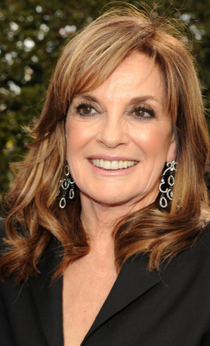
"Linda Ann Gray (born September 12, 1940) is an American film, stage and television actress, director, producer and former model, best known for her role as Sue Ellen Ewing, the long-suffering wife of Larry Hagman's character on the long-running CBS television drama series Dallas, for which she was nominated for the 1981 Primetime Emmy Award for Outstanding Lead Actress in a Drama Series. The role also earned her two Golden Globe Award nominations. Linda Ann Gray was born in Santa Monica, California. She grew up in Culver City, California, where her father Leslie, who was a watchmaker, had a shop. Before acting Gray worked as a model in the 1960s and began her acting career in television commercials, nearly 400 of them—and also made brief appearances in feature films, such as Under the Yum Yum Tree and Palm Springs Weekend in 1963. In the 1967 film The Graduate, the legs featured on the movie along with promotional poster were not Anne Bancroft's but Linda Gray's, where she was "paid $25 for one leg," she said. Gray achieved stardom for her role as Sue Ellen in the CBS drama series Dallas. Initially a recurring guest role for the five-episode first series, Gray became a series regular later in 1978 and remained with the show until 1989. Her character was well received by television critics. Corruption and betrayal, lies, greed, affairs and scandal—all were just part of another day at the Southfork Ranch. Gray was married for 21 years to Ed Thrasher, an art director and photographer who designed many iconic album covers throughout the 1960s and 1970s. The marriage resulted in two children: Jeff Thrasher and Kehly Sloane. Gray also has two grandsons, Ryder and Jack Sloane. Her younger sister, Betty, died in 1989 from breast cancer. Gray was also the aunt (by marriage) of actress Lindsay Wagner, best known as The Bionic Woman. She resides in Los Angeles, California. Gray was visiting Larry Hagman in the hospital during his last days before he died on November 23, 2012. Prior to his death, Gray released a statement: "Larry Hagman was my best friend for 35 years. He was the Pied Piper of life and brought joy to everyone he knew," She also added, "He was creative, generous, funny, loving and talented and I will miss him enormously. He was an original and lived life to the fullest. The world was a brighter place because of Larry."
|
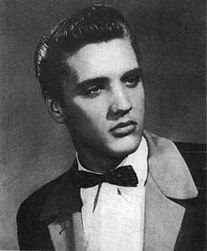 "Find a Grave Memorial ID 66876464" "Find a Grave Memorial ID 66876464"
"Elvis Aaron Presley (January 8, 1935–August 16, 1977) was an American musician and actor. Regarded as one of the most significant cultural icons of the 20th century, he is often referred to as "the King of Rock and Roll", or simply, "the King." Presley was born in Tupelo, Mississippi, as a twinless twin, and when he was 13 years old, he and his family relocated to Memphis, Tennessee. His music career began there in 1954, when he recorded a song with producer Sam Phillips at Sun Records. Accompanied by guitarist Scotty Moore and bassist Bill Black, Presley was an early popularizer of rockabilly, an up-tempo, backbeat-driven fusion of country music and rhythm and blues. RCA Victor acquired his contract in a deal arranged by Colonel Tom Parker, who managed the singer for more than two decades. Presley's first RCA single, "Heartbreak Hotel", was released in January 1956 and became a number-one hit in the United States. He was regarded as the leading figure of rock and roll after a series of successful network television appearances and chart-topping records. His energized interpretations of songs and sexually provocative performance style, combined with a singularly potent mix of influences across color lines that coincided with the dawn of the Civil Rights Movement, made him enormously popular—and controversial. In November 1956, he made his film debut in Love Me Tender. In 1958, he was drafted into military service. He resumed his recording career two years later, producing some of his most commercially successful work before devoting much of the 1960s to making Hollywood films and their accompanying soundtrack albums, most of which were critically derided. In 1968, following a seven-year break from live performances, he returned to the stage in the acclaimed televised comeback special Elvis, which led to an extended Las Vegas concert residency and a string of highly profitable tours. In 1973, Presley was featured in the first globally broadcast concert via satellite, Aloha from Hawaii. Several years of prescription drug abuse severely damaged his health, and he died in 1977 at the age of 42. Presley was born on January 8, 1935, in Tupelo, Mississippi, the son of Gladys Love Smith and Vernon Elvis Presley in the two-room shotgun house built by Vernon's father in preparation for the child's birth. Jesse Garon Presley, his identical twin brother, was delivered stillborn 35 minutes before him. As an only child, Presley became close to both parents and formed an especially close bond with his mother. The family attended an Assembly of God, where he found his initial musical inspiration. Although he was in conflict with the Pentecostal church in his later years, he never officially left it. Rev. Rex Humbard officiated at his funeral, as Presley had been an admirer of Humbard's ministry. Presley was known for a life of luxury and excess, as exemplified by his estate at Graceland. He owned a number of expensive cars, including three pink Cadillacs, immortalized in his version of the song "Baby, Let's Play House," in which Presley replaced the line "you may get religion" with "you may have a Pink Cadillac." A number of stories, both real and exaggerated, detail Presley's appetite for rich or heavy food. He was said to enjoy the Southern cuisine of his upbringing, including chicken-fried steak and biscuits and gravy. Presley is commonly associated with rich sandwiches, including the Fool's Gold Loaf and peanut butter, banana and bacon sandwiches, now commonly called an "Elvis sandwich."

"Brandy Rayana Norwood (born February 11, 1979) better known mononymously as Brandy, is an American recording artist and actress. Born into a musical family in McComb, Mississippi and raised in Carson, California, she enrolled in performing arts schools as a child and performed as a backing vocalist for teen groups. From 1993 to 1994, Norwood appeared in a supporting role on the short-lived ABC sitcom Thea and signed with Atlantic Records. The following year, she released her self-titled debut album. Norwood starred in the UPN sitcom Moesha as the title character, which lasted six seasons and resulted in numerous other roles. She resumed her music career in 1998 with the widely successful duet with Monica, "The Boy Is Mine," and her second album, Never Say Never; it sold 16 million copies, featured two number one singles, and earned Norwood her first Grammy award. She served as a judge on the first season of America's Got Talent before being involved in a widely-publicized car accident in 2006. After several lawsuits stemming from the accident, Norwood's fifth album Human (2008) was released to critical and commercial failure. In the 2010s, Norwood received a critical and commercial resurgence. In 2010, she returned to television as a contestant on the eleventh season of Dancing with the Stars and starred in the reality series Brandy & Ray J: A Family Business and the BET series The Game. She released her sixth album Two Eleven in 2012 to critical praise and in April 2015, Norwood made her Broadway debut in the musical Chicago. She is also set to star in her new sitcom Zoe Ever After in 2016. Norwood was born on February 11, 1979, in McComb, Mississippi, the daughter of Willie Norwood, a former gospel singer and choir director, and his wife, Sonja Norwood Bates, a former district manager for H&R Block. She is the older sister of entertainer Ray J, as well as a first cousin of rapper Snoop Dogg. Raised in a Christian home, Norwood started singing through her father's work as part of the local church choir, performing her first gospel solo at the age of two. In 1983, her parents relocated to Los Angeles, California, where Norwood was schooled at the Hollywood High Performing Arts Center. Norwood's interest in music and performing increased after becoming a fan of singer Whitney Houston at the age of seven, but at school, she experienced trouble with persuading teachers to send her on auditions as she found no support among the staff. In 1996, she shared a short relationship with Los Angeles Lakers player Kobe Bryant, whom she accompanied to his prom at Lower Merion High School in Ardmore, Pennsylvania. She also dated Boyz II Men lead singer Wanya Morris, whom she cited as her "first love." Morris, who was six years older than her, reportedly ended their relationship a month before her nineteenth birthday. Also during their work on the Never Say Never album, she briefly dated rapper Mase. During the production of the Full Moon album, in mid-2001, Norwood became involved romantically with producer Robert "Big Bert" Smith. The couple kept the relationship secret until February 2002, when Norwood announced that she was expecting her first child. However, a year after the birth of their daughter, Sy'rai Iman Smith, on June 16, 2002—an event tracked by the four-part MTV reality series Brandy: Special Delivery—Norwood and Smith separated. Driving home on December 30, 2006, Norwood was involved in a fatal automobile accident on Los Angeles' San Diego 405 Freeway. The accident claimed the life of 38-year-old Awatef Aboudihaj, the driver of the Toyota that was struck by Norwood's Range Rover. Aboudihaj died from her injuries at the L. A. Holy Cross Hospital the following day. Norwood was neither arrested nor charged with vehicular manslaughter due to insufficient evidence. Law enforcement officials reported that Norwood was driving her car at 65 miles per hour, and did not notice that vehicles ahead of her had slowed considerably. Her vehicle then collided with rear of Aboudihaj's, causing the Toyota to strike another vehicle before sliding sideways and impacting the center divider. As the Toyota came to a stop, it was hit by yet another vehicle. A well-placed source in the California Highway Patrol, however, later reported that Aboudihaj actually struck the car in front of her and then slammed on her brakes before Norwood made contact. The sudden stop caused Norwood to hit Aboudihaj's car. As confirmed, toxicology reports showed that Aboudihaj had "slight traces" of marijuana in her system at the time of the crash. In December 2007, Norwood's attorney Blair Berk stated that "after a more thorough and extensive investigation by authorities, the Los Angeles City Attorney has determined that Brandy Norwood should not be charged with any crime whatsoever relating to the accident back in 2006."
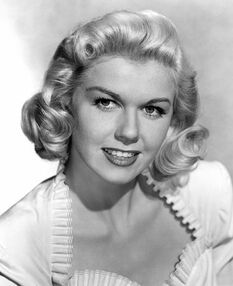 “Find a Grave Memorial ID 199089236” “Find a Grave Memorial ID 199089236”
"Doris Day, born Doris Mary Ann Kappelhoff (April 3, 1922-May 13, 2019) was an American actress, singer, and animal welfare activist. Day began her career as a big band singer in 1939. Her popularity began to rise after her first hit recording "Sentimental Journey," in 1945. After leaving Les Brown & His Band of Renown to embark on a solo career, Day started her long-lasting partnership with Columbia Records, which remained her only recording label. The contract lasted from 1947 to 1967 and included more than 650 recordings, making Day one of the most popular and acclaimed singers of the 20th century. She received the Grammy Lifetime Achievement Award and a Legend Award from the Society of Singers. In 2011, she released her 29th studio album, My Heart, which debuted at No. 9 on the UK Top 40 charts. As of January 2014, Day is the oldest living artist to score a UK Top 10 with an album featuring new material. Day received an Academy Award nomination for her performance in Pillow Talk, won three Henrietta Awards and received the Los Angeles Film Critics Association's Career Achievement Award. In 1989, she received the Cecil B. DeMille Award for lifetime achievement in motion pictures. She made her last film in 1968. Her strong commitment to animal welfare began in 1971, when she co-founded Actors and Others for Animals. She started her own non-profit organization in the 1970s, the Doris Day Animal Foundation and, later, the Doris Day Animal League. Establishing the annual observance Spay Day USA in 1995, the Doris Day Animal League now partners with The Humane Society of the United States and continues to be a leading advocacy organization. Day is retired from acting and performing, but has continued her work in animal rights and welfare causes. Doris Mary Ann Kappelhoff was born on April 3, 1922 or 1924 in Cincinnati, the daughter of Alma Sophia Welz, a housewife, and William Joseph Kappelhoff, a music teacher and choir master. All of her grandparents were German immigrants. The youngest of three siblings, she had two older brothers: Richard (who died before her birth) and Paul, several years older. Due to her father's alleged infidelity, her parents separated. She developed an early interest in dance, and in the mid-1930s formed a dance duo with Jerry Doherty that performed locally in Cincinnati. A car accident on October 13, 1937, injured her legs and curtailed her prospects as a professional dancer. While singing with the Les Brown band and for nearly two years on Bob Hope's weekly radio program, she toured extensively across the United States. Her popularity as a radio performer and vocalist, which included a second hit record "My Dreams Are Getting Better All the Time," led directly to a career in films. When her third husband Martin Melcher died on April 20, 1968, a shocked Day discovered that Melcher and his business partner Jerome Bernard Rosenthal had squandered her earnings, leaving her deeply in debt. Rosenthal had been her attorney since 1949, when he represented her in her uncontested divorce action against her second husband, saxophonist George W. Weidler. In February 1969, Day filed suit against Rosenthal and won the then-largest civil judgment (over $20 million) in the state of California. Since her retirement from films, Day has lived in Carmel-by-the-Sea, California. She has many pets and adopts stray animals. Day is a lifelong Republican, and supported George W. Bush's presidential campaign in 2000. Her only child, music producer and songwriter Terry Melcher, who had a hit in the 1960s with "Hey Little Cobra" under the name The Rip Chords, died of melanoma in 2004, about five months after Day had received the Presidential Medal of Freedom. She owns a hotel in Carmel-by-the-Sea, the Cypress Inn, which Melcher had co-owned with Day. Day's interest in animal welfare and related issues apparently dates to her teen years. While recovering from an automobile accident, she took her dog Tiny for a walk without a leash. Tiny ran into the street and was killed by a passing car. Day later confessed guilt and loneliness about Tiny's untimely death. In 1971, she co-founded Actors and Others for Animals, and appeared in a series of newspaper advertisements denouncing the wearing of fur, alongside Mary Tyler Moore, Angie Dickinson and Jayne Meadows. In 1978, Day founded the Doris Day Pet Foundation, now the Doris Day Animal Foundation. A non-profit 501(c)(3) grant-giving public charity, DDAF funds other non-profit causes throughout the US that share DDAF's mission of helping animals and the people who love them. The DDAF continues to operate independently under Day's personal supervision. A facility to help abused and neglected horses opened in 2011 and bears her name—the Doris Day Horse Rescue and Adoption Center, located in Murchison, Texas, on the grounds of an animal sanctuary started by her late friend, author Cleveland Amory. Day contributed $250,000 towards the founding of the center. For most of her life, Day reportedly believed she had been born in 1924 and reported her age accordingly; it was not until her 95th birthday—when the Associated Press found her birth certificate, showing a 1922 date of birth—that she learned otherwise"
Source: Wikipedia.org | Last updated Sunday, March 31, 2019, 12:00 AM CDT 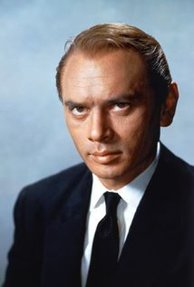 "Find a Grave Memorial ID 2966" "Find a Grave Memorial ID 2966"
"Yuliy Borisovich Briner (July 11, 1920–October 10, 1985) was a Russian-born United States-based actor of stage and film. He was best known for his portrayal of the King of Siam in the Rodgers and Hammerstein musical The King and I, for which he won two Tony Awards and an Academy Award for the film version; he played the role 4,625 times on stage. He is also remembered as Rameses II in the 1956 Cecil B. DeMille blockbuster The Ten Commandments, General Bounine in the 1956 film Anastasia and Chris Adams in The Magnificent Seven. Brynner was noted for his distinctive voice and for his shaved head, which he maintained as a personal trademark long after adopting it in 1951 for his role in The King and I. Earlier, he was a model and television director, and later a photographer and the author of two books. Yul Brynner was born Yuliy Borisovich Briner in 1920. He exaggerated his background and early life for the press, claiming that he was born Taidje Khan of part-Mongol parentage, on the Russian island of Sakhalin. In reality, he was born at home in a four-story residence at 15 Aleutskaya Street, Vladivostok, in the Far Eastern Republic, present-day Primorsky Krai, Russia. He occasionally referred to himself as Julius Briner, Jules Bryner, or Youl Bryner. The 1989 biography by his son, Rock Brynner, clarified some of these issue. His father, Boris Yuliyevich Briner, was a mining engineer whose father, Jules Briner, was a Swiss citizen who moved to Vladivostok in the 1870s and established a successful import-export company. Brynner's paternal grandmother, Natalya Yosifovna Kurkutova, was a native of Irkutsk and was partly of Buryat ancestry. His mother, Marousia Dimitrievna came from the intelligentsia and studied to be an actress and singer. He felt a strong personal connection to the Romani [people.] [In] 1977, Yul Brynner was named Honorary President of the International Romani Union, an office that he kept until his death. In 1940, speaking very little English, Brynner and his mother emigrated to the US aboard the S. S. President Cleveland, arriving in New York City on October 25, 1940, where his sister already lived. Vera, a singer, starred in The Consul on Broadway in 1950 and appeared at The Metropolitan Opera as Prince Orlofsky in Die Fledermaus and on television in the title role of Carmen. She later taught voice in New York. Brynner married four times. The first three ended in divorce. He fathered three children and adopted two. On April 4, 1983, aged 62, Brynner married his fourth and last wife, Kathyyam Lee a 24-year-old ballerina from Malaysia, whom he had met in a production of The King and I in which she had a small dancing role. They remained married for the last 2 years of Brynner's life. Brynner, a Swiss citizen, was naturalized as a U. S. citizen, but in June 1965, he renounced his US citizenship at the US Embassy in Berne, Switzerland for tax reasons. He had lost his tax exemption as an American resident abroad by working too long in the United States and would have been bankrupted by his tax and penalty debts. Brynner began smoking heavily at age 12 and, although his promotional photos often showed him with a cigarette in-hand, he quit the habit in 1971. In September 1983, Brynner found a lump on his vocal cords. In Los Angeles, only hours before his 4,000th performance in The King and I, he received the test results. His throat was fine, but he had inoperable lung cancer. On September 28, 2012, an [8-foot] tall statue was inaugurated at Yul Brynner Park, in front of the home where he was born at Aleutskaya St. No. 15 in Vladivostok, Russia. Created by local sculptor Alexei Bokiy, the monument was carved in granite from China. The grounds for the park were donated by the city of Vladivostok, which also paid additional costs. His remains are interred in France on the grounds of the Saint-Michel-de-Bois-Aubry Russian Orthodox monastery near Luzé between Tours and Poitiers."
|
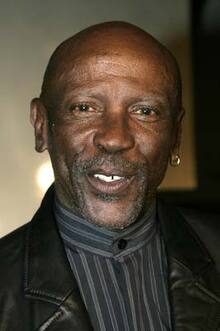 "Find a Grave Memorial ID 268833750" "Find a Grave Memorial ID 268833750"
"Louis Cameron Gossett, Jr. (May 27, 1936-March 29, 2024) is an American actor. He is perhaps best known for his Academy Award-winning role as Gunnery Sergeant Emil Foley in the 1982 film An Officer and a Gentleman, and his Emmy Award-winning role as Fiddler in the 1977 ABC television miniseries Roots. Gossett has also starred in numerous film productions including A Raisin In The Sun, Skin Game, Travels with My Aunt, The Laughing Policeman, The Deep, Jaws 3-D, Wolfgang Peterson's Enemy Mine, the Iron Eagle series, Toy Soldiers and The Punisher, in an acting career that spans over seven decades. Gossett was born in Sheepshead Bay, Brooklyn, New York on May 27, 1936, to Hellen Rebecca Wray a nurse, and Louis Gossett, Sr., a porter. His stage debut came at the age of 17, in a school production of You Can't Take It with You when a sports injury resulted in the decision to take an acting class. Polio had already delayed his graduation. After graduating from Abraham Lincoln High School in 1954, he attended New York University, declining an athletic scholarship. Standing 6'4" he was offered the opportunity to play varsity basketball during his college years at NYU, which he declined to concentrate on theater. His high school teacher had encouraged him to audition for a Broadway part, which resulted in his selection for a starring role on Broadway in 1953 from among 200 other actors well before he entered NYU. Gossett has been married three times and fathered one son and adopted one son. His first marriage was to Hattie Glascoe; it was annulled. His second, to Christina Mangosing, took place on August 21, 1973. Their son Satie was born in 1974. Gossett and Mangosing divorced in 1975. His third marriage, to Star Search champion Cyndi James-Reese, took place on December 25, 1987. They adopted a son, Sharron. Gossett and James-Reese divorced in 1992. Louis is the uncle of actor Robert Gossett who stars on TNT's The Closer. According to a DNA analysis, he descended, mainly, from people of Liberia and Sierra Leone. On February 9, 2010, Gossett announced that he is suffering from prostate cancer. He added the disease was caught in its early stages, and expects to make a full recovery. Gossett replaced Bill Gunn as Spencer Scott in Broadway's Take a Giant Step, which was selected by The New York Times drama critics as one of the 10 best shows of the year. He was 17, and still a student at Abraham Lincoln High School, with no formal drama training. Gossett's Broadway theatre credits include A Raisin in the Sun. Gossett stepped into the world of cinema in the Sidney Poitier vehicle A Raisin in the Sun in 1961. Also in 1961, Gossett appeared in the original cast of Jean Genet's The Blacks, the longest running off-Broadway play of the decade, running for 1,408 performances. The original cast also featured James Earl Jones, Roscoe Lee Browne, Cicely Tyson, Godfrey Cambridge, Maya Angelou and Charles Gordone. Gossett co-wrote the antiwar folk song "Handsome Johnny" with Richie Havens which Havens recorded in 1967. His Emmy Award-winning role of Fiddler in the 1977 television miniseries Roots first brought Gossett to the audience's attention. On February 9, 2010, Gossett announced that he had prostate cancer. He added the disease was caught in its early stages, and he expected to make a full recovery. In late December 2020, Gossett was hospitalized in Georgia with COVID-19. Gossett died at a rehabilitation center in Santa Monica, California, on March 29, 2024, at the age of [88]."
Source: Wikipedia.org | Friday, March 29, 2024, 10:18 AM CDT |
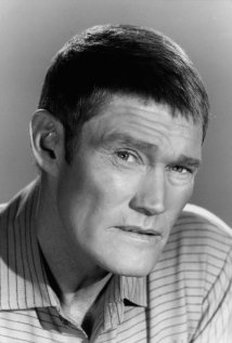 "Find a Grave Memorial ID 1145" "Find a Grave Memorial ID 1145"
"Kevin Joseph Connors (April 10, 1921–November 10, 1992) was an American actor, writer and professional basketball and baseball player. He is one of only 12 athletes in the history of American professional sports to have played both Major League Baseball and in the National Basketball Association. With a 40-year film and television career, he is best known for his five-year role as Lucas McCain in the highly rated 1958–1963 ABC series The Rifleman. Connors was born Kevin Joseph Connors in Brooklyn, New York City, New York, the second of two children and the only son of Allan and Marcella Connors, immigrants from the Dominion of Newfoundland, now a Canadian province. He was raised Roman Catholic and served as an altar boy at the Basilica of Our Lady of Perpetual Help in Brooklyn. His sister learned that Connors did not like his first name and was seeking another one. He tried out "Lefty" and "Stretch" before settling on "Chuck," because while playing first base, he would always yell, "Chuck it to me, baby, chuck it to me!" to the pitcher. The rest of his teammates and fans soon caught on and the name stuck. He loved the Brooklyn Dodgers despite their losing record during the 1930s, and hoped to someday join the team himself. Connors' athletic abilities earned him scholarships to both the Adelphi Academy where he graduated in 1939 and Seton Hall University in South Orange, New Jersey. He left college after two years. Connors was married three times. He met his first wife, Elizabeth Jane Riddell Connors, at one of his baseball games, and married her on October 1, 1948. They had four sons, Michael, Jeffrey, Steven, Kevin and divorced in 1961. Connors married Kamala Devi the year after, co-starring with her in Geronimo. She also acted with Connors in Branded, Broken Sabre, and Cowboy in Africa. They were divorced in 1973. Connors was a supporter of the Republican Party and attended several fundraisers for campaigns for U. S. President Richard M. Nixon. Connors had smoked three packs of Camel cigarettes a day until he quit the habit in the mid-1970s, though he occasionally resumed smoking afterwards. He died on November 10, 1992 in Los Angeles at the age of 71 of pneumonia stemming from lung cancer. At the time of his death, his companion was Rose Mary Grumley. He was interred in the San Fernando Mission Cemetery in Los Angeles. Connors was introduced to Secretary General Leonid Brezhnev of the former Soviet Union at a party given by Nixon at the Western White House in San Clemente, California, in June 1973. Connors presented Brezhnev with a pair of Colt Single Action Army "Six-Shooters" (revolvers) which Brezhnev liked greatly. Upon boarding his airplane bound for Moscow, Brezhnev noticed Connors in the crowd and went back to him to shake hands, and jokingly jumped up into Connors' towering hug. The Rifleman was one of the few American shows allowed on Russian television at that time; that was because it was Brezhnev's favorite. Connors and Brezhnev got along so well that Connors traveled to the Soviet Union in December 1973. In 1982, Connors expressed an interest in traveling to the Soviet Union for Brezhnev's funeral, but the U. S. [G]overnment would not allow him to be part of the official delegation. Coincidentally, Connors and Brezhnev died on the same day, ten years apart. He had a key role against type as a slave owner in the 1977 miniseries Roots, and was nominated for an Emmy Award for his performance."
|
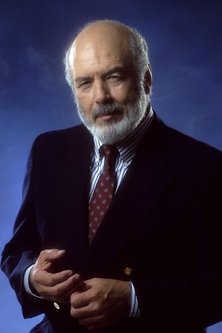 "Find a Grave Memorial ID 47127568" "Find a Grave Memorial ID 47127568"
"Pernell Elven Roberts, Jr. (May 18, 1928–January 24, 2010) was an American stage, movie and television actor, as well as a singer. In addition to guest starring in over 60 television series, he was best known for his roles as Ben Cartwright's eldest son, Adam Cartwright, on the western series Bonanza, a role he played from 1959 until 1965—and as chief surgeon Dr. John McIntyre, the title character on Trapper John, M. D. He was also known for his lifelong activism, which included participation in the Selma to Montgomery marches in 1965 and pressuring NBC to refrain from hiring whites to portray minority characters. Roberts was born in 1928 in North Carolina and moved to Waycross, Georgia as an infant, the only child of Pernell Elven Roberts, Sr., a Dr Pepper salesman, and Minnie Myrtle Morgan Roberts. During his high school years, Pernell played the horn, acted in school and church plays and sang in local USO shows. He attended, but did not graduate from, Georgia Tech. While serving for two years in the United States Marine Corps, he played the tuba and horn in the Marine Corps Band, although he was also skilled in the sousaphone and percussion. Roberts moved to Washington, D. C., in 1950 and supported himself in a variety of jobs while performing with the Arena Stage Theater for two years. Roberts played Ben Cartwright's eldest son, Adam, in the Western television series Bonanza—an architectural engineer with a university education, unlike his brothers. Adam has been variously described as urbane, intense, introspective, quiet, sullen and serious. Roberts, having largely been "a stage actor, accustomed as he was to a rigorous diet of the classics" and to freely move about from part to part, found the "transition to a television series," playing the same character, "without costume changes," a difficult one. "It was perhaps not surprising that, despite enormous success, he bolted from "Bonanza" after the 1964-65 season, criticizing the show's simple-minded content and lack of minority actors." It particularly distressed him that his character, a man in his 30's, had to defer continually to the wishes of his widowed father and he reportedly disliked the series itself, calling it—"junk" television and accused NBC of "perpetuating banality and contributing to the dehumanization of the industry." The equally self-critical Roberts, "I guess I'll never be satisfied with my own work," "had long disdained the medium's commercialization of his craft and its mass production, assembly-line mindset." Frustrated with Bonanza and angry, he told a reporter in 1965, "I feel I'm an aristocrat in my field of endeavor. My being part of Bonanza was like Isaac Stern sitting in with Lawrence Welk." Roberts married four times, first in 1951 to Vera Mowry—a professor of theater history at Washington State University and subsequently Hunter College as well as professor emerita of the Ph. D. Program in Theatre at City University of New York—with whom he had his only child Jonathan Christopher "Chris" Roberts. Pernell and his first wife later divorced. Chris Roberts, who lived variously in California and New York, attended Franconia College and died in a motorcycle accident in 1989 at age 38, sometimes reported as age 37. Roberts married Judith Anna LeBrecque on October 15, 1962; they divorced in 1971. He subsequently married Kara Knack in 1972, divorcing in 1996. At the time of his death—from pancreatic cancer on January 24, 2010—Roberts was married to Dr. Eleanor Criswell."
|
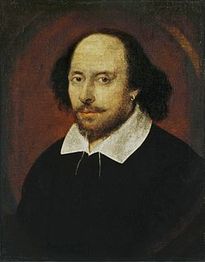 “Find a Grave Memorial ID 1450” “Find a Grave Memorial ID 1450”
"William Shakespeare (26 April 1564 | baptism–23 April 1616) was an English poet and playwright, widely regarded as the greatest writer in the English language and the world's pre-eminent dramatist. He is often called England's national poet and the "Bard of Avon." His surviving works consist of 38 plays, 154 sonnets, two long narrative poems, and several other poems. His plays have been translated into every major living language, and are performed more often than those of any other playwright. Shakespeare was born and raised in Stratford-upon-Avon. At the age of 18 he married Anne Hathaway, who bore him three children: Susanna, and twins Hamnet and Judith. Between 1585 and 1592 he began a successful career in London as an actor, writer, and part owner of the playing company the Lord Chamberlain's Men, later known as the King's Men. He appears to have retired to Stratford around 1613, where he died three years later. Few records of Shakespeare's private life survive, and there has been considerable speculation about such matters as his sexuality, religious beliefs, and whether the works attributed to him were written by others. Shakespeare produced most of his known work between 1590 and 1613. His early plays were mainly comedies and histories, genres he raised to the peak of sophistication and artistry by the end of the sixteenth century. Next he wrote mainly tragedies until about 1608, including Hamlet, King Lear, and Macbeth, considered some of the finest examples in the English language. In his last phase, he wrote tragicomedies, also known as romances, and collaborated with other playwrights. Many of his plays were published in editions of varying quality and accuracy during his lifetime, and in 1623 two of his former theatrical colleagues published the First Folio, a collected edition of his dramatic works that included all but two of the plays now recognized as Shakespeare's. Shakespeare was a respected poet and playwright in his own day, but his reputation did not rise to its present heights until the nineteenth century. The Romantics, in particular, acclaimed Shakespeare's genius, and the Victorians hero-worshipped Shakespeare with a reverence that George Bernard Shaw called "Mariolatry." In the twentieth century, his work was repeatedly adopted and rediscovered by new movements in scholarship and performance. His plays remain highly popular today and are consistently performed and reinterpreted in diverse cultural and political contexts throughout the world. Shakespeare died on 23 April 1616, at the age of 52. He died within a month of signing his will, a document which he begins by describing himself as being in "perfect health." No extant contemporary source explains how or why he died. Half a century later, John Ward, the vicar of Stratford, wrote in his notebook: "Shakespeare, Drayton and Ben Jonson had a merry meeting and, it seems, drank too hard, for Shakespeare died of a fever there contracted," not an impossible scenario, since Shakespeare knew Jonson and Drayton."
|
"Balaam's" "Ass" speaks?
 Find a Grave Memorial ID unavailable Find a Grave Memorial ID unavailable
"(1837–June 14, 1905) real name, Hamad bin Muḥammad bin Jumah bin Rajab bin Muḥammad bin Sa‘īd al-Murghabī. [He] was a Swahili-Zanzibari trader. He was known by the natives of Southeast Africa as Tippu Tib after the sounds that his many guns made. A slave trader, plantation owner and governor, who worked for a succession of sultans of Zanzibar, he led many trading expeditions into Central Africa, involving the slave trade and ivory trade. He also constructed profitable trading posts that reached deep into Central Africa. Tippu Tip built himself a trading empire that he then translated into clove plantations on Zanzibar. Abdul Sheriff reported that when he left for his twelve years of "empire building" on the mainland, he had no plantations of his own. However, by 1895, he had acquired "seven shambas [plantations] and 10,000 slaves." His mother, Bint Habib bin Bushir, was a Muscat Arab of the ruling class. His father and paternal grandfather were coastal Swahili who had taken part in the earliest trading expeditions to the interior. His paternal great-grandmother, wife of Rajab bin Mohammed bin Said el Murgebi, was the daughter of Juma bin Mohammed el Nebhani, a member of a respected Muscat (Oman) family, and a Bantu woman from the village of Mbwa Maji, a small village south of what would later become the German capital of Dar es Salaam. He met and helped several famous western explorers of the African continent, including Henry Morton Stanley. He died June 13, 1905, of malaria (according to Brode) in his home in Stone Town, the main town on the island of Zanzibar."
|
"Balaam is a diviner in the Torah, his story occurring towards the end of the Book of Numbers. The etymology of his name is uncertain, and discussed below. Every ancient reference to Balaam considers him a non-Israelite, a prophet, and the son of Beor, though Beor is not so clearly identified. Though other sources describe the apparently positive blessings he delivers upon the Israelites, he is reviled as a "wicked man" in the major story concerning him. Balaam refused to speak what God didn't speak and would not curse the Israelites, even though King Balak of Moab offered him money to do so. But Balaam's error and the source of his wickedness came from sabotaging the Israelites as they entered the Promised Land. Balaam returned to King Balak and informed the king on how to get the Israelites to curse themselves by enticing them with prostitutes and unclean food sacrificed to idols. The Israelites fell into transgression due to these traps and God sent a deadly plague to them as a result. The main story of Balaam occurs during the sojourn of the Israelites in the plains of Midian, east of the Jordan River, at the close of forty years of wandering, shortly before the death of Moses, and the crossing of the Jordan. The Israelites have already defeated two kings on this side of the Jordan: Sihon, king of the Amorites, and Og, king of Bashan. Balak, king of Moab consequently becomes alarmed, and sends elders of Midian and his messengers to Balaam, son of Beor, to induce him to come and curse Israel. Balaam's location, Pethor, is simply given as "which is by the river of the land of the children of his people" in the masoretic text and the Septuagint, though the Samaritan Pentateuch, Vulgate, and Syriac Peshitta all identify his land as Ammon. Balaam sends back word that he can only do what YHWH commands, and God has, via a nocturnal dream, told him not to go. Moab consequently sends higher-ranking priests and offers Balaam honours; Balaam, in his coveteousness, continues to press God, and God finally gives him over to his greed and permits him to go but with instructions to say only what he commands. Balaam thus, without being asked again, sets out in the morning with the princes of Moab and God becomes angry that he went, and the Angel of the Lord is sent to prevent him. At first the angel is seen only by the donkey Balaam is riding, which tries to avoid the otherwise invisible angel. After Balaam starts punishing the donkey for refusing to move, it is miraculously given the power to speak to Balaam and it complains about Balaam's treatment. At this point, Balaam is allowed to see the angel, who informs him that the donkey is the only reason the angel did not kill Balaam. Balaam immediately repents, but is told to go on. With God's protection taken from him, Balaam is later listed amongst the Midianites who were killed in revenge for the "matter of Peor," which is where Balaam showed King Balak how to trap the Israelites so that God might destroy them?"
|
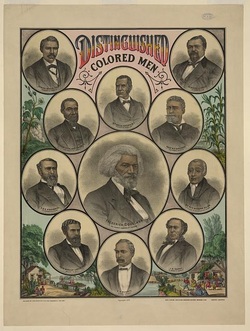
|
|
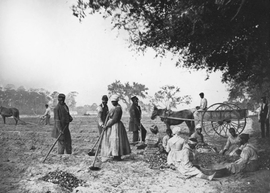
|

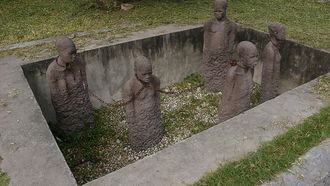
"40 acres and a mule?"
 Oh, why bother the White House anymore since Black folks done bellied up? Oh, why bother the White House anymore since Black folks done bellied up?
"A mule is the offspring of a male donkey and a female horse. Horses and donkeys are different species, with different numbers of chromosomes. Of the two F1 hybrids between these two species, a mule is easier to obtain than a hinny (the offspring of a male horse and a female donkey). The size of a mule and work to which it is put depends largely on the breeding of the mule's dam. Mules can be lightweight, medium weight, or even, when produced from draught horse mares, of moderately heavy weight. It has been claimed that mules are "more patient, sure-footed, hardy and long-lived than horses, and they are considered less obstinate, faster, and more intelligent than donkeys." A female mule that has estrus cycles and thus, in theory, could carry a fetus, is called a "molly" or "Molly mule," though the term is sometimes used to refer to female mules in general. Pregnancy is rare, but can occasionally occur naturally as well as through embryo transfer. One of several terms for a gelded mule is a "John mule." "40 acres and a mule refers to a concept in the United States for agrarian reform for former enslaved African American farmers, following disruptions to the institution of slavery provoked by the American Civil War. Many freedmen believed they had a moral right to own the land they had long worked as slaves, and were eager to control their own property. Freed people widely expected to legally claim 40 acres of land and a mule after the end of the war, long after proclamations such as Sherman's Special Field Orders, No. 15 and the Freedmen's Bureau Act were explicitly reversed. The institution of slavery in the United States deprived multiple generations of the opportunity to own land. Legally, slaves could not own property, but in practice they did acquire capital—and generally perceived themselves as the lowest-ranking members of the capitalist system. As legal slavery came to an end, many freed people fully expected to gain ownership of the land they had worked. African Americans in the U. S. faced severe discrimination, and were maintained as a distinct racial group by laws against "miscegenation." Perceived as a threat to society, and particularly as a dangerous influence on slaves, free Negroes had not been welcome in most areas of the United States. Before the Civil War, most free blacks lived in the North, which had abolished slavery. In some places they acquired substantial real estate. The phrase "40 acres and a mule" has come to symbolize the broken promise that Reconstruction policies would offer economic justice for African Americans. The "40 acres and a mule" promise featured prominently in the Pigford decision. Ruling that the United States Department of Agriculture had discriminated against African American farmers, Friedman wrote: "Forty acres and a mule. The government broke that promise to African American farmers. Over one hundred years later, the USDA broke its promise to Mr. James Beverly. "40 Acres and a Mule" is often discussed in the context of reparations for slavery. However, strictly speaking, the various policies offering 'forty acres' provided land for political and economic reasons—and with a price tag—and not as unconditional compensation for lifetimes of unpaid labor."" Source: Wikipedia.org | September 11, 2012 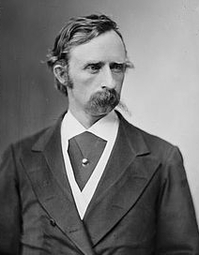 "Find a Grave Memorial ID 50416053" "Find a Grave Memorial ID 50416053"
"George Armstrong Custer (December 5, 1839–June 25, 1876) was a U. S. Army officer and cavalry commander in the American Civil War and the American Indian Wars. Raised in Michigan and Ohio, Custer was admitted to West Point in 1857, where he graduated last in his class in 1861. With the outbreak of the Civil War, Custer was called to serve with the Union Army. Custer's ancestor, Gertrude Küster, emigrated to North America around 1693 from the Rhineland in Germany, probably among thousands of Palatine refugees whose passage was arranged by the English government to gain settlers. According to family letters, Custer was named after George Armstrong, a minister, in his devout mother's hope that her son might join the clergy. Custer was born in New Rumley, Ohio, to Emanuel Henry Custer, a farmer and blacksmith and Marie Ward Kirkpatrick. He had two younger brothers, Thomas Custer and Boston Custer, who both died with him on the battlefield at Little Bighorn. The deaths of Custer and his troops became the best-known episode in the history of the American Indian Wars, due in part to a painting commissioned by the brewery Anheuser-Busch as part of an advertising campaign. The enterprising company ordered reprints of a dramatic work that depicted "Custer's Last Stand" and had them framed and hung in many United States saloons. This created lasting impressions of the battle and the brewery’s products in the minds of many bar patrons."
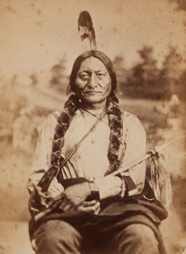 "Find a Grave Memorial ID 955" "Find a Grave Memorial ID 955"
"Sitting Bull also nicknamed Hunkesni or "Slow" (c. 1831–December 15, 1890) was a Hunkpapa Lakota holy man who led his people as a tribal chief during years of resistance to United States government policies. He was killed by Indian agency police on the Standing Rock Indian Reservation during an attempt to arrest him, at a time when authorities feared that he would join the Ghost Dance movement. Before the Battle of the Little Bighorn, Sitting Bull had a vision in which he saw the defeat of the 7th Cavalry under Lt. Col. George Armstrong Custer on June 25, 1876. Sitting Bull's leadership inspired his people to a major victory. Sitting Bull was born in Dakota Territory. In 2007, Sitting Bull's great-grandson asserted from family oral tradition that Sitting Bull was born along the Yellowstone River, south of present-day Miles City, Montana. He was named Jumping Badger at birth. When Jumping Badger was fourteen years old he accompanied a group of Lakota warriors (which included his father and his uncle Four Horns) in a raiding party to take horses from a camp of Crow warriors. Jumping Badger displayed bravery by riding forward and counting coup on one of the surprised Crow, which was witnessed by the other mounted Lakota. Upon returning to camp his father gave a celebratory feast at which he conferred his own name upon his son. The name, [Tatanka Iyotake] which in the Lakota language means "Buffalo Bull Sits Down," would later be abbreviated to "Sitting Bull." Thereafter, Sitting Bull's father was known as Jumping Bull. At this ceremony before the entire band, Sitting Bull's father presented his son with an eagle feather to wear in his hair, a warrior's horse, and a hardened buffalo hide shield to mark his son's passage into manhood as a Lakota warrior."
Source: Wikipedia.org | July 10, 2015 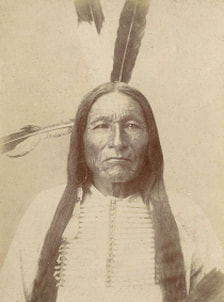 Find a Grave Memorial ID unavailable Find a Grave Memorial ID unavailable
"White Bull (April 1849–June 21, 1947) was the nephew of Sitting Bull, and a famous warrior in his own right. White Bull participated in the Battle of the Little Bighorn on June 25, 1876. For years it was rumored that White Bull boasted of killing Lt. George Armstrong Custer at the infamous battle. Although, others that knew White Bull himself claim that he never made that statement but admitted to struggling with Custer. Born in the Black Hills in South Dakota, White Bull came from a prominent Sioux family. He was the son of Makes Room, a Miniconjou chief and the brother of One Bull. After the battle, White Bull joined his uncle, Hunkpapa Sioux leader Sitting Bull, while fleeing to Canada. Also, young Chief Solomon "Smoke" and Chief No Neck fled with White Bull and Sitting Bull and their bands to Canada. White Bull surrendered to government troops in 1876. He eventually became a chief, replacing his father Chief Makes Room upon his death. He acted as a judge of the Court of Indian Offenses, and was a proponent of Lakota land claims in the Black Hills."
Source: Wikipedia.org | August 29, 2016 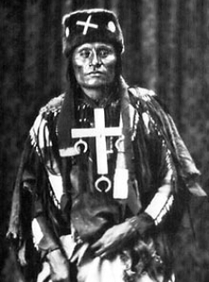 “Find a Grave Memorial ID 7954203” “Find a Grave Memorial ID 7954203”
"Little Wolf (c.1820—1904) was a Northern Só'taeo'o Chief and Sweet Medicine Chief of the Northern Cheyenne. He was known as a great military tactician and led a dramatic escape from confinement in Oklahoma back to the Northern Cheyenne homeland in 1878, known as the Northern Cheyenne Exodus. Born in present day Montana, by the mid-1820s, Little Wolf had become a prominent chieftain of the Northern Cheyenne, leading a group of warriors called the "Elk Horn Scrapers" during the Northern Plains Wars. He fought in Red Cloud's War, the war for the Bozeman Trail, which lasted from 1866 to 1868. As chief, he signed the Treaty of Fort Laramie. On December 21, 1866, Crazy Horse and six other warriors, both Lakota and Cheyenne, decoyed Capt. William Fetterman's 53 infantrymen and 27 cavalry troopers under Lt. Grummond into an ambush. They had been sent out from Fort Phil Kearny to follow up on an earlier attack on a wood train. Crazy Horse lured Fetterman's infantry up a hill. Grummond's cavalry followed the other six decoys along Peno Head Ridge and down toward Peno Creek, where several Cheyenne women taunted the soldiers. Meanwhile, Cheyenne leader Little Wolf and his warriors, who had been hiding on the opposite side of Peno Head Ridge, blocked the return route to the fort. The Lakota warriors swept over the hill and attacked the infantry. Additional Cheyenne and Lakota hiding in the buckbrush along Peno Creek effectively surrounded the soldiers. Seeing that they were surrounded, Grummond headed his cavalry back to Fetterman. The combined warrior forces of nearly 1,000 killed all the US soldiers, in what became known at the time to the white population as the Fetterman Massacre. It was the Army's worst defeat on the Great Plains up to that time. The Lakota and Cheyenne call it the Battle of the Hundred in the Hand. He [Little Wolf] was not present at the Battle of the Little Bighorn, but played a part before and after the battle."
Source: Wikipedia.org | August 29, 2016 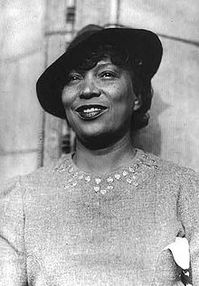 “Find a Grave Memorial ID 2571” “Find a Grave Memorial ID 2571”
"Zora Neale Hurston (January 7, 1891– January 28, 1960) was an American novelist, short story writer, folklorist, and anthropologist. Of Hurston's four novels and more than 50 published short stories, plays, and essays, she is best known for her 1937 novel Their Eyes Were Watching God. In addition to new editions of her work being published after a revival of interest in her in 1975, her manuscript Every Tongue Got to Confess, a collection of folktales gathered in the 1920s, was published posthumously after being discovered in the Smithsonian archives. Hurston was the fifth of eight children of John Hurston and Lucy Ann Hurston Potts, two former slaves. Her father was a Baptist preacher, tenant farmer, and carpenter, and her mother was a school teacher. She was born in Notasulga, Alabama, on January 7, 1891, where her father grew up and her grandfather was the preacher of a Baptist church. When she was three, her family moved to Eatonville, Florida; in 1887 it was one of the first all-black towns to be incorporated in the United States. Hurston said she always felt that Eatonville was "home" to her as she grew up there, and sometimes she claimed it as her birthplace. Her father later was elected as mayor of the town in 1897 and in 1902 became preacher of its largest church, Macedonia Missionary Baptist. Hurston later used Eatonville as a backdrop in her stories. It was a place where African Americans could live as they desired, independent of white society. In 1901, some northern schoolteachers visited Eatonville and gave Hurston a number of books that opened her mind to literature; she described it as a kind of "birth." Hurston spent the remainder of her childhood in Eatonville, and describes the experience of growing up there in her 1928 essay, "How It Feels to Be Colored Me." In 1904, Hurston's mother died. Her father remarried to Matte Moge; this was considered a minor scandal, as it was rumored that he had relations with Moge before his first wife's death. Hurston's father and stepmother sent her away to a Baptist boarding school in Jacksonville, Florida. They eventually stopped paying her tuition and the school expelled her. She later worked as a maid to the lead singer in a traveling Gilbert & Sullivan theatrical company. In 1917, Hurston began attending Morgan College, the high school division of Morgan State University, a historically black college in Baltimore, Maryland. At this time, apparently to qualify for a free high-school education as well, perhaps to reflect her literary birth, the 26-year-old Hurston began claiming 1901 as her year of birth. She graduated from the high school of Morgan State University in 1918. In 1927, Hurston married Herbert Sheen, a jazz musician and a former classmate at Howard who later became a physician. Their marriage ended in 1931. In 1939, while Hurston was working for the WPA, she married Albert Price. The marriage ended after seven months. In 1948, Hurston was falsely accused of molesting a ten-year-old boy in New York City. Although the case was dismissed after Hurston presented evidence that she was in Honduras when the crime supposedly occurred in the U. S., her personal life was seriously disrupted by the scandal. She was a Republican who was generally sympathetic to the foreign policy non-interventionism of the Old Right and a fan of Booker T. Washington's self-help politics. During a period of financial and medical difficulties, Hurston was forced to enter St. Lucie County Welfare Home, where she suffered a stroke. She died of hypertensive heart disease on January 28, 1960, and was buried at the Garden of Heavenly Rest in Fort Pierce, Florida. Her remains were in an unmarked grave until 1973. Novelist Alice Walker and literary scholar Charlotte D. Hunt found an unmarked grave in the general area where Hurston had been buried, and decided to mark it as hers. After Hurston died her papers were ordered to be burned. A law officer and friend, Patrick DuVal, passing by the house where she had lived, stopped and put out the fire, thus saving an invaluable collection of literary documents for posterity."
|
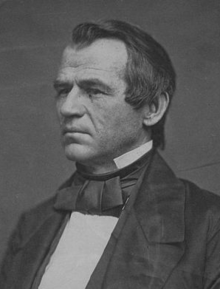 "Find a Grave Memorial ID 548" "Find a Grave Memorial ID 548"
"Andrew Johnson (December 29, 1808–July 31, 1875) was the 17th President of the United States, serving from 1865 to 1869. Johnson became president as Abraham Lincoln's vice president at the time of Lincoln's assassination. A Democrat who ran with Lincoln on the National Union ticket, Johnson came to office as the Civil War concluded. The new president favored quick restoration of the seceded states to the Union. His plans did not give protection to the former slaves, and he came into conflict with the Republican-dominated Congress, culminating in his impeachment by the House of Representatives. The first American president to be impeached, he was acquitted in the Senate by one vote. Johnson was born in poverty in Raleigh, North Carolina. Apprenticed as a tailor, he worked in several frontier towns before settling in Greeneville, Tennessee. He served as alderman and mayor there before being elected to the Tennessee House of Representatives in 1835. After brief service in the Tennessee Senate, Johnson was elected to the federal House of Representatives in 1843, where he served five two-year terms. He became Governor of Tennessee for four years, and was elected by the legislature to the Senate in 1857. In his congressional service, he sought passage of the Homestead Bill, which was enacted soon after he left his Senate seat in 1862. Johnson implemented his own form of Presidential Reconstruction–a series of proclamations directing the seceded states to hold conventions and elections to re-form their civil governments. When Southern states returned many of their old leaders, and passed Black Codes to deprive the freedmen of many civil liberties, Congress refused to seat legislators from those states and advanced legislation to overrule the Southern actions. Johnson vetoed their bills, and Congress overrode him, setting a pattern for the remainder of his presidency. Johnson opposed the Fourteenth Amendment, which gave citizenship to African Americans. Andrew Johnson was born in Raleigh, North Carolina on December 29, 1808, to Jacob Johnson and Mary "Polly" McDonough, a laundress. He had a brother William, four years his elder, and an older sister Elizabeth, who died in childhood. Being born in a log cabin was a political asset in the 19th century, and in the years to come Johnson would not hesitate to remind voters of his humble birth. Jacob Johnson was a poor man, as was his father, William, but became town constable of Raleigh before marrying and starting a family. He died of an apparent heart attack while ringing the town bell, shortly after rescuing three drowning men when Andrew was three. Polly Johnson had worked as a washerwoman; she continued in that trade as the sole support of her children. At the time, her occupation was considered less than respectable as it often took her into others' homes unaccompanied; the Johnsons were considered white trash, and there were rumors that Andrew, who did not resemble his siblings, was fathered by another man. Eventually, Polly Johnson married Turner Doughtry, who was also poor."
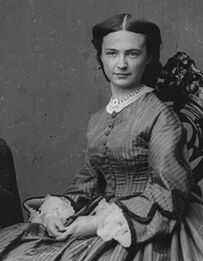 "Find a Grave Memorial ID 12920" "Find a Grave Memorial ID 12920"
"Elizabeth Bacon Custer (April 8, 1842–April 4, 1933) was an American author and public speaker who was the wife of Brevet Major General George Armstrong Custer, United States Army. She spent most of their marriage in relative proximity to him despite his numerous military campaigns in the American Civil War and subsequent postings on the Great Plains as a commanding officer in the United States Cavalry. Left nearly destitute in the aftermath of her husband's death, she became an outspoken advocate for his legacy through her popular books and lectures. Largely as a result of her decades of campaigning on his behalf, General Custer's image as the gallant fallen hero amid the glory of Custer's Last Stand was a canon of American history for almost a century after his death. Elizabeth Custer never remarried and died in 1933, four days short of her 91st birthday. She has been portrayed by a number of actresses, starting in the 1940s in films and later on television. Elizabeth "Libbie" Bacon was born in 1842 in Monroe, Michigan, as the daughter of Daniel Bacon (b. 1798), a wealthy and influential judge and state representative. Her father had profitable investments in real estate and other business ventures. Elizabeth Custer and her husband George had a loving but tumultuous relationship. Both were stubborn, opinionated, and ambitious. Their private correspondence was filled with sexually charged double entendres. The 1876 campaign against the Sioux seemed like a chance for glory to George Armstrong Custer. The couple's final home together was at Fort Abraham Lincoln near what is now Bismarck, North Dakota. From there, the general led the Seventh Cavalry in pursuit of Sitting Bull, Crazy Horse and the Sioux and Northern Cheyenne who refused to be confined to the reservation system. Elizabeth remained utterly devoted to her husband and never remarried. Despite having spent her life traveling extensively throughout the United States and the world, she never visited the valley of Little Big Horn. She was said to treasure a letter from President Theodore Roosevelt who stated that her husband was "one of my heroes" and "a shining light to all the youth of America." In later decades, historians reexamined George's actions leading up to and during the battle and found much to criticize. After an initial period of distress dealing with her late husband's debts, Elizabeth spent her over a half-century of widowhood in financial comfort attained as the result of her literary career and lecture tours, leaving an estate of over $100,000. She died in New York City, four days before her 91st birthday, on April 4, 1933, and was buried next to her husband at West Point. A few years before her death she told a writer that her greatest disappointment was that she never had a son to bear her husband's honored name."
Source: Wikipedia.org | Sunday, June 25, 2023, 2:30 PM CDT 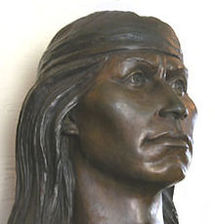 "Find a Grave Memorial ID 7373566" "Find a Grave Memorial ID 7373566"
"Cochise Cheis or A-da-tli-chi, in Apache (c. 1805–June 8, 1874) was leader of the Chihuicahui local group of the Chokonen and principal chief of the Chokonen band of the Chiricahua Apache. He led an uprising against the American government that began in 1861. Cochise County, Arizona is named after him. Cochise was one of the most noted Apache leaders (along with Geronimo and Mangas Coloradas) to resist intrusions by European Americans during the 19th century. He was described as a large man with a muscular frame, classical features, and long black hair, which he wore in traditional Apache style. He was about 6' tall and weighed about 175 lbs. In his own language, his name Cheis meant "having the quality or strength of oak."
Source: Wikipedia.org | July 9, 2015 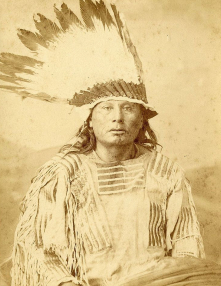 Find a Grave Memorial ID unavailable Find a Grave Memorial ID unavailable
"Gall (c. 1840–December 5, 1894) was a battle leader of the Hunkpapa Lakota in the long war against the United States. He was also one of the commanders in the Battle of Little Bighorn. Born in present-day South Dakota around 1840, and orphaned, Gall was said to receive his name after eating the gall of an animal killed by a neighbor. An accomplished warrior by his late teens, Gall became a war chief in his twenties. As a Lakota war leader in the long conflict against United States intrusion onto tribal lands, Gall served with Sitting Bull during several battles, including the famous Battle of the Little Bighorn in 1876. In later years, Gall recounted his role in the battle. He had mistakenly thought the survivors of Custer's three southeastern companies fled northwest to Custer because they ran out of ammunition. The horse soldiers may also have fled after losing their will to fight, as many men simply ran, even abandoning loaded rifles. The Sioux and Cheyenne picked these up and fired the weapons to drive off the soldiers' horses, thus depriving them of a key tactical mobility advantage. Soon the Indians finished off Custer and his men in the remaining companies C, E, and K. The last approximately 28 survivors made a dash south for the river. They were trapped in the box canyon called "Deep Ravine." After killing them, the Indians had won the battle, having completely annihilated Custer's five companies. Eventually Gall disagreed with Sitting Bull, who had become involved with the Ghost Dance movement, and who was killed by a tribal policeman in a bungled confrontation in 1890. Gall lived on the Standing Rock Agency until his death at his Oak Creek home on December 5, 1894. He is buried in Saint Elizabeth Episcopal Cemetery in Wakpala, South Dakota. In 1991, his remains were exhumed because a Utah state park museum purported to have his skull, but his remains were found intact."
Source: Wikipedia.org | August 29, 2016 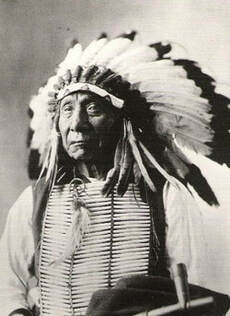 “Find a Grave Memorial ID 6878358” “Find a Grave Memorial ID 6878358”
"Red Cloud (1822–December 10, 1909) was one of the most important leaders of the Oglala Lakota from 1868 to 1909. He was one of the most capable American Indian opponents that the United States Army faced in its mission to settle the western territories, leading a successful campaign in 1866–68 known as Red Cloud's War over control of the Powder River Country in northeastern Wyoming and southern Montana. The largest action of the war was the Fetterman Fight, with 81 Army soldiers killed, and was the worst military defeat suffered by the Army on the Great Plains until the Battle of the Little Bighorn ten years later. After signing the Treaty of Fort Laramie (1868), Red Cloud led his people in the important transition to reservation life. Some of his opponents mistakenly thought of him as overall leader of the Sioux groups (Dakota, Lakota, and Nakota), but the large tribe had several major divisions and was highly decentralized. Bands among the Oglala and other divisions operated independently, even though some individual leaders were renowned as warriors and highly respected as leaders, such as Red Cloud. Red Cloud was born close to the forks of the Platte River, near the modern-day city of North Platte, Nebraska. His mother, Walks As She Thinks, was an Oglala Lakota and his father, Lone Man, was a Brulé Lakota leader. They came from two of the seven major Lakota divisions. As was traditional among the matrilineal Lakota, in which the children belonged to the mother's clan and people, Red Cloud was mentored as a boy by his maternal uncle, Old Chief Smoke. Old Chief Smoke played a major role in the boy's childhood. He brought Red Cloud into the Smoke household when the boy's parents died around 1825. At a young age, Red Cloud fought against neighboring Pawnee and Crow bands, gaining much war experience. Red Cloud's War was the name the U. S. Army gave to a series of conflicts fought with Native American Plains tribes in the Wyoming and Montana territories. The battles were waged between the Northern Cheyenne, allied with Lakota and Arapaho bands, against the United States Army between 1866 and 1868. In December 1866, the Native American allies attacked and defeated a United States unit in what the whites would call the Fetterman Massacre which resulted in the most U. S. casualties of any Plains battle up to that point. Captain William J. Fetterman was sent from Fort Phil Kearny with two civilians and 79 cavalry and infantrymen to chase away a small Native American war party that had attacked a wood-gathering party days before. Captain Frederick Brown accompanied Fetterman; the two were confident in their troops and anxious to go to battle with the Native Americans. They disobeyed orders to stay behind the Lodge Trail Ridge and pursued a small decoy band of warriors, led by a Native American on an apparently injured horse. The decoy was the prominent warrior Crazy Horse. Fetterman and his troops followed the decoy into an ambush by more than 2,000 Sioux, Cheyenne, and Arapaho. Combined Native American forces suffered only 14 casualties, while they killed the entire 81-man U. S. detachment. Following this battle, a U. S. peace commission toured the Plains in 1867 to gather information to help bring about peace among the tribes and with the US. Finding that the Native Americans had been provoked by white encroachment and competition for resources, the commission recommended assigning definite territories to the Plains tribes. The Lakota, Northern Cheyenne, Arapaho, and other bands settled for peace with the U. S. under the Treaty of Fort Laramie. The U. S. agreed to abandon its forts and withdraw completely from Lakota territory. Red Cloud became an important leader of the Lakota as they transitioned from the freedom of the plains to the confinement of the reservation system. His trip to Washington, DC had convinced him of the number and power of European Americans, and he believed the Oglala had to seek peace. In 1884, he and his family, along with five other leaders, converted and were baptized as Catholics by Father Joseph Bushman. Red Cloud continued fighting for his people, even after being forced onto the reservation. In 1887 Red Cloud opposed the Dawes Act, which broke up communal tribal holdings, and allocated 160-acre plots of land to heads of families on tribal rolls for subsistence farming. The U. S. declared additional communal tribal lands as excess, and sold it to immigrant settlers. In 1889 Red Cloud opposed a treaty to sell more of the Lakota land. Due to his steadfastness and that of Sitting Bull, government agents obtained the necessary signatures for approval through subterfuge, such as using the signatures of children. He negotiated strongly with Indian Agents such as Dr. Valentine McGillycuddy. Red Cloud, chief of the Oglala Lakota, for years frustrated efforts of the United States government to open up the West. From 1859 on he and his warriors, living near Fort Laramie, Wyoming attacked whites encroaching on Indian Territory along the North Platte River. By 1865 he was effectively discouraging white intrusion by way of the Bozeman trail. Red Cloud led the 1866 massacre of 80 troops from Fort Kearney, one of the posts built to protect the trail, an event that led to the abandonment of the trail by the whites in 1868. A peace treaty, which Red Cloud signed, seems to have been a turning point for the war chief. After visiting Washington, D.C., he agreed to settle down as a reservation chief. According to Sitting Bull and Crazy Horse, he sold out to the whites, permitting corrupt and inadequate conditions on Sioux reservations. He lost his status as head chief in 1881. After the Wounded Knee massacre (1890) he lived quietly on Pine Ridge Reservation. Outliving all the other major Lakota leaders of the Indian Wars, Red Cloud died on Pine Ridge Reservation in 1909 at the age of 87, and was buried there in the cemetery now bearing his name. In old age, he is quoted as having said, "They made us many promises, more than I can remember. But they kept but one -- They promised to take our land ... and they took it."
Source: Wikipedia.org | January, 17, 2019, 10:57AM |

"Elon Reeve Musk (born June 28, 1971) is a South African born Canadian American business magnate, investor, engineer and inventor. In December 2016, Musk was ranked 21st on the Forbes list of The World's Most Powerful People. As of January 2018, he has a net worth of $20.9 billion and is listed by Forbes as the 53rd richest person in the world. Born in Pretoria, Musk taught himself computer programming at the age of 12. He moved to Canada when he was 17 to attend Queen's University. He transferred to the University of Pennsylvania two years later, where he received a degree in physics from the College of Arts and Sciences and an economics degree from the Wharton School. He began a PhD in applied physics and material sciences at Stanford University in 1995 but dropped out within a month to pursue an entrepreneurial career. He subsequently co-founded Zip2, a web software company, which was acquired by Compaq for $340 million in 1999. Musk then founded X.com, an online payment company. It merged with Confinity in 2000 and became PayPal, which was bought by eBay for $1.5 billion in October 2002. In addition to his primary business pursuits, Musk has envisioned a high-speed transportation system known as the Hyperloop, and has proposed a vertical take-off and landing supersonic jet electric aircraft with electric fan propulsion, known as the Musk electric jet. Musk has stated that the goals of SpaceX, Tesla, and SolarCity revolve around his vision to change the world and humanity. His goals include reducing global warming through sustainable energy production and consumption, and reducing the "risk of human extinction" by establishing a human colony on Mars. Musk was born on June 28, 1971, in Pretoria, Transvaal, South Africa, the son of Maye Musk Haldeman, a model and dietician from Regina, Saskatchewan, Canada, and Errol Musk, a South African electromechanical engineer, pilot, and sailor. He has a younger brother, Kimbal, and a younger sister, Tosca. His paternal grandmother was British, and he also has Pennsylvania Dutch ancestry. His maternal grandfather was American, from Minnesota. After his parents divorced in 1980, Musk lived mostly with his father in the suburbs of Pretoria, which Musk chose two years after his parents split up, but now says was "not a good idea." As an adult, Musk has severed relations with his father. He has a half sister. During his childhood he was an avid reader. At age 10, he developed an interest in computing with the Commodore VIC-20. He taught himself computer programming at the age of 12, sold the code of a BASIC-based video game he created called Blastar, to a magazine called PC and Office Technology, for approximately $500. A web version of the game is available online. His childhood reading included Isaac Asimov's Foundation series from which he drew the lesson that "you should try to take the set of actions that are likely to prolong civilization, minimize the probability of a dark age and reduce the length of a dark age if there is one." Musk was severely bullied throughout his childhood, and was once hospitalized when a group of boys threw him down a flight of stairs and then beat him until he lost consciousness. Musk was initially educated at private schools, attending the English-speaking Waterkloof House Preparatory School. Musk later graduated from Pretoria Boys High School and moved to Canada in June 1989, just before his 18th birthday, after obtaining Canadian citizenship through his Canadian-born mother. Politically, Musk has described himself as "half Democrat, half Republican." In his own words: "I'm somewhere in the middle, socially liberal and fiscally conservative." In December 2016, Musk became a member of two of then President-elect Donald Trump's presidential advisory committees but resigned from both in June 2017, in protest at Trump's decision to withdraw the United States from the Paris Agreement on climate change. Musk has described himself as "nauseatingly pro-American." According to Musk, the United States is "[inarguably] the greatest country that has ever existed on Earth," describing it as "the greatest force for good of any country that's ever been." Musk believes outright that there "would not be democracy in the world if not for the United States," arguing there were "three separate occasions in the 20th-century where democracy would have fallen with World War I, World War II and the Cold War, if not for the United States." Musk also stated that he thinks "it would be a mistake to say the United States is perfect, it certainly is not. There have been many foolish things the United States has done and bad things the United States has done." Prompted by the emergence of self-driving cars and Artificial Intelligence, Musk has voiced support for a universal basic income. Prior to the election of Donald Trump as President of the United States, Musk criticized candidate Trump by saying: "I feel a bit stronger that he is probably not the right guy. He doesn't seem to have the sort of character that reflects well on the United States." Following Donald Trump's inauguration, Musk expressed approval of Trump's choice of Rex Tillerson as Secretary of State and accepted an invitation to appear on a panel advising President Trump. Regarding his cooperation with Trump, Musk has subsequently commented: "The more voices of reason that the President hears, the better." Musk met his first wife, Canadian author Justine Wilson, while both were students at Ontario's Queen's University. They married in 2000 and separated in 2008.Their first son, Nevada Alexander Musk, died of sudden infant death syndrome (SIDS) at the age of 10 weeks. They later had five sons through in vitro fertilization – twins in 2004, followed by triplets in 2006. They share custody of all five sons. In 2008, Musk began dating English actress Talulah Riley, and in 2010, the couple married. In January 2012, Musk announced that he had ended his four-year relationship with Riley, tweeting to Riley, "It was an amazing four years. I will love you forever. You will make someone very happy one day." In July 2013, Musk and Riley remarried. In December 2014, Musk filed for a second divorce from Riley; however, the action was withdrawn. The media announced in March 2016 that divorce proceedings were again under way, this time with Riley filing for divorce from Musk. The divorce was finalized in late 2016. Musk began dating American actress Amber Heard in 2016 but the two split up after one year due to their conflicting schedules."
Source: Wikipedia.org | Thursday, February 8, 2018, 5:00AM CDT 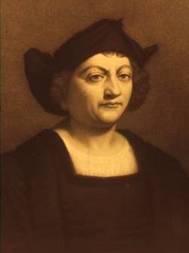 "Find a Grave Memorial ID 1988" "Find a Grave Memorial ID 1988"
"Cristoforo Colombo (born between October 31, 1450 and October 30, 1451–20 May 1506) was an Italian explorer, navigator, and colonizer, born in the Republic of Genoa. Under the auspices of the Catholic Monarchs of Spain, he completed four voyages across the Atlantic Ocean that led to general European awareness of the American continents. Those voyages, and his efforts to establish permanent settlements on the island of Hispaniola, initiated the Spanish colonization of the New World. The name Christopher Columbus is the Anglicisation of the Latin Christophorus Columbus. His name in Italian is Cristoforo Colombo, and in Spanish, it is Cristóbal Colón. Columbus was born before 31 October 1451 in territory of the Republic of Genoa, part of modern Italy, though the exact location remains disputed. His father was Domenico Colombo, a middle-class wool weaver who worked both in Genoa and Savona and who also owned a cheese stand at which young Christopher worked as a helper. Christopher's mother was Susanna Fontanarossa. Bartolomeo, Giovanni Pellegrino, and Giacomo were his brothers. Bartolomeo worked in a cartography workshop in Lisbon for at least part of his adulthood. He also had a sister named Bianchinetta. In 1479 or 1480, his son Diego Columbus was born. Between 1482 and 1485, Columbus traded along the coasts of West Africa, reaching the Portuguese trading post of Elmina at the Guinea coast. Some records report that Filipa died in 1485. It is also speculated that Columbus may have simply left his first wife. In either case, Columbus left Portugal for Castile in 1485, where he found a mistress in 1487, a 20-year-old orphan named Beatriz Enríquez de Arana. Between 1492 and 1503, Columbus completed four round-trip voyages between Spain and the Americas, all of them under the sponsorship of the Crown of Castile. These voyages marked the beginning of the European exploration and colonization of the American continents, and are thus of enormous significance in Western history. On the evening of 3 August 1492, Columbus departed from Palos de la Frontera with three ships: a larger carrack, the Santa María ex-Gallega and two smaller caravels, the Pinta and the Santa Clara, nicknamed the Niña after her owner Juan Niño of Moguer. The monarchs forced the Palos inhabitants to contribute to the expedition. The Santa María was owned by Juan de la Cosa and captained by Columbus. The Pinta and the Niña were piloted by the Pinzón brothers. During a violent storm on his first return voyage, Columbus, then approximately 41, suffered an attack of what was believed at the time to be gout. In subsequent years, he was plagued with what was thought to be influenza and other fevers, bleeding from the eyes, and prolonged attacks of gout. The suspected attacks increased in duration and severity, sometimes leaving Columbus bedridden for months at a time, and culminated in his death fourteen years later. Based on Columbus' lifestyle and the described symptoms, modern doctors suspect that he suffered from Reiter's Syndrome, rather than gout. Reiter's Syndrome is a common presentation of reactive arthritis, a joint inflammation caused by intestinal bacterial infections or after acquiring certain sexually transmitted diseases. "It seems likely that [Columbus] acquired reactive arthritis from food poisoning on one of his ocean voyages because of poor sanitation and improper food preparation," writes Dr. Frank C. Arnett, a rheumatologist and professor of internal medicine, pathology and laboratory medicine the University of Texas Medical School at Houston. On 20 May 1506, aged probably 54, Columbus died in Valladolid, Spain."
|
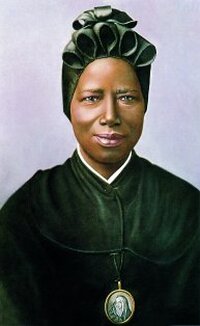 Find a Grave Memorial ID unavailable Find a Grave Memorial ID unavailable
"Josephine Margaret Bakhita (ca. 1869–8 February 1947) was a Sudanese-born former slave who became a Canossian Religious Sister in Italy, living and working there for 45 years. In 2000 she was declared a saint by the Catholic Church. She was born around the year 1869 in the western Sudanese region of Darfur; in the village of Olgossa, west of Nyala and close to Mount Agilerei. She belonged to the prestigious Daju people; her well respected and reasonably prosperous father was brother of the village chief. She was surrounded by a loving family of three brothers and three sisters. Sometime between the age of seven to nine, probably in February 1877, she was kidnapped by Arab slave traders, who already had kidnapped her elder sister two years earlier. She was cruelly forced to walk barefoot about 600 mi to El Obeid and was already sold and bought twice before she arrived there. Over the course of twelve years 1877–1889, she was resold again three more times and then given away. It is said that the trauma of her abduction caused her to forget her own name; she took one given to her by the slavers, bakhita, Arabic for lucky. She was also forcibly converted to Islam. She says that the most terrifying of all her memories there was when she in common with other slaves was marked by a process resembling both scarification and tattooing. As her mistress was watching her with a whip in her hand, a dish of white flour, a dish of salt and a razor were brought by a woman. She used the flour to draw patterns on her skin and then she cut deeply along the lines before filling the wounds with salt to ensure permanent scarring. A total of 114 intricate patterns were cut into her breasts, belly, and into her right arm. On 7 December 1893 Josephine Bakhita entered the novitiate of the Canossian Sisters and on 8 December 1896 she took her vows, welcomed by Cardinal Sarto. In 1902 she was assigned to the Canossian convent at Schio, in the northern Italian province of Vicenza, where she spent the rest of her life. Her only extended time away was between 1935 and 1939, when she stayed at the Missionary Novitiate in Vimercate; mostly visiting other Canossian communities in Italy, talking about her experiences and helping to prepare young sisters for work in Africa. A strong missionary drive animated her throughout her entire life-"her mind was always on God, and her heart in Africa.” During her 42 years in Schio, Bakhita was employed as the cook, sacristan and door keeper and was in frequent contact with the local community. Her gentleness, calming voice, and ever-present smile became well known and Vicenzans still refer to her as "little brown sister" or "black mother." Her special charisma and reputation for sanctity were noticed by her order; the first publication of her story Storia Meravigliosa by Ida Zanolini in 1931, made her famous throughout Italy. During the Second World War she shared the fears and hopes of the town people, who considered her a saint and felt protected by her mere presence. Not quite in vain as the bombs did not spare Schio, but the war passed without one single casualty. Her last years were marked by pain and sickness. She used a wheelchair, but she retained her cheerfulness, and if asked how she was, she would always smile and answer: "As the Master desires." In the extremity of her last hours her mind was driven back to the years of her slavery and she cried out: "The chains are too tight, loosen them a little, please!" After a while she came round again. Someone asked her: "How are you? Today is Saturday." "Yes, I am so happy: Our Lady... Our Lady!" These were her last audible words. Bakhita died at 8:10 PM on 8 February 1947. For three days her body lay on display while thousands of people arrived to pay their respects. The petitions for her canonization began immediately, and the process officially commenced by Pope John XXIII in 1959, only twelve years after her death. On 1 December 1978, Pope John Paul II declared Josephine Venerabilis, the first step towards canonization. On 17 May 1992, she was declared Blessed and given February 8 as her feast day. On 1 October 2000, she was canonized and became Saint Josephine Bakhita. She is venerated as a modern African saint, and as a statement against the brutal history of Africa's people practicing slavery. She has been adopted as the only patron saint of Sudan. Bakhita's legacy is that transformation is possible through suffering. Her story of deliverance from physical slavery also symbolizes all those who find meaning and inspiration in her life for their own deliverance from spiritual slavery. On a larger scale, however, Bakhita's story of a slave who was forced to convert to Islam and later chose Christianity represents a conflict between Christianity and Islam. In May 1992 news of her beatification was banned by Khartoum which Pope John Paul II then personally visited only nine months later. On 10 February 1993, he solemnly honoured Bakhita on her own soil. "Rejoice, all of Africa! Bakhita has come back to you. The daughter of Sudan sold into slavery as a living piece of merchandise and yet still free. Free with the freedom of the saints."
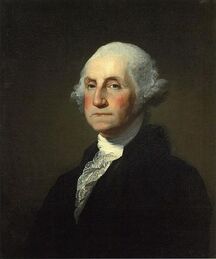 Find a Grave Memorial ID unavailable Find a Grave Memorial ID unavailable
"George Washington (February 22, 1732–December 14, 1799) was the first President of the United States, the commander-in-chief of the Continental Army during the American Revolutionary War and one of the Founding Fathers of the United States. He presided over the convention that drafted the United States Constitution, which replaced the Articles of Confederation and which remains the supreme law of the land. Washington was elected President as the unanimous choice of the electors in 1788, and he served two terms in office. He oversaw the creation of a strong, well-financed national government that maintained neutrality in the wars raging in Europe, suppressed rebellion, and won acceptance among Americans of all types. His leadership style established many forms and rituals of government that have been used since, such as using a cabinet system and delivering an inaugural address. Further, the peaceful transition from his presidency to that of John Adams established a tradition that continues into the 21st century. Washington was hailed as "father of his country" even during his lifetime. Washington was born into the provincial gentry of Colonial Virginia; his wealthy planter family owned tobacco plantations and slaves. After both his father and older brother died when he was young, Washington became personally and professionally attached to the powerful William Fairfax, who promoted his career as a surveyor and soldier. Washington quickly became a senior officer in the colonial forces during the first stages of the French and Indian War. Chosen by the Second Continental Congress in 1775 to be commander-in-chief of the Continental Army in the American Revolution, Washington managed to force the British out of Boston in 1776, but was defeated and almost captured later that year when he lost New York City. After crossing the Delaware River in the dead of winter, he defeated the British in two battles, retook New Jersey and restored momentum to the Patriot cause. The first child of Augustine Washington and his second wife, Mary Ball Washington. George Washington was born on their Pope's Creek Estate near present-day Colonial Beach in Westmoreland County, Virginia. According to the Julian calendar and Annunciation Style of enumerating years, then in use in the British Empire, Washington was born on February 11, 1731; when the Gregorian calendar was implemented in the British Empire in 1752, in accordance with the provisions of the Calendar Act 1750, his birth date became February 22, 1732. Washington's ancestors were from Sulgrave, England; his great-grandfather, John Washington, had emigrated to Virginia in 1657. George's father Augustine was a slave-owning tobacco planter who later tried his hand in iron-mining ventures. In George's youth, the Washingtons were moderately prosperous members of the Virginia gentry, of "middling rank" rather than one of the leading planter families. At this time, Virginia and other southern colonies had become a slave society, in which slaveholders formed the ruling class and the economy was based on slave labor. On January 6, 1759, Washington married the wealthy widow Martha Dandridge Custis, then 28 years old. Surviving letters suggest that he may have been in love at the time with Sally Fairfax, the wife of a friend. Nevertheless, George and Martha made a compatible marriage, because Martha was intelligent, gracious, and experienced in managing a planter's estate. On Thursday, December 12, 1799, Washington spent several hours inspecting his plantation on horseback, in snow, hail, and freezing rain—later that evening eating his supper without changing from his wet clothes. That Friday he awoke with a severe sore throat and became increasingly hoarse as the day progressed, yet still rode out in the heavy snow, marking trees on the estate that he wanted cut. Sometime around 3 a.m. that Saturday, he suddenly awoke with severe difficulty breathing and almost completely unable to speak or swallow. A firm believer in bloodletting, a standard medical practice of that era which he had used to treat various ailments of enslaved Africans on his plantation, he ordered estate overseer Albin Rawlins to remove half a pint of his blood. A total of three physicians were sent for, including Washington's personal physician Dr. James Craik along with Dr. Gustavus Brown and Dr. Elisha Dick. Craik and Brown thought that Washington had what they diagnosed as "quinsey" or "quincy," while Dick, the younger man, thought the condition was more serious or a "violent inflammation of the throat." By the time the three physicians had finished their treatments and bloodletting of the President, there had been a massive volume of blood loss—half or more of his total blood content being removed over the course of just a few hours. Recognizing that the bloodletting and other treatments were failing, Dr. Dick proposed performing an emergency tracheotomy, a procedure that few American physicians were familiar with at the time, as a last-ditch effort to save Washington's life; but the other two doctors rejected this proposal. Washington died at home around 10 p.m. on Saturday, December 14, 1799, aged 67. In his journal, Lear recorded Washington's last words as being "'Tis well." George, however, apparently did not get along well with his mother, Mary Ball Washington who was a very demanding and difficult person. Washington was the only prominent Founding Father to arrange in his will for the manumission of all his slaves following his death. He privately opposed slavery as an institution which he viewed as economically unsound and morally indefensible. He also regarded the divisiveness of his countrymen's feelings about slavery as a potentially mortal threat to the unity of the nation. Yet, as general of the army, president of the Constitutional Convention, and the first president of the United States, he never publicly challenged the institution of slavery, possibly because he wanted to avoid provoking a split in the new republic over so inflammatory an issue. Washington had owned slaves since the death of his father in 1743, when at the age of eleven, he inherited 10 slaves. At the time of his marriage to Martha Custis in 1759, he personally owned at least 36 slaves, which meant he had achieved the status of a major planter defined in the Upper South as owning 20 or more slaves."
|
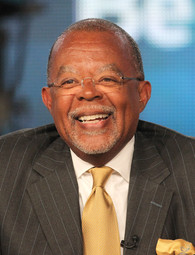
"Henry Louis Gates, Jr. (born September 16, 1950) is the Alphonse Fletcher University Professor and Director of the Hutchins Center for African and African American Research at Harvard University. He is also an Emmy Award-winning filmmaker, literary scholar, journalist, cultural critic, and institution builder. Gates has written seventeen books and created fourteen documentary films, including Wonders of the African World, African American Lives, Black in Latin America, and Finding Your Roots, now in its second season on PBS. His six-part PBS documentary series, The African Americans: Many Rivers to Cross which he wrote, executive produced, and hosted, earned the News and Documentary Emmy Award for Outstanding Historical Program—Long Form, as well as the Peabody Award and NAACP Image Award. Having written for such leading publications as The New Yorker, The New York Times, and Time, Gates is editor-in-chief of TheRoot.com, a daily online magazine, while overseeing the Oxford African American Studies Center, the first comprehensive scholarly online resource in the field. In 2012, The Henry Louis Gates, Jr. Reader, a collection on his writings, was published. Gates's latest book is Finding Your Roots: The Official Companion to the PBS Series, released by the University of North Carolina Press in 2014. The recipient of fifty-three honorary degrees and numerous prizes, Gates was a member of the first class awarded "genius grants" by the MacArthur Foundation in 1981, and in 1998, he became the first African American scholar to be awarded the National Humanities Medal. He was named to the Time 25 Most Influential Americans list in 1997, to the Ebony Power 150 list in 2009, and to Ebony's Power 100 list in 2010 and 2012. He earned his B. A. in English Language and Literature, summa cum laude, from Yale University in 1973, and his M. A. and Ph. D. in English Literature from Clare College at the University of Cambridge in 1979. Gates was born in Keyser, West Virginia, to Henry Louis Gates, Sr. and his wife Pauline Augusta Coleman. He grew up in neighboring Piedmont, which he described in his best-selling memoir Colored People. His family is descended from the Yoruba nation in the country of Benin. Gates graduated from Piedmont High School in 1968 and attended Potomac State College in Keyser, West Virginia. He completed his BA degree in History at Yale University, summa cum laude. The first African American to be awarded an Andrew W. Mellon Foundation Fellowship, Gates sailed on the RMS Queen Elizabeth 2 for England and Cambridge University, where he studied English literature at Clare College and earned a PhD. Gates married Sharon Lynn Adams in 1979. They have two daughters, though they eventually divorced. In 2010, Gates wrote an op-ed in The New York Times that discussed the role played by Africans in the slave trade. In an article for Newsweek, journalist Lisa Miller reported on the reaction to Gates' article: The enemy of individuality is group think, Gates says, and here he holds everyone accountable. Recently, he has enraged many of his colleagues in the African-American studies field—especially those campaigning for government reparations for slavery—by insistently reminding them, as he did in a New York Times op-ed last year, that the folks who captured and sold blacks into slavery in the first place were also Africans, working for profit. "People wanted to kill me, man," Gates says of the reaction to that op-ed. "Black people were so angry at me. But we need to get some distance from the binary opposition we were raised in: evil white people and good black people. The world just isn't like that. Lolita Buckner Inniss, a professor at the Cleveland-Marshall College of Law, wrote a letter to The New York Times in response to the Gates piece in which she argues that regardless of who did the capturing, it was white people who created the market for African slaves and perpetuated the practice even after the import trade was banned. "Up until that recent piece, people would have thought of him as someone who took a cautious and nuanced approach to questions like reparations." Gates has such an eminent reputation, she said, and "so much gravitas. Many of us were troubled."
|
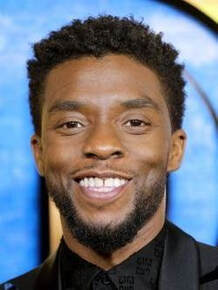 “Find a Grave Memorial ID 214960990” “Find a Grave Memorial ID 214960990”
"Chadwick Aaron Boseman (November 29, 1976–August 28, 2020) was an American actor. After studying directing at Howard University, he landed his first major role as a series regular on Persons Unknown. Boseman's breakthrough performance came as baseball player Jackie Robinson in the biographical film. He continued to portray historical figures, starring in Get on Up as singer James Brown and Marshall as Supreme Court Justice Thurgood Marshall. Boseman achieved international fame for playing superhero Black Panther in the Marvel Cinematic Universe (MCU) from 2016 to 2019. He appeared in four MCU films, including an eponymous 2018 film that earned him an NAACP Image Award for Outstanding Actor in a Motion Picture and a Screen Actors Guild Award for Outstanding Performance by a Cast in a Motion Picture. His final film, Ma Rainey's Black Bottom, is scheduled to be released posthumously. In 2016, Boseman was diagnosed with colon cancer. He kept his condition private, continuing to act while receiving treatment. Boseman died on August 28, 2020 from complications related to the illness. Chadwick Aaron Boseman was born and raised in Anderson, South Carolina, the son of Carolyn and Leroy Boseman, both African-American. His mother was a nurse and his father worked at a textile factory, managing anupholstery business as well. According to Boseman, DNA testing indicated that some of his ancestors were Krio peoplefrom Sierra Leone, Yoruba people from Nigeria and Limba people from Sierra Leone. Boseman graduated from T. L. Hanna High School in 1995. In his junior year, he wrote his first play, Crossroads, and staged it at the school after a classmate was shot and killed. Boseman attended college at Howard University in Washington, D.C., graduating in 2000 with a Bachelor of Fine Arts in directing. One of his teachers was Phylicia Rashad, who became a mentor. She helped raise funds, notably from her friend and prominent actor Denzel Washington, so that Boseman and some classmates could attend the Oxford Mid-Summer Program of the British American Drama Academy in England, to which they had been accepted. Boseman wanted to write and direct, and initially began studying acting to learn how to relate to actors. After he returned to the U. S., he graduated from New York City's Digital Film Academy. He lived in Brooklyn at the start of his career. Boseman worked as the drama instructor in the Schomburg Junior Scholars Program, housed at the Schomburg Center for Research in Black Culture in Harlem, New York. In 2008, he moved to Los Angeles to pursue his acting career. Boseman began dating singer Taylor Simone Ledward in 2015. The two reportedly got engaged by October 2019, and they later married in secret, as revealed by Boseman's family in a statement announcing his death. Boseman was raised a Christian and was baptized. He was part of a church choir and youth group and his former pastor said that he still kept his faith. Boseman had stated that he prayed to be the Black Panther character before he was cast as the character in the Marvel Cinematic Univers. Boseman was diagnosed with stage III colon cancer in 2016, which eventually progressed to stage IV before 2020. He had never spoken publicly about his cancer diagnosis, and according to The Hollywood Reporter, "[o]nly a handful of non-family members knew that Boseman was sick... with varying degrees of knowledge about the severity of [his] condition." During treatment, involving multiple surgeries and chemotherapy, he continued to work and completed production for several films, including Marshall, Da 5 Bloods, Ma Rainey's Black Bottom, and others. Boseman died at his home as a result of complications related to colon cancer on August 28, 2020, with his wife and family by his side."
|
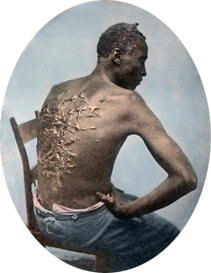 Why did you do this to me? Why did you do this to me?
"Construction of the White House began with the laying of the cornerstone on October 13, 1792, although there was no formal ceremony. The main residence, as well as foundations of the house, were built largely by enslaved and free African American laborers, as well as employed Europeans. Much of the other work on the house was performed by immigrants, many not yet with citizenship. The sandstone walls were erected by Scottish immigrants, employed by Hoban, as were the high-relief rose and garland decorations above the north entrance and the "fish scale" pattern beneath the pediments of the window hoods. The initial construction took place over a period of eight years, at a reported cost of $232,371.83, equal to $3,196,252 today. Although not yet completed, the White House was ready for occupancy [around] November 1, 1800. Today the group of buildings housing the presidency is known as the White House Complex. It includes the central Executive Residence flanked by the East Wing and West Wing. The Chief Usher coordinates day to day household operations. The White House includes: six stories and 55,000 ft of floor space, 132 rooms and 35 bathrooms, 412 doors, 147 windows, twenty-eight fireplaces, eight staircases, three elevators, five full-time chefs, a tennis court, a single-lane bowling alley, a movie theater, a jogging track, a swimming pool, and a putting green. It receives up to 30,000 visitors each week. Despite its importance the White House is ranked only 25th on the list of [the] largest houses in the United States."
Source: Wikipedia.org | Sunday, July 24, 2016, 12:00AM | July 28, 2016, 4:10PM | July 30, 2016, 6:40PM 
"On Saturday, November 1, 1800, John Adams became the first president to take residence in the [White House]. During Adams' second day in the house, he wrote a letter to his wife Abigail, containing a prayer for the house. Adams wrote: I pray Heaven to bestow the best of blessings on this House, and all that shall hereafter inhabit it. May none but honest and wise men ever rule under this roof. Franklin D. Roosevelt had Adams's blessing carved into the mantel in the State Dining Room. Adams lived in the house only briefly before Thomas Jefferson moved into the "pleasant country residence" in 1801. Despite his complaints that the house was too big ("big enough for two emperors, one pope, and the grand lama in the bargain") Jefferson considered how the White House might be added to. With Benjamin Henry Latrobe, he helped lay out the design for the East and West Colonnades, small wings that help conceal the domestic operations of laundry, a stable and storage. Today, Jefferson's colonnades link the residence with the East and West Wings. In 1814, during the War of 1812, the White House was set ablaze by British troops during the Burning of Washington, in retaliation for burning Upper Canada's Parliament Buildings in the Battle of York; much of Washington was affected by these fires as well. Only the exterior walls remained, and they had to be torn down and mostly reconstructed because of weakening from the fire and subsequent exposure to the elements, except for portions of the south wall. Of the numerous objects taken from the White House when it was ransacked by British troops, only two have been recovered. Employees and slaves rescued a painting of George Washington, and in 1939, a Canadian man returned a jewelry box to President Franklin D. Roosevelt, claiming that his grandfather had taken it from Washington."
Source: Wikipedia.org | Sunday, July 24, 2016, 1:20 PM | Updated Monday, September 21, 2020, 9:51 PM CDT |
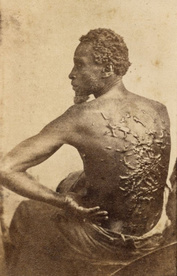 Damn, done it to myself again? Damn, done it to myself again?
"Louisiana was founded as a French colony. Colonial officials in 1724 implemented Louis XIV of France's Code Noir, which regulated the slave trade and the institution of slavery in New France and French Caribbean colonies. This resulted in a different pattern of slavery in Louisiana, purchased in 1803, compared to the rest of the United States. As written, the Code Noir gave some rights to slaves, including the right to marry. Although it authorized and codified cruel corporal punishment against slaves under certain conditions, it forbade slave owners to torture them or to separate married couples (or to separate young children from their mothers). It also required the owners to instruct slaves in the Catholic faith. Together with a more permeable historic French system that allowed certain rights to free people of color, often born to white fathers and their mixed-race concubines, a far higher percentage of African Americans in Louisiana were free as of the 1830 census (13.2% in Louisiana compared to 0.8% in Mississippi, whose population was dominated by white Anglo-Americans. Most of Louisiana's "third class" of free people of color, situated between the native-born French and mass of African slaves, lived in New Orleans). The Louisiana free people of color were often literate, had gained education, and a significant number owned businesses, properties, and even slaves. The Code Noir forbade interracial marriages. However, interracial unions were widespread under the system known as placage. The mixed-race offspring (cf. creoles of color) from such unions were among those in the intermediate social caste of free people of color. The English colonies insisted on a binary system, in which mulatto and black slaves were treated equally under the law, and discriminated against equally if free. But many free people of African descent were mixed race. When the US took over Louisiana, Americans from the Protestant South entered the territory and began to impose their norms. They officially discouraged interracial relationships (although white men continued to have unions with black women, both enslaved and free.) The Americanization of Louisiana gradually resulted in a binary system of race, causing free people of color to lose status as they were grouped with the slaves. They lost certain rights as they became classified by American whites as officially "black." "In Louisiana, French colonists had established sugar cane plantations and exported sugar as the chief commodity crop. After the Louisiana Purchase in 1803, Americans entered the state and joined the sugar cultivation. Between 1810 and 1830, planters bought slaves from the North and the number of slaves increased from less than 10,000 to more than 42,000. Planters preferred young males, who represented two-thirds of the slave purchases. Dealing with sugar cane was even more physically demanding than growing cotton. The largely young, unmarried male slave force made the reliance on violence by the owners "especially savage." New Orleans became nationally important as a slave market and port, as slaves were shipped from there upriver by steamboat to plantations on the Mississippi River; it also sold slaves who had been shipped downriver from markets such as Louisville. By 1840, it had the largest slave market in North America. It became the wealthiest and the fourth-largest city in the nation, based chiefly on the slave trade and associated businesses. The trading season was from September to May, after the harvest." *On July 30, 2008, the United States House of Representatives passed a resolution apologizing for American slavery and subsequent discriminatory laws. The U. S. Senate unanimously passed a similar resolution on June 18, 2009, apologizing for the "fundamental injustice, cruelty, brutality, and inhumanity of slavery. It also explicitly states that it cannot be used for restitution claims." If history has shown us that the monster of slavery assumes new forms, it has also shown us that its oppressive systems crumble in the face of those who heartily oppose them. It is our collective responsibility to oppose slavery in the time given to us. History is on our side.
*Source: Wikipedia.org, "Slavery in the United States" / "Apologies" | Sunday, July 31, 2016, 4:30PM |
This post and/or page contains affiliate links, at no additional cost
to you I am compensated only if you purchase after clicking on the links.
to you I am compensated only if you purchase after clicking on the links.
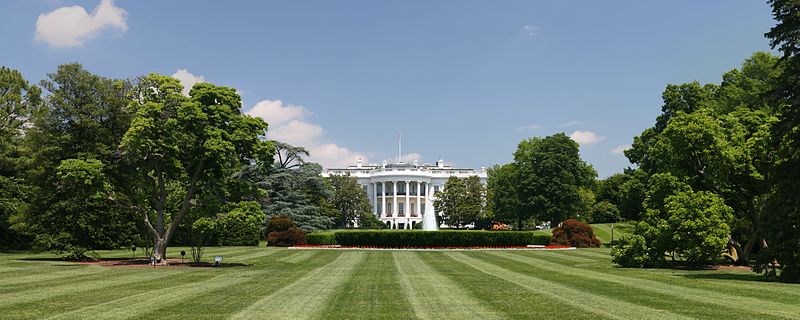
ClassicShoppes.us
~Where Class & Distinction Meets~
~Where Class & Distinction Meets~
